Complete Guide to Incoterms 2020: What Every Shipper Must Know
Incoterms determine who pays for what and who bears risk during shipment. Getting them wrong can cost you thousands. This guide explains all 11 Incoterms 2020 rules in plain language.
What Are Incoterms?
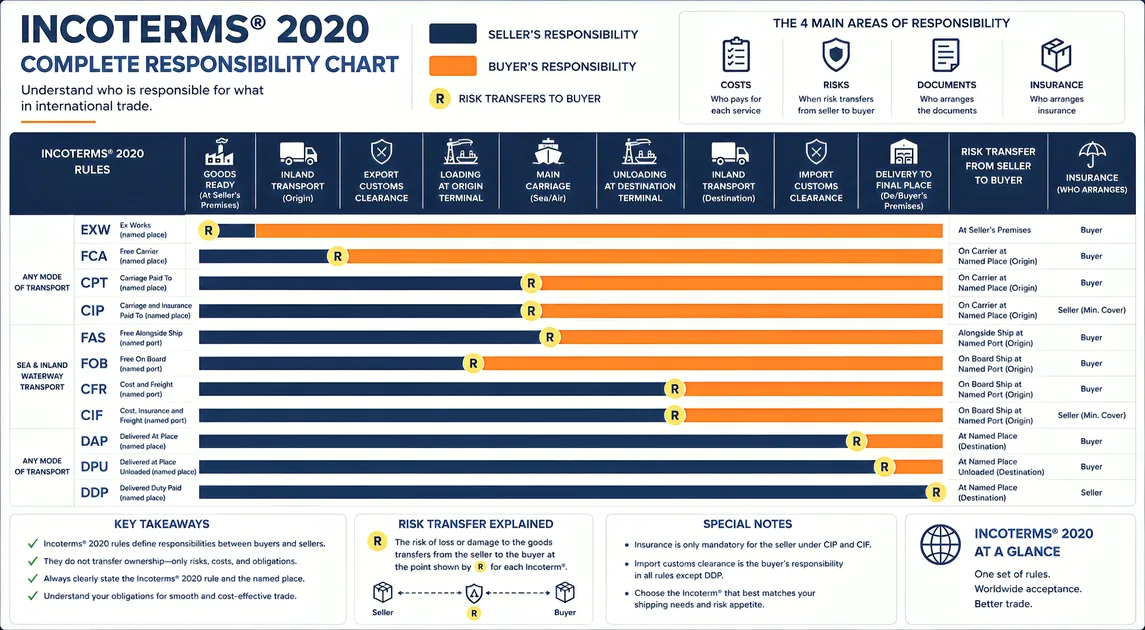
Incoterms (International Commercial Terms) are a set of 11 standardised trade terms published by the International Chamber of Commerce (ICC) that define the responsibilities of buyers and sellers in international trade. They specify who pays for freight, insurance, and import/export duties, and at what point risk transfers from seller to buyer.
The current version is Incoterms 2020, which replaced the 2010 edition. Using the correct Incoterm on your commercial invoice and contract of sale is legally important — disputes over damaged or lost cargo often come down to which Incoterm applied and therefore who bears the loss.
The 11 Incoterms 2020 Rules
EXW — Ex Works: Buyer collects from seller's premises. Maximum responsibility for the buyer. Seller does nothing beyond making goods available. Not recommended for inexperienced importers.
FCA — Free Carrier: Seller delivers to a named carrier at a named place. Very flexible — can be used for any transport mode. FCA with an added clause "on board" is now possible under Incoterms 2020 for letter of credit transactions.
FAS — Free Alongside Ship: Seller delivers alongside the vessel at origin port. Buyer handles loading and all costs from that point. Used for bulk cargo and heavy lift.
FOB — Free On Board: The most commonly misused Incoterm. Seller is responsible until goods are on board the vessel at origin port. Buyer takes risk and cost from that point. Should only be used for sea or inland waterway transport.
CFR — Cost and Freight: Seller pays freight to destination port. Risk transfers to buyer when goods are loaded on vessel. Buyer handles insurance and import.
CIF — Cost, Insurance and Freight: Like CFR but seller must also provide minimum cargo insurance. Common in commodity trading. Note: the insurance provided is minimum cover — buyers should arrange their own comprehensive policy.
CPT — Carriage Paid To: Seller pays freight to destination. Can be used for any transport mode. Risk transfers when goods are handed to first carrier.
CIP — Carriage and Insurance Paid To: Like CPT but seller provides ALL-RISK insurance (upgraded from minimum cover in Incoterms 2020). Best choice when seller is providing insurance.
DAP — Delivered at Place: Seller delivers to named destination, not cleared for import. Buyer handles import duties and taxes. Very common for e-commerce and B2B trade.
DPU — Delivered at Place Unloaded: New in 2020 (replaced DAT). Seller delivers AND unloads at destination. Seller bears all costs and risk until goods are unloaded.
DDP — Delivered Duty Paid: Maximum responsibility for seller. Seller handles everything including import duties and delivery. Best for buyers who want a simple "landed cost."
Which Incoterm Should You Use?
For most importers buying from Asia: FOB at origin port gives you control over the freight and insurance. CIF is simpler but you lose control of carrier selection and insurance quality. DDP is easiest for buyers but sellers usually build a premium into the price.
For exporters: EXW minimises your responsibility but buyers may struggle with Chinese or Indian export customs. FCA is a better alternative that handles export customs while leaving freight to the buyer.
Critical Mistakes to Avoid
- Using FOB for air freight or courier — FOB is for sea only
- Assuming CIF insurance is adequate — it is minimum cover only
- Forgetting to specify the named place (e.g. "FOB Shanghai" not just "FOB")
- Using EXW when you cannot handle Chinese/Indian export customs
Frequently Asked Questions
Ready to Get Competitive Freight Quotes?
Submit your enquiry to NavilinkGlobal's network of verified freight forwarders. No registration required — get multiple quotes fast.
Get My Freight QuoteFree · No signup · Multiple forwarders
Related Guides
Browse All Guides
- FCL vs LCL: Which Container Option is Right for Your Cargo?
- How to Find a Reliable Freight Forwarder
- Complete Guide to Incoterms 2020: What Every Shipper Must Know
- Sea Freight Cost: What Factors Affect Your Shipping Rate?
- Air Freight vs Sea Freight: Cost, Speed & When to Choose Each
- How to Ship a Full Container (FCL) — Step by Step
- What is a Bill of Lading? Types, Requirements & Common Mistakes
- China to UAE Shipping: Costs, Transit Times & Best Options
- China to USA Shipping: Sea Freight, Air Freight & Costs
- How to Calculate CBM for Shipping: Formula & Examples
- Import Customs Clearance: A Beginner's Guide
- What is a Freight Forwarder and What Do They Do?
- Dangerous Goods Shipping: IMDG Code & What You Need to Know
- How to Negotiate Freight Rates: Tips for Importers
- LCL Consolidation Explained: How Groupage Shipping Works
- Port of Dubai (Jebel Ali): Complete Importer's Guide
- Temperature Controlled (Reefer) Shipping: Complete Guide
- What is a Freight Quote and How Do You Compare Them?
- Top 10 Documents Required for International Shipping
- Peak Season Shipping: How to Plan and Beat the Rush