
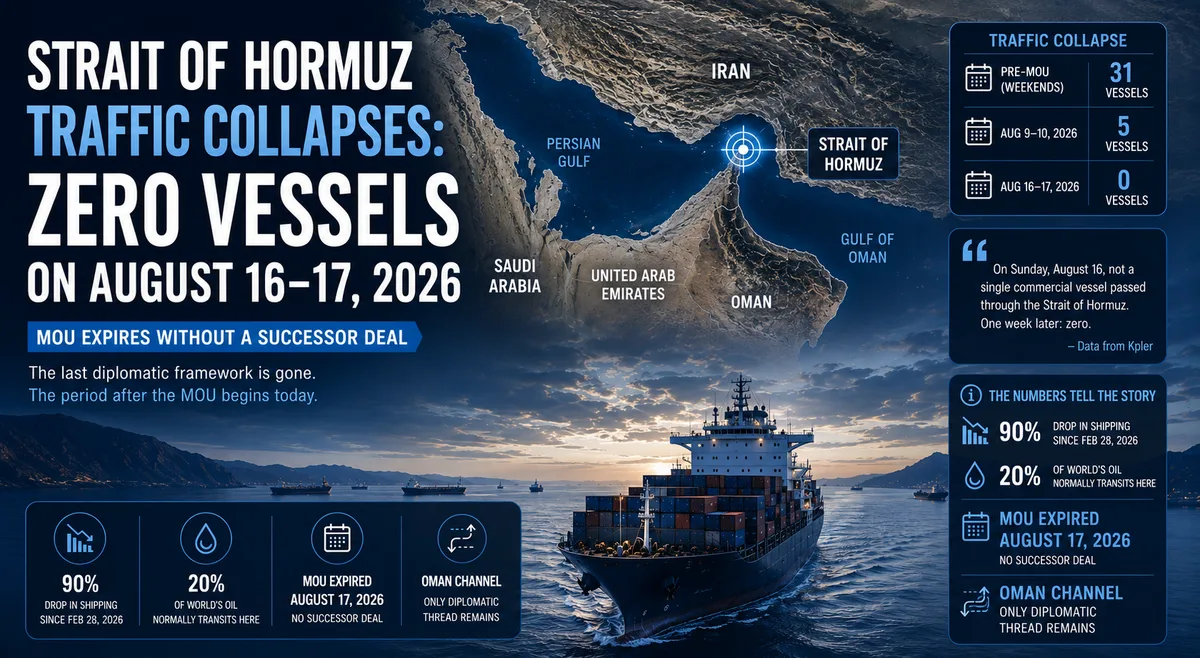
The number that defines today's Strait of Hormuz situation is not six, or ten, or even one. It is zero. On Sunday August 16, not a single commercial vessel passed through the Strait of Hormuz, according to data from trade intelligence firm Kpler cited by CNBC. The previous weekend, 31 vessels made the transit. The weekend before that, 31. One week later: zero. The 60-day US-Iran memorandum of understanding — the fragile framework that had provided a thin basis for diplomatic engagement since June 17 — expired today, August 17, with no successor deal in place, no negotiations scheduled, and the two sides further apart than at any point since the MOU was signed.
For the global shipping industry, today is not just another day in a six-month crisis. It is a specific threshold: the expiry of the last formal diplomatic framework governing the strait, without a replacement. Whatever comes next — escalation, a new negotiating round, or a prolonged period of open-ended conflict — the period of operating under the MOU is over. The period after the MOU begins today.
The Traffic Collapse — What the Numbers Actually Show
Shipping traffic through the Strait of Hormuz slowed to a halt over the weekend ahead of the expiry date of the 60-day ceasefire between the US and Iran on Monday, with no official negotiations or deal in sight. Over the weekend, only five cargo ships passed through the critical oil passage on Saturday, according to data from Kpler cited by Reuters, while no ships were registered to pass through the passage on Sunday.
Shipping traffic had already hit a three-month low last week, with a five-day average of 13 vessel transits on Tuesday reflecting the lowest level since May 12, according to a CNBC analysis of Kpler data. The trajectory is unmistakable: traffic that had been running at approximately 31 vessels per weekend during the MOU period has collapsed to single digits and then to zero as the deadline approached with no deal in sight.
Overall, shipping is down 90% since before the war started on February 28, with the Strait of Hormuz carrying about a fifth of the world's oil, averaging about 130 vessel transits per day before the conflict began. The 130-to-zero trajectory — played out across 170 days — is the most severe sustained closure of a major energy shipping chokepoint in modern maritime history. The strait that normally carries one fifth of the world's oil supply processed zero commercial transits on Sunday.
Why the MOU Failed — The Unbridgeable Gap
The June 17 MOU was always a fragile arrangement. It established a 60-day framework for diplomatic engagement and provided a thin basis for reduced hostilities — but it never resolved the fundamental dispute about who controls the strait, whether Iran can collect transit fees, and what the US's long-term role in Gulf security looks like. As NavilinkGlobal reported on August 3 when the MOU deadline first came into focus, the gap between the two sides' positions was not a negotiating difference — it was a structural incompatibility.
Iranian officials said Sunday an agreement with Oman to set up new shipping lanes in the Strait of Hormuz was in its final stages. But earlier in the weekend, Iran said it wouldn't fully reopen until US leaders meet certain conditions — including compensating Tehran for war damages, lifting sanctions and permanently ending the conflict. Those three conditions — war damage compensation, sanctions lifted, and a permanent end to a conflict the US has not agreed to end — are not negotiating positions. They are maximalist demands that no US administration could accept without a fundamental strategic reversal.
President Trump countered, saying Monday that Iran should pay reparations for those who have died in the war, as well as for those killed in attacks from throughout the last 50 years. Trump also claimed last week that "pretty soon I'll be declaring the Hormuz Strait a territory of the United States" — a statement with no basis in international maritime law but one that signals the US administration's position is hardening rather than softening as the MOU expires.
Iran's Deputy Foreign Minister Kazem Gharibabadi insisted in a post on X on Friday that the Strait will remain "Iranian" and only be closed and opened "under Iran's command." Two positions — the US claiming territorial control, Iran asserting sovereign authority — that are not just different but mutually exclusive. The MOU expired into this environment.
The Oman Channel — The Only Remaining Diplomatic Thread
The one thread of diplomatic activity that remains active is the Oman channel. Iranian officials said Sunday an agreement with Oman to set up new shipping lanes in the Strait of Hormuz was in its final stages. Iran and Oman agreed coordinates for new shipping routes on August 5 — a development NavilinkGlobal reported on August 3 — and Oman has continued to work the diplomatic channel despite the breakdown of direct US-Iran talks.
The Oman lane arrangement, if implemented, would create a designated corridor for commercial shipping — separate from the US-Iran political dispute — allowing vessels to transit under Iranian supervision without the broader diplomatic issues being resolved. It is a narrow, operational arrangement rather than a comprehensive settlement. Iran's conditions for full reopening remain maximalist. But a designated shipping lane — even one that requires Iranian permit and supervision — would be a meaningful improvement over zero transits.
The critical question for the shipping industry is whether the Oman arrangement can be implemented independently of the US-Iran political deadlock. Iran says the arrangement is in "final stages" — but it also says full reopening requires US concessions that have not been forthcoming. Those two positions are not necessarily contradictory: Iran could implement a partial Oman-brokered lane arrangement while maintaining its maximalist position on full reopening conditions. Whether the US would accept vessels transiting through an Iranian-supervised corridor without endorsing the broader fee and sovereignty framework Iran is demanding is the unresolved question.
What the Numbers Mean for the Rest of 2026
The MOU expiry today sets the framework for the second half of 2026 in global shipping. Several data points from this week's Lloyd's List Intelligence Strait of Hormuz Brief provide the clearest picture of where things actually stand:
- An estimated 1.8 million to 2 million TEU of global container volumes was lost to disruption in the Middle East Gulf during the first half of 2026, with regional imports down 21% and exports down 31%, according to Container Trades Statistics.
- Marine insurers estimate the Middle East Gulf conflict has generated $1.5 billion to $2 billion in claims from around 70 casualties since the end of February.
- Underwriters are concerned that continuation of the Hormuz crisis for another six months would see hundreds of vessels filing total loss claims after 12 months' deprivation of use. Earlier estimates suggested that if that eventually materialised, payouts at Lloyd's alone could hit $20 billion on ships.
- Maersk raised full-year guidance to $10.5-12.5 billion EBITDA on August 13 without pricing in a Hormuz reopening before year-end. CMA CGM posted record Q2 results. AD Ports posted its strongest quarter in history despite a 65% UAE container volume decline. Every major carrier's guidance assumes the disruption continues through year-end.
The insurance data point is particularly significant. Underwriters concerned that continuation of the Hormuz crisis for another six months would see hundreds of vessels filing total loss claims after 12 months' deprivation of use. The 12-month clock on those total loss claims started on February 28. Six months from today — February 28, 2027 — is the date at which deprivation-of-use claims begin to materialise at Lloyd's at potentially catastrophic scale. The MOU's expiry today without a successor arrangement means that clock continues running.
What Shippers and Logistics Operators Need to Know Right Now
- The MOU framework is gone — there is no current diplomatic ceiling on escalation. The June 17 MOU, however imperfectly observed, provided a formal framework that both sides had agreed to. Its expiry without a replacement removes that framework entirely. Escalation — additional strikes, expanded naval blockade, new Houthi attacks — no longer violates a signed agreement. It is simply the next military action in an ongoing conflict.
- Zero transits on Sunday is the new baseline — not the worst case. The zero-transit day on August 16 happened before the MOU formally expired. Now that it has expired, there is no structural reason for traffic to recover above that level without a new arrangement. Build supply chain plans around zero or near-zero Hormuz transits through year-end as the base case, not as the worst case.
- The Oman channel is the only near-term hope for any commercial transit. If Oman's lane arrangement is implemented, it would provide a designated corridor — likely requiring Iranian supervision and potentially fees — that enables some commercial transit. Watch for any concrete Oman-Iran-US announcement in the next 48-72 hours as the most significant near-term signal.
- The Cape of Good Hope is now the permanent primary route for Gulf-origin cargo. With the MOU expired and no successor framework in place, every carrier, insurer, and port operator should be planning around Cape of Good Hope routing as the permanent baseline for Asia-Europe and Gulf-Europe trade through at least year-end 2026. Any planning assumption that includes a Hormuz reopening before then is speculative.
- The February 28, 2027 insurance deadline is now the most important date in shipping. If the Hormuz crisis continues for another six months without resolution, the 12-month deprivation-of-use window closes on vessels that have been stranded since February 28. The scale of total loss claims that would follow — potentially $20 billion at Lloyd's alone — is a systemic risk to the global marine insurance market that has no precedent in peacetime.
Key Takeaways — August 17, 2026
- Zero commercial vessels passed through the Strait of Hormuz on Sunday August 16 — compared with 31 the previous weekend. Five vessels transited on Saturday. The strait processed no commercial traffic on Sunday for the first time since the war began February 28.
- The 60-day US-Iran memorandum of understanding expired today, August 17, with no successor deal in place and no negotiations scheduled — ending the last formal diplomatic framework governing the strait.
- Shipping is down 90% from pre-war normal of approximately 130 vessel transits per day. The strait carries about a fifth of the world's oil supply.
- Iran's conditions for full reopening include US war damage compensation, sanctions lifted, and a permanent end to the conflict. Trump countered that Iran should pay reparations and claimed the US will declare Hormuz "a territory of the United States." The two positions are mutually exclusive.
- The Oman diplomatic channel remains the only active thread — Iran said Sunday an Oman shipping lane arrangement was in "final stages." Whether it can be implemented independently of the broader US-Iran deadlock is the key near-term question.
- Marine insurers estimate $1.5-2 billion in claims from 70 casualties since February 28. If the crisis continues six more months, hundreds of vessels could file 12-month total loss claims — with potential Lloyd's payouts of $20 billion.


Comments
No comments yet. Be the first to share your thoughts!