What Happened — Simple Version
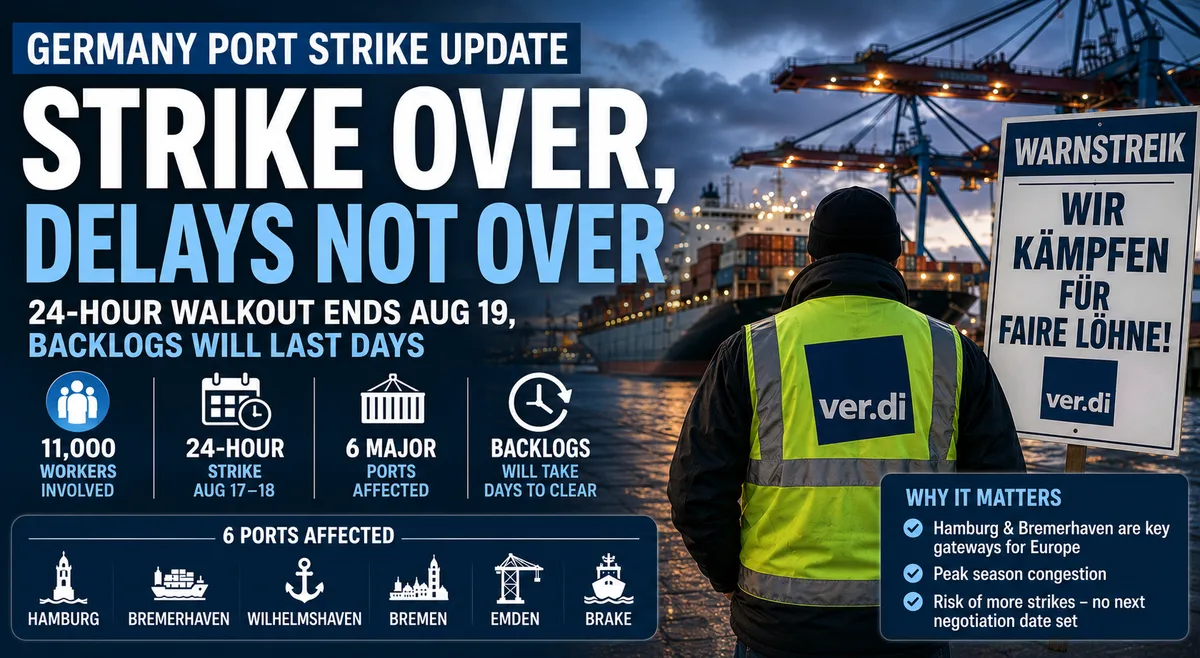
On the night of Monday August 17, 2026, Germany's largest service union — Ver.di — called a 24-hour warning strike at six of Germany's biggest seaports. The strike began with the night shift and continued through the day shift on Tuesday August 18.
The six ports affected were:
- Hamburg — Germany's largest port and one of Europe's biggest container hubs
- Bremerhaven — one of Europe's largest container terminals
- Wilhelmshaven — Germany's only deepwater port
- Bremen
- Emden
- Brake
The strike brought most container and cargo operations to a standstill. In Hamburg alone, as many as 2,100 members were off the job and gathered for a demonstration. All four major Hamburg container terminals — including those operated by HHLA and Eurogate — stopped working.
The 24-hour strike officially ended on the morning of Wednesday August 19. But as anyone who has seen a port strike before knows — the disruption does not end when workers go back.
Why Did the Workers Strike?
This is a wage dispute. Here is what each side wants:
What the Workers Want (Ver.di Union)
- 8.2% wage increase — over a 12-month contract period
- Minimum increase of €2.50 per hour for all workers regardless of grade
- Covers approximately 11,000 port employees across the six ports
Ver.di negotiator Sylvi Krisch said: "Our message to employers is that we are serious about our demands. The workers want a better offer, and they deserve it. They are the ones who keep the infrastructure running at the ports and ensure that the industry as a whole remains stable and successful."
What the Employers Offered (ZDS)
- 5.1% wage increase — but spread over a longer 19-month contract period
- €300 holiday pay bonus in 2027
- €460 increase in the annual allowance for container terminal workers
More than 6,100 workers participated in a consultation on the proposal, with a large majority rejecting it. The employers called the union's response "incomprehensible" and the strike "disproportionate." The union called the offer "completely inadequate."
The gap between the two sides is real: workers want 8.2% over 12 months. Employers are offering 5.1% over 19 months. Those are very different outcomes in purchasing power — especially in a year when German inflation and energy costs remain elevated.
What Specifically Stopped Working?
Here is the detailed picture of what was shut down:
- Hamburg: All four major container terminals shut down. EUROGATE Container Terminal Hamburg confirmed no cargo handling from 22:00 on August 17 until 22:00 on August 18. HHLA terminals also stopped. More than a dozen companies directly impacted.
- Bremerhaven: EUROGATE Container Terminal Bremerhaven: complete 24-hour work stoppage from 06:00 August 18 until 06:00 August 19. No handling operations expected at any terminal during the strike period. No truck or rail slots could be booked.
- Wilhelmshaven: Terminal operations suspended from 22:00 August 17 until 22:00 August 18. No truck or rail slots available. Additional restrictions on truck handling on August 19 due to staff meetings.
- Rail connections: Contargo, a trimodal container logistics operator, said delays and potential cancellations were expected for rail and truck transport.
The Strike Is Over — But the Delays Are Not
This is the most important point for shippers to understand right now.
The 24-hour strike officially ended on Wednesday August 19. Workers are back. Cranes are running again. But the backlog created by a full day of zero operations at six ports does not clear overnight.
Previous warning strikes have affected vessel loading and unloading as well as truck and rail container movements, potentially creating backlogs that take additional time to clear. Disruption could extend beyond the strike.
Import containers may miss scheduled rail or trucking connections, while export cargo could miss terminal cut-offs or planned vessel departures.
Industry analysts are warning that post-strike congestion at Hamburg and Bremerhaven could last several days — especially because this strike hit during peak shipping season, when port yards are already full and vessel schedules have very little spare capacity to absorb delays.
Could There Be More Strikes?
Yes — and this is the bigger risk. The 24-hour warning strike was exactly that: a warning. It was designed to show employers that workers are serious — not to be the end of the dispute.
With the peace obligation having expired, further warning strikes at other German ports cannot be ruled out. Critically, no date has yet been fixed for a third round of negotiations — meaning there is currently no scheduled meeting between Ver.di and the employers' ZDS association to resolve this dispute.
If no deal is reached and more strikes are called, the situation could escalate quickly. The last major German port strike cycle — in 2024 — involved multiple rounds of increasing intensity before a deal was eventually reached. Industry experts warned that a prolonged strike would cause delays at Hamburg and Bremerhaven ports and could severely disrupt German exports, particularly affecting the automotive and machinery sectors, which rely heavily on these gateways for global trade.
Why Does This Matter Beyond Germany?
Hamburg is not just Germany's problem. It is one of the most important cargo gateways in all of Europe — a key hub for goods moving between:
- Asia and Northern Europe
- North America and Central/Eastern Europe
- German industrial exports (cars, machinery, chemicals) to the world
When Hamburg stops, the effects spread across the continent. Cargo that cannot move through Hamburg gets rerouted to Rotterdam, Antwerp, or other North Sea ports — which then become more congested themselves. In previous German port strikes, Rotterdam and Antwerp have declined to take transshipment cargo for German ports when their own yards reached capacity.
The timing makes this especially concerning: this strike hit during August peak season, when container volumes are at their annual high as retailers stock up for the fourth quarter and holiday season.
What Should Shippers and Freight Forwarders Do Right Now?
- Check your Hamburg and Bremerhaven shipments immediately. Contact your freight forwarder and ask: is my cargo currently at or heading to any of the six affected German ports? What is the current situation with that vessel or container?
- Expect delays — even though the strike is over. The 24-hour shutdown created a backlog that will take 3-5 days to work through. Do not expect normal service to resume immediately on August 19.
- Alert your customers and delivery partners. If you have cargo expected to arrive via Hamburg or Bremerhaven in the coming days, inform your recipients now. Give them early warning rather than last-minute news of a delay.
- Watch for the next negotiation date. If Ver.di and ZDS cannot agree on a new negotiation date quickly, the risk of further strikes goes up significantly. Monitor this carefully over the coming week.
- Have a rerouting contingency plan. If further strikes are called, your freight forwarder should be able to identify alternative routing via Rotterdam or Antwerp. Discuss this now — before you need it urgently.
- Do not panic-switch to air freight yet. The strike was 24 hours. The backlog is real but manageable unless further action is called. Air freight costs are extremely high right now — switching unnecessarily is expensive.
Key Takeaways — August 19, 2026
- Ver.di launched a 24-hour warning strike at 6 German ports starting August 17 night — Hamburg, Bremerhaven, Wilhelmshaven, Bremen, Emden, Brake.
- 11,000 port workers covered — all four major Hamburg container terminals shut down.
- Strike is officially over as of August 19 morning — but backlogs will take days to clear.
- Workers demand 8.2% wage rise over 12 months. Employers offered 5.1% over 19 months. No deal yet.
- No next negotiation date has been set — risk of further strikes remains high.
- Peak season timing makes the backlog more severe — ports were already running near capacity.
- Rotterdam and Antwerp may be used as alternatives if more strikes are called.
- Action now: check Hamburg/Bremerhaven shipment status, alert recipients, have rerouting plan ready.
The 24-hour strike is done. But the wage dispute is not — and with no negotiation date set, Germany's ports could face more disruption ahead. For every company moving cargo through Northern Europe's most important shipping gateway, this is a story to watch very closely in the coming days.



Comments
No comments yet. Be the first to share your thoughts!