
What Happened
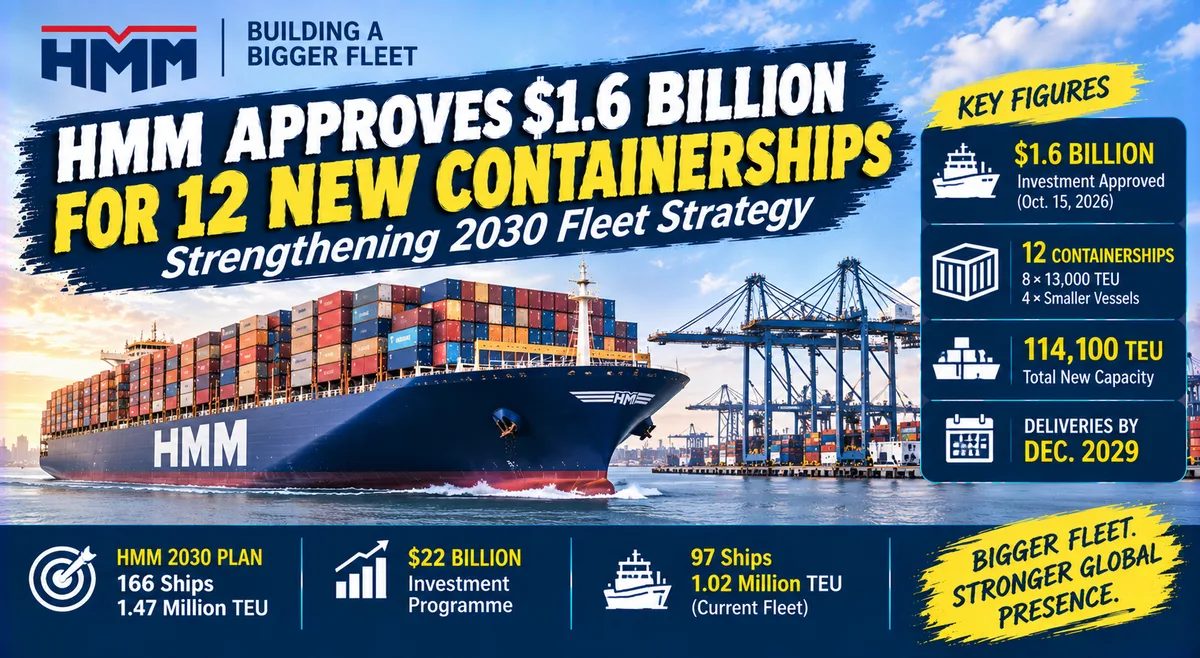
South Korean container line HMM has approved a $1.6 billion investment in 12 containerships, comprising eight 13,000 TEU newbuildings and four smaller vessels. HMM's board cleared the investment on Thursday, October 15, 2026.
The 12 vessels will add a combined 114,100 TEUs of capacity to the company's fleet. In a regulatory disclosure, HMM put the total vessel price at $1,617,156,000 — equivalent to 8.16 percent of the company's consolidated equity at the end of its most recent financial year, though the final figure may shift depending on final vessel specifications.
What's Being Ordered — and What's Already Under Construction
The order breaks down into two parts. Alongside the eight newbuilding orders for 13,000 TEU ships, HMM will acquire three 2,800 TEU vessels and one 1,700 TEU vessel as resale newbuildings — meaning these smaller ships were originally ordered by another owner and are being transferred to HMM before delivery, rather than being newly commissioned from scratch.
HMM has not yet disclosed which shipyards will build the eight larger vessels, or who the sellers are for the four smaller ships. Deliveries across the full order are scheduled to be completed by December 2029.
This is not HMM's first 13,000 TEU order this cycle. The carrier ordered 12 ships of the same size in late 2025, with HD Hyundai named as builder for eight of those vessels and Hanwha Ocean securing the contract for the remaining four. Those earlier ships are scheduled to enter the fleet between the second half of 2028 and the first half of 2029 — meaning HMM now has two overlapping waves of 13,000 TEU newbuildings arriving within roughly a year of each other.
How This Fits HMM's Bigger 2030 Plan
This latest commitment is part of a revised fleet strategy HMM's board approved back on July 24, 2026. That strategy targets 166 containerships and 1.47 million TEU of capacity by the end of 2030, backed by a KRW29 trillion ($22 billion) investment programme. It replaces an earlier 2024 strategy that had aimed for a smaller fleet of 130 containerships with 1.55 million TEU.
The plan is built around a hub-and-spoke network — large vessels running the main ocean-going routes, supported by smaller and medium-sized ships that connect origin and destination ports into those hub routes. That structure explains why this order mixes large 13,000 TEU newbuildings with much smaller 1,700-2,800 TEU feeder-type vessels rather than ordering only one ship size.
As of the first half of 2026, HMM operated 97 containerships with a combined capacity of approximately 1.02 million TEU, alongside 36 ships already on its orderbook before this latest approval.
Why This Matters for the Wider Market
HMM's move is part of a broader pattern of aggressive newbuilding commitments among major Asian carriers in 2026, even as the industry works through elevated freight rates, Red Sea diversions, and Strait of Hormuz disruption this year. A carrier willing to commit $1.6 billion to new tonnage, on top of an already-active $2.8 billion order from the previous year, signals confidence that long-term demand on Asia-linked trade lanes will justify the added capacity well into the next decade.
For the wider shipbuilding market, HMM's continued reliance on HD Hyundai and Hanwha Ocean in its prior order — and the fact that shipyards for this new batch have not yet been named — is also worth watching, since it will add to an already busy orderbook across South Korean yards.
What This Means for Shippers and Freight Forwarders
- More capacity is coming, but not until 2028-2029. These newbuildings will not affect near-term space or rates on HMM's services. Treat this as a signal about HMM's capacity position toward the end of the decade, not a factor in 2026-2027 booking decisions.
- Watch for HMM's hub-and-spoke network to expand reach. As the smaller 1,700-2,800 TEU vessels enter service alongside the larger ships, expect HMM to potentially add or strengthen feeder connections into secondary ports that feed its main hub routes — worth tracking if you ship through smaller regional ports HMM serves.
- Shipyard capacity is tightening further. With HMM alone committing to 12 more vessels on top of its 2025 order, and shipyards not yet confirmed, expect continued pressure on newbuilding slots and pricing across the shipbuilding sector — relevant if your own company is weighing vessel orders or charters that depend on yard availability.
- This reflects longer-term carrier confidence, not a short-term market signal. A multi-year fleet expansion plan like HMM's 2030 target should be read as a strategic bet on sustained demand growth, rather than a reaction to current freight rate conditions.
Key Takeaways
- HMM's board approved a $1.6 billion investment in 12 containerships on October 15, 2026.
- The order comprises eight newly ordered 13,000 TEU vessels and four smaller resale newbuildings (three 2,800 TEU, one 1,700 TEU).
- Combined, the 12 ships add 114,100 TEU of capacity, with deliveries scheduled by December 2029.
- Shipyards for the eight larger vessels have not yet been disclosed.
- This follows a 12-ship, $2.8 billion order placed in late 2025 with HD Hyundai and Hanwha Ocean.
- The investment supports HMM's revised 2030 strategy: 166 containerships and 1.47 million TEU, backed by a $22 billion investment programme.
- HMM currently operates 97 containerships totalling roughly 1.02 million TEU.


Comments
No comments yet. Be the first to share your thoughts!