
What Happened
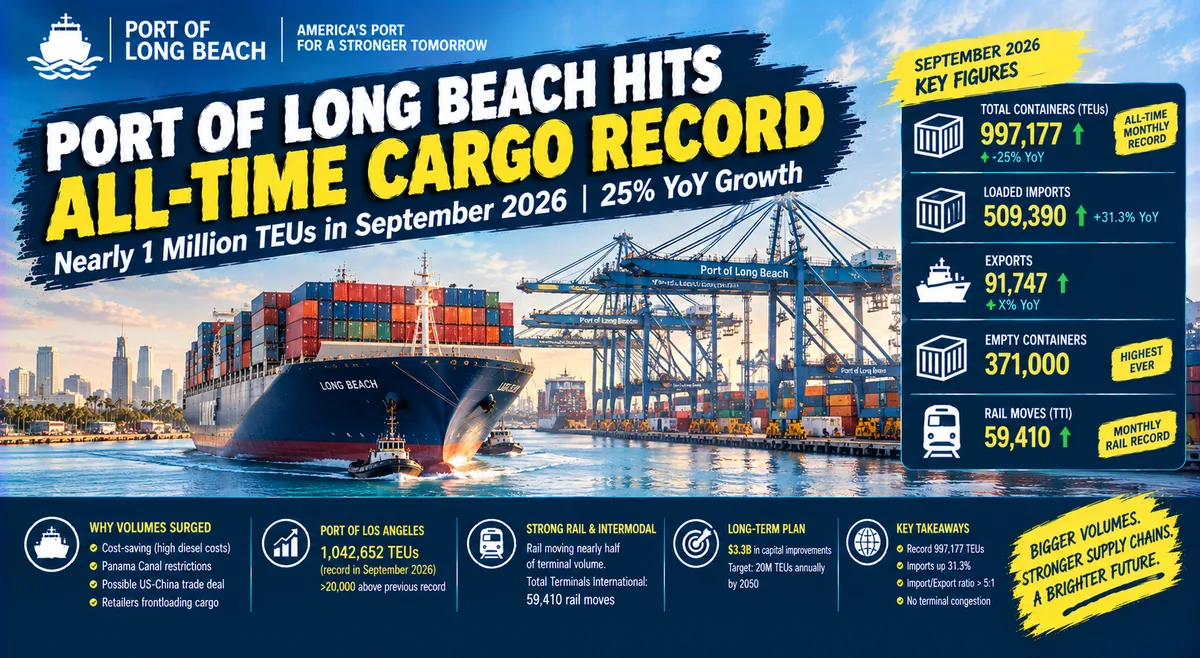
The Port of Long Beach handled nearly 1 million container units in September, setting an all-time monthly cargo record in its 115-year history, port officials announced Thursday, October 15, 2026.
Longshore workers and terminal operators processed 997,177 twenty-foot equivalent units (TEUs) in September, a 25 percent increase over the same month last year. That surpasses the port's previous monthly record of 987,191 TEUs, set in October 2024.
"I am extremely proud of everyone who has played a role in delivering the busiest month the Port of Long Beach has ever experienced, including our dockworkers and terminal operators," Long Beach Harbor Commission President Steven Neal said in a statement. Port officials also noted the record was achieved without congestion at the port's terminals.
Imports Did the Heavy Lifting
Loaded imports accounted for the largest share of September's traffic, climbing 31.3 percent year-on-year to 509,390 TEUs. That surge pushed the ratio of import to export boxes past 5:1, with the port handling just 91,747 TEUs of exports in the same month.
The port also processed 371,000 empty containers in September — the highest monthly total in its history — reflecting the broader imbalance between inbound and outbound trade that has characterized the year.
Through the first nine months of 2026, Long Beach has moved 7.68 million TEUs, up 3.9 percent compared with the same period last year.
Why Volumes Surged
The port credited the record to a combination of factors: shippers' cost-saving strategies against high diesel costs, Panama Canal access restrictions, and the prospect of a possible new US-China trade deal. Port of Los Angeles Executive Director Gene Seroka, discussing the broader surge across the San Pedro Bay complex, pointed to major retailers frontloading cargo ahead of tariff changes, while noting that "outbound volumes remain softer than normal, which reflects the ongoing challenges facing American farmers and manufacturers."
September marked the fourth straight month of historic volumes for the broader port complex, with the record-setting pace extending the early-arriving peak season on the transpacific trade further into the year than usual.
A Rail Record Too
Port officials also highlighted a monthly rail record set by Total Terminals International, which handled 59,410 rail moves in September — representing nearly half of the terminal's total container volume. That underscores how much of the record cargo surge is moving onward by rail rather than staying in the local trucking network.
Long Beach Wasn't Alone
The neighboring Port of Los Angeles also reported a record-setting September, handling 1,042,652 TEUs — more than 20,000 units above its previous record, set in July 2025, and the most volume ever moved through any port in the Western Hemisphere. Los Angeles handled 371,000 empty containers and exported 126,000 loaded containers, with loaded exports up 10 percent from the prior September but still trailing well behind import volumes.
Together, the two adjoining ports moved close to 2.04 million TEUs in a single month — a scale of combined throughput that underlines just how much cargo is currently moving through the San Pedro Bay complex relative to recent years.
What's Next for the Port
The Port of Long Beach is planning $3.3 billion in capital improvements over the next decade as part of a long-term strategy to increase annual cargo volumes to 20 million TEUs by 2050. The scale of September's record — and the fact that it was achieved without terminal congestion — suggests the port's current infrastructure handled the surge well, even as officials plan for further growth.
What This Means for Shippers and Importers
- Expect continued strong West Coast volumes through year-end. With September marking the fourth consecutive month of record or near-record throughput across Long Beach and Los Angeles, and the peak season extending later than usual, plan for continued high volumes rather than an imminent slowdown.
- Rail capacity is absorbing a growing share of the surge. With Total Terminals International setting its own rail record, shippers moving cargo onward via intermodal rail should confirm current rail allocations and transit times with their carriers, since rail volumes at this scale can affect scheduling further inland.
- Watch the import-to-export imbalance. A ratio exceeding 5:1 means a large number of empty containers are accumulating at the port. If you're an exporter, this imbalance can sometimes translate into more available export equipment, but also reflects weaker overall export demand that may affect backhaul pricing.
- Tariff and trade-policy developments remain a direct driver of volume. Port officials explicitly linked the record to frontloading ahead of possible tariff changes and a prospective US-China trade deal. Any further policy shifts on these fronts are likely to show up quickly in booking patterns at both ports.
- No congestion reported despite record volume — a positive signal for reliability. Unlike some past surge periods, officials say this record was handled without the terminal backups that have historically caused delays, which is worth factoring into confidence around current West Coast transit reliability.
Key Takeaways
- Port of Long Beach handled 997,177 TEUs in September 2026 — its busiest month in 115 years, up 25% year-on-year.
- The record surpasses the previous high of 987,191 TEUs, set in October 2024.
- Loaded imports rose 31.3% year-on-year to 509,390 TEUs, pushing the import-to-export ratio past 5:1.
- The port processed a record 371,000 empty containers and achieved the volume without terminal congestion.
- Total Terminals International set a monthly rail record of 59,410 rail moves.
- Neighboring Port of Los Angeles also set a record in September, handling 1,042,652 TEUs — the most ever moved through any Western Hemisphere port in a single month.
- Officials credit frontloading ahead of tariff changes, Panama Canal restrictions, and high diesel costs for the surge.
- Long Beach plans $3.3 billion in capital improvements over the next decade, targeting 20 million TEUs annually by 2050.



Comments
No comments yet. Be the first to share your thoughts!