
What Happened
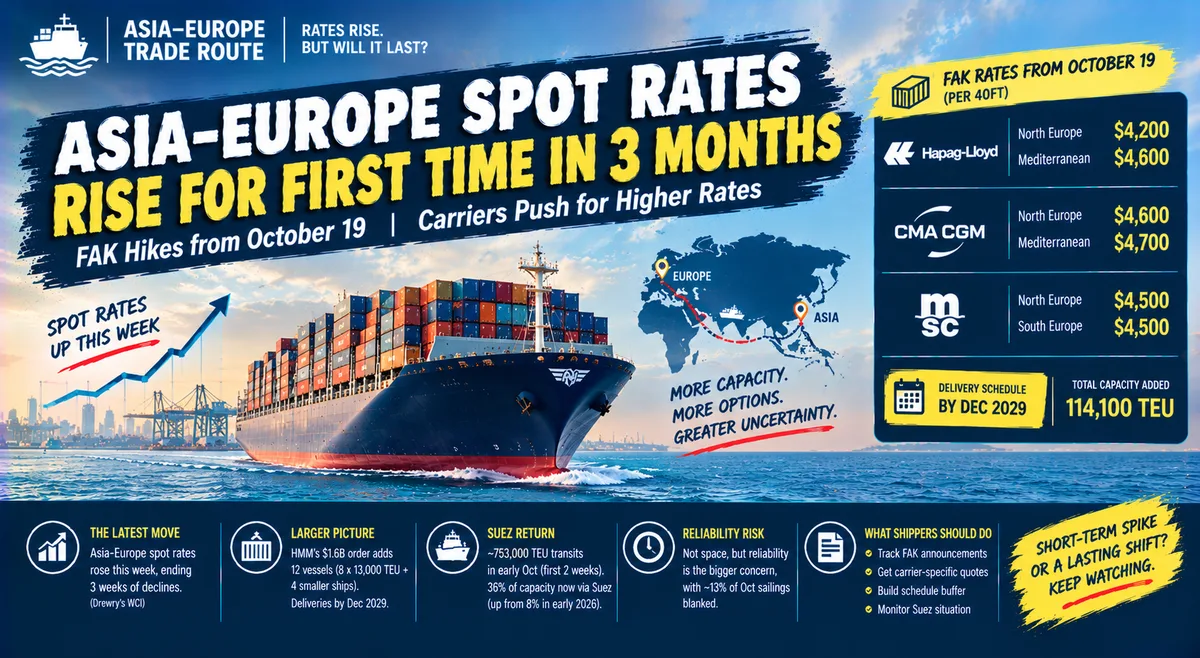
Container spot freight rates on the Asia-Europe trades rose for the first time in three months this week, according to Drewry's World Container Index (WCI), as reported by The Loadstar on October 16, 2026. The increase was enough to wipe out the past three weeks of declines in a single move.
The rise coincides with a fresh round of FAK (freight all kinds) rate hikes that carriers have announced for October 19 bookings, after weeks of steadily falling spot prices through late September and early October.
What Are Carriers Actually Charging From October 19?
According to figures carriers have advised to the market, the new FAK levels effective October 19 are:
- Hapag-Lloyd: $4,200 per 40ft on Asia-North Europe, and $4,600 per 40ft on Asia-Mediterranean
- CMA CGM: $4,600 per 40ft to North Europe, and $4,700 per 40ft to the Mediterranean
- MSC: $4,500 per 40ft to both North and South Europe
This follows a pattern seen repeatedly through 2026: after a period of falling spot rates, carriers attempt to "reset the floor" with a coordinated round of FAK increases timed around the same effective date — in this case, October 19.
Why the Rate Reversal May Not Last
Despite this week's rise, forwarders speaking to The Loadstar said they expect rates to fall again. This caution reflects a pattern carriers and forwarders have seen repeatedly over the autumn: FAK hikes briefly interrupt a downward trend, but underlying demand conditions — softer post-Golden Week cargo volumes and returning Suez Canal capacity — continue to push rates back down within a few weeks.
Drewry's own October 1 reading showed Shanghai-Rotterdam at $3,399 per 40ft, down 2% week-on-week, after twelve consecutive weeks of decline. Carriers had already flagged higher FAK rates for the second half of October specifically to try to arrest that slide — this week's rise appears to be the first sign those hikes are gaining traction, at least temporarily.
Reliability, Not Space, Is the Real Concern
One telling comment from the market: "On Asia-Europe, the challenge we foresee is reliability rather than space," a source told The Loadstar. That distinction matters for shippers. A capacity-driven rate spike usually means bookings are hard to secure. A reliability-driven concern instead points to unpredictable transit times, blanked sailings, and schedule disruption — even when space itself is available.
This fits a wider pattern we've tracked in recent coverage. The same week, a separate Loadstar weekly freight report noted that global ocean on-time performance has fallen for four consecutive months, with containers bound for North America now arriving almost a week late on average, as carriers blank roughly 13% of October sailings.
The Bigger Picture: Suez Return and Elevated Capacity
This rate movement is happening against the backdrop of continued container shipping return to the Suez Canal route, which we've been tracking closely. Weekly container transits through the canal reached roughly 753,000 TEUs in the first two weeks of October — still well below the 1.457 million TEUs seen in the same period of 2023, but a clear acceleration from earlier in 2026.
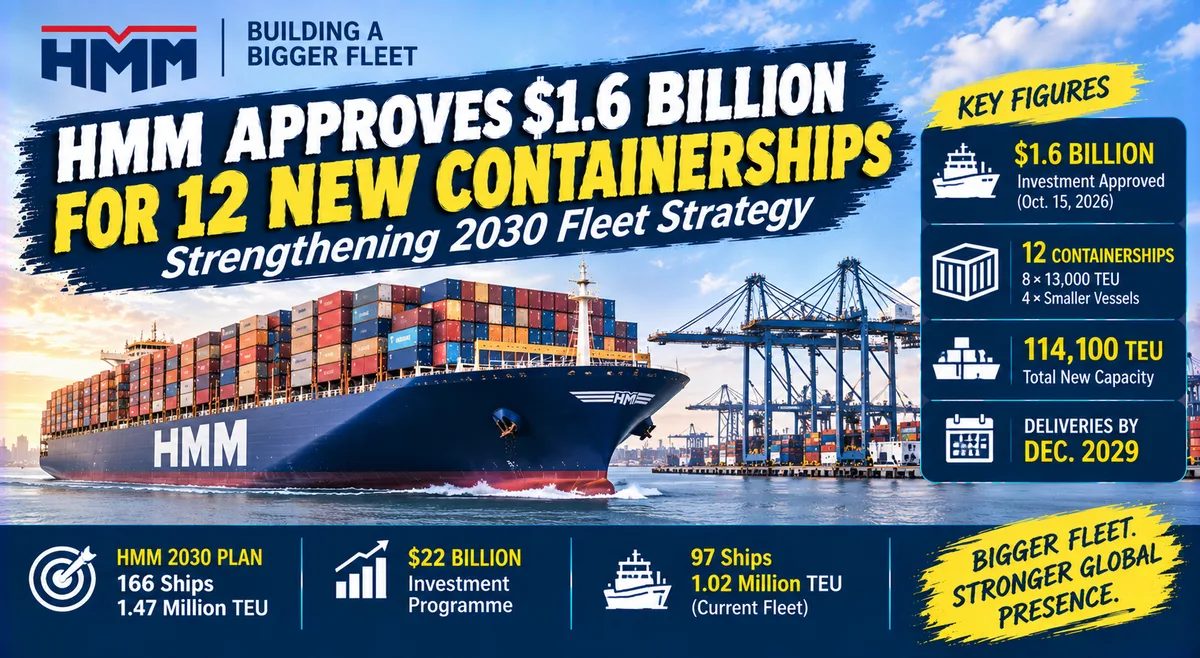
According to Clarksons Research, 36% of container capacity routed via the canal or the Cape of Good Hope traversed the Suez in early October, up sharply from just 8% between 2024 and mid-2026, though still well below the pre-attack baseline of around 80% of transits. The Premier Alliance (Ocean Network Express, HMM, and Yang Ming) is also adding its FE1 Asia-North Europe service to the Suez slate this week — its first return to the Red Sea route since diverting around Africa when Houthi attacks began.
More vessels taking the shorter Suez route effectively adds capacity to the Asia-Europe trade over time, which works against carriers' ability to sustain rate increases — a key reason forwarders remain skeptical this week's rise will hold.
What This Means for Shippers
- Expect volatility, not a clean trend, through the rest of October. With rates rising this week after 12-13 weeks of declines, and forwarders themselves expecting another fall, avoid reading too much into any single week's movement. Track the FAK announcement dates (19 October, and watch for a mid-November round) rather than daily spot indices alone.
- Budget around the specific FAK figures by carrier, not an average. The spread between Hapag-Lloyd's $4,200 and CMA CGM's $4,700 to North Europe shows real pricing variation right now — it's worth getting live quotes from more than one carrier before booking.
- Build in schedule buffer, not just cost buffer. With on-time performance down for four straight months and roughly 13% of October sailings blanked, ask your carrier or forwarder which specific services are protected from blanking before committing to a tight delivery deadline.
- Watch the Suez return closely if you ship Asia-Europe regularly. As more capacity shifts back to the shorter Suez route, further downward pressure on rates is plausible into Q4 — but this depends on the Red Sea security situation remaining stable, which is not guaranteed.
Key Takeaways
- Asia-Europe container spot rates rose this week for the first time in three months, erasing three weeks of prior declines, per Drewry's WCI.
- New FAK rates effective October 19: Hapag-Lloyd $4,200 (North Europe) / $4,600 (Mediterranean); CMA CGM $4,600 / $4,700; MSC $4,500 to both regions, all per 40ft.
- Forwarders expect the rate rise to be temporary, citing continuing capacity growth from returning Suez Canal traffic.
- Reliability, not available space, is flagged as the bigger near-term concern on Asia-Europe routes.
- Suez Canal transits reached ~753,000 TEUs in the first two weeks of October — still well below pre-attack levels but rising fast, with 36% of relevant capacity now routing via Suez, up from 8% earlier in 2026.
- The Premier Alliance (ONE, HMM, Yang Ming) is adding its first Red Sea service back onto the Suez route this week.



Comments
No comments yet. Be the first to share your thoughts!