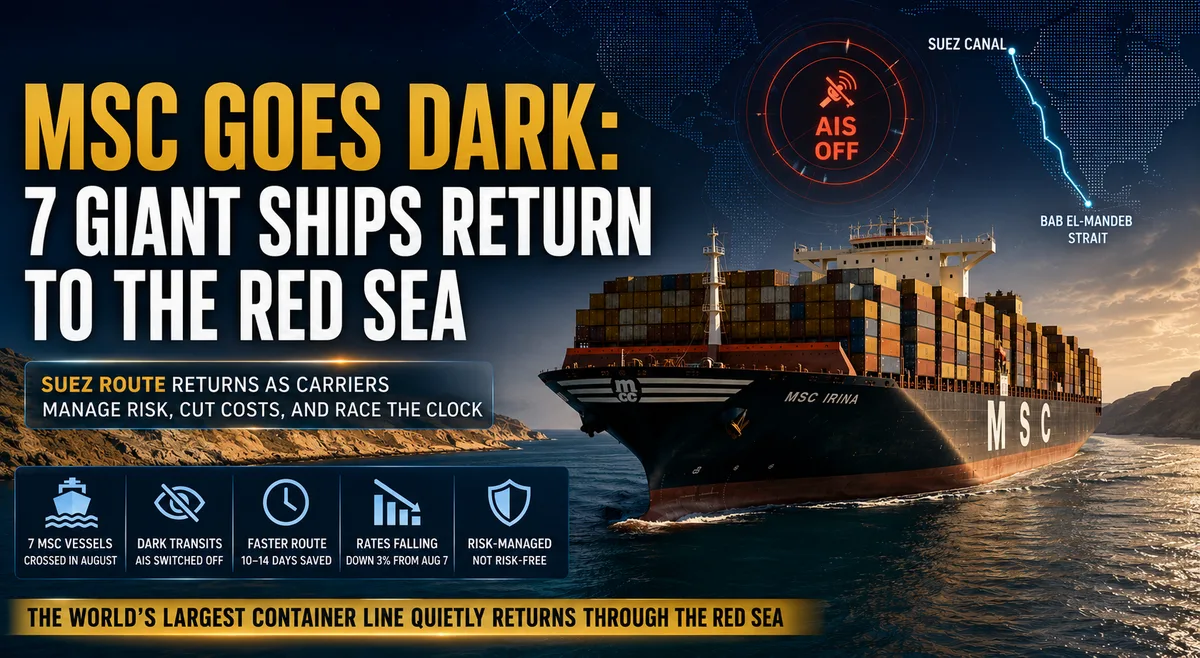
What Does "Going Dark" Mean?
Every commercial ship in the world is required to broadcast its location, name, speed, and direction using a system called AIS — Automatic Identification System. This is like a GPS tracker that anyone can watch online in real time. Ports, coast guards, freight forwarders, and even the public can track ships using websites like MarineTraffic.
When a ship "goes dark," it switches off its AIS transponder. The ship disappears from tracking screens. Nobody — including Houthi forces in Yemen — can see where it is, where it is going, or what route it is taking.
This is exactly what MSC's seven ships did as they crossed the Bab el-Mandeb Strait — the narrow chokepoint at the southern end of the Red Sea — on their way from Asia to Europe through the Suez Canal.
Which Ships? The Full List — Verified
According to container shipping consultancy Linerlytica's report, published August 18, 2026, here are the seven MSC vessels that have transited the Suez Canal and Red Sea this month:
- MSC Amelia (23,782 TEU) — China-Mediterranean Tiger service. Crossed Suez on July 31, Bab el-Mandeb on August 3.
- MSC Vega (13,102 TEU) — China-Mediterranean Dragon service. Crossed Suez on July 31, Bab el-Mandeb on August 3.
- MSC Giulia (9,408 TEU) — China-Mediterranean positioning trip. Transited Suez on July 21, Bab el-Mandeb on August 4, after stopping at Saudi Arabia's King Abdullah Port.
- MSC Irina (24,346 TEU) — China-Mediterranean Jade service. Suez passage on August 4, Bab el-Mandeb on August 8.
- MSC Annabella (15,413 TEU) — China-North Europe Britannia service. Crossed Suez on August 4, Bab el-Mandeb on August 11, after stopping at King Abdullah Port.
- MSC Oliver (19,224 TEU) — China-Mediterranean Tiger service. Passed through Suez on August 10, Bab el-Mandeb on August 13.
- MSC Napoli (15,576 TEU) — China-North Europe Lion service. Transited Suez on August 12, Bab el-Mandeb on August 16.
All the Bab el-Mandeb Strait crossings were "dark" transits — the ships had switched off their AIS transponders to hide their location, names, and movement, minimising the risk of Houthi attacks.
These are not small ships. The MSC Irina at 24,346 TEU is one of the largest container ships ever built — capable of carrying 24,346 standard shipping containers in one voyage. Sending ships of this size through a conflict zone, in secret, tells you everything about how urgent the pressure to use this route has become.
Why Is MSC Taking This Risk Now?
The Red Sea has been effectively off-limits for most major carriers since late 2023, when Houthi forces in Yemen began attacking commercial ships in support of Gaza. Ships have been rerouting around Africa's Cape of Good Hope instead — adding 10 to 14 days to Asia-Europe voyages and significantly increasing fuel costs.
So why are carriers suddenly willing to risk it now? Three reasons:
1. China Port Congestion Is Forcing Faster Routes
Worsening port congestion in China is encouraging mainline operators to speed up Asia-Europe sailing times and close one eye to the Houthi threat, as stormy weather has seen vessel waiting times top 12 days. Three typhoons — Bavi, Noul, and Dolphin — have made landfall in eastern and southern China over the past month, affecting operations in Shanghai, Ningbo, Qingdao, Yantian, and Shekou.
When a ship is stuck waiting 12 days outside a Chinese port, every day of delay costs money. Taking the faster Suez route — even with security risks — starts to look like the better option compared to adding another two weeks going around Africa.
2. Freight Rates Are Falling — Carriers Need to Cut Costs
The Bab el-Mandeb Strait crossings coincide with downward pressure on Asia-Europe freight rates. The Shanghai-North Europe rate corrected by about 3% from August 7, to $4,811 per 40ft. Some shipping lines were already quoting lower rates.
When rates fall, carriers need to cut costs to protect margins. The Suez route is significantly cheaper than Cape of Good Hope routing — less fuel, shorter voyage time, fewer ships needed per service. The financial math is starting to favour the risk.
3. Other Major Carriers Are Already Doing It
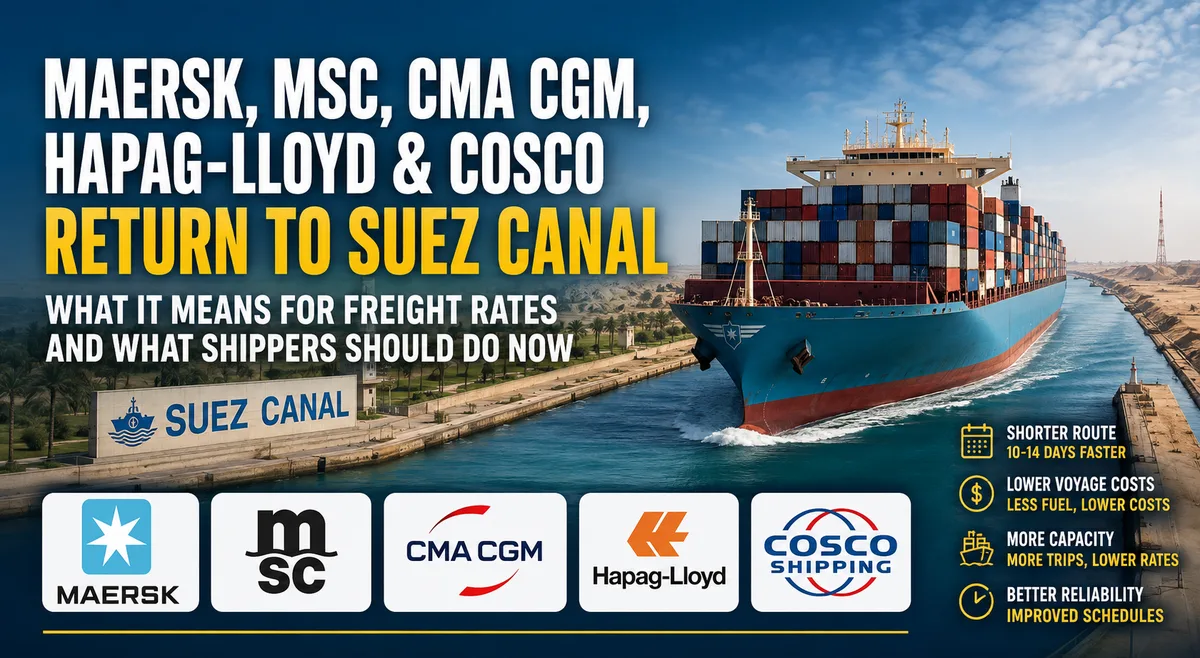
MSC is not alone. Maersk, CMA CGM, and COSCO have all resumed Red Sea transits, or are planning to do so. The Maritime Executive confirmed today that MSC is the latest carrier to test the routes, as Maersk and Hapag-Lloyd have reported they are continuing to transfer services back to the Suez-Red Sea corridor, and CMA CGM is growing its volumes on the waterway.
There is also peer pressure at work. When your competitors are using the faster, cheaper route and you are still going around Africa, you are at a cost and schedule disadvantage. Carriers are watching each other closely.
Is It Safe? What Are the Risks?
The honest answer is: it is safer than it was, but not safe. The Houthi threat has not gone away — it has simply become less intense and less organised than at its peak in 2024.
The "going dark" tactic reduces risk by removing the information Houthis need to target a ship. Without AIS data, they cannot easily identify which ships are commercial vessels, where they are heading, or which flag they sail under.
But it is not foolproof. Radar, visual sighting, and other intelligence methods can still identify ships in the strait. And the Houthis have previously stated they will attack ships regardless of flag or operator. The carriers are making a calculated risk — not eliminating it.
The Suez Canal Authority has been lobbying the industry for its return and reports it continues its "constructive strategy in opening direct communication channels with all its customers." While volumes remain below historic peaks, the strategy appears to be working as more carriers are returning vessels to the routes.
What Does This Mean for Asia-Europe Freight Rates?
This is the most direct impact for shippers and freight forwarders. More ships using the Suez route means:
- More effective capacity on Asia-Europe lanes. The Cape of Good Hope route uses more ships to maintain the same frequency — because each voyage takes 10-14 days longer. As ships return to Suez, that extra capacity is released back into the market.
- Downward pressure on rates. More capacity = lower rates. The SCFI Shanghai-North Europe rate is already down 3% from August 7. Although some carriers are aiming for a modest rate hike in September of around $500 per 40ft, the market momentum remains negative with September contracts currently trading at a 30% discount to current SCFI rates.
- Shorter transit times. If your cargo moves Asia-Europe via Suez instead of Cape of Good Hope, your transit time drops by roughly 10-14 days. This is significant for time-sensitive goods, seasonal stock, and just-in-time supply chains.
What Should Shippers and Freight Forwarders Do Right Now?
- Ask your carrier which route your cargo is taking. Not all carriers are using Suez. Some are still going around Africa. Ask specifically: is my vessel going via Suez or Cape of Good Hope? This directly affects your ETA.
- Review Asia-Europe contract rates. If you locked in long-term contracts when Cape rerouting was pushing rates up, a Suez return could mean spot rates fall below your contract rate. Monitor the market and know your contract terms.
- Do not assume Suez is fully open. Ships are transiting — but selectively, in the dark, with security precautions. This is not a full return to normal. One significant Houthi attack could push carriers back to Cape routing overnight. Build contingency plans for both scenarios.
- Watch September rate announcements. Carriers are planning a September peak season surcharge of around $500 per 40ft — but the market does not currently support it. If rates keep falling, that surcharge may not stick. Watch carrier announcements closely in the next 2-3 weeks.
- Plan for faster deliveries — but verify first. If your carrier confirms Suez routing, update your delivery ETAs. Notify your customers and warehouses of potentially earlier arrivals — better to give good news early than scramble at the last minute.
Key Takeaways — August 19, 2026
- MSC sent 7 giant container ships through the Suez Canal and Red Sea in August 2026.
- All Bab el-Mandeb crossings were "dark" — AIS transponders switched off to hide from Houthis.
- Ships range from 9,408 TEU to 24,346 TEU — among the largest container vessels in the world.
- Maersk, CMA CGM, and COSCO are also resuming Red Sea transits.
- Drivers: China port congestion (12-day waits), falling freight rates, peer carrier pressure.
- Shanghai-North Europe rate already down 3% from August 7 to $4,811 per 40ft.
- September rate hike of $500/40ft planned by carriers — but market momentum is negative.
- Houthi threat has not ended — transits are risk-managed, not risk-free.
- Ask your carrier now: Suez or Cape of Good Hope? Your ETA depends on the answer.
The world's largest container line is sending its biggest ships through a conflict zone — in the dark — because the cost of going around Africa has simply become too high. For the global logistics industry, the gradual return to Suez is one of the most significant developments of August 2026. It will not happen overnight, and it will not be smooth. But the direction is clear: the world's ships are quietly finding their way back through the Red Sea.
Comments
No comments yet. Be the first to share your thoughts!