
What Is Happening Right Now?
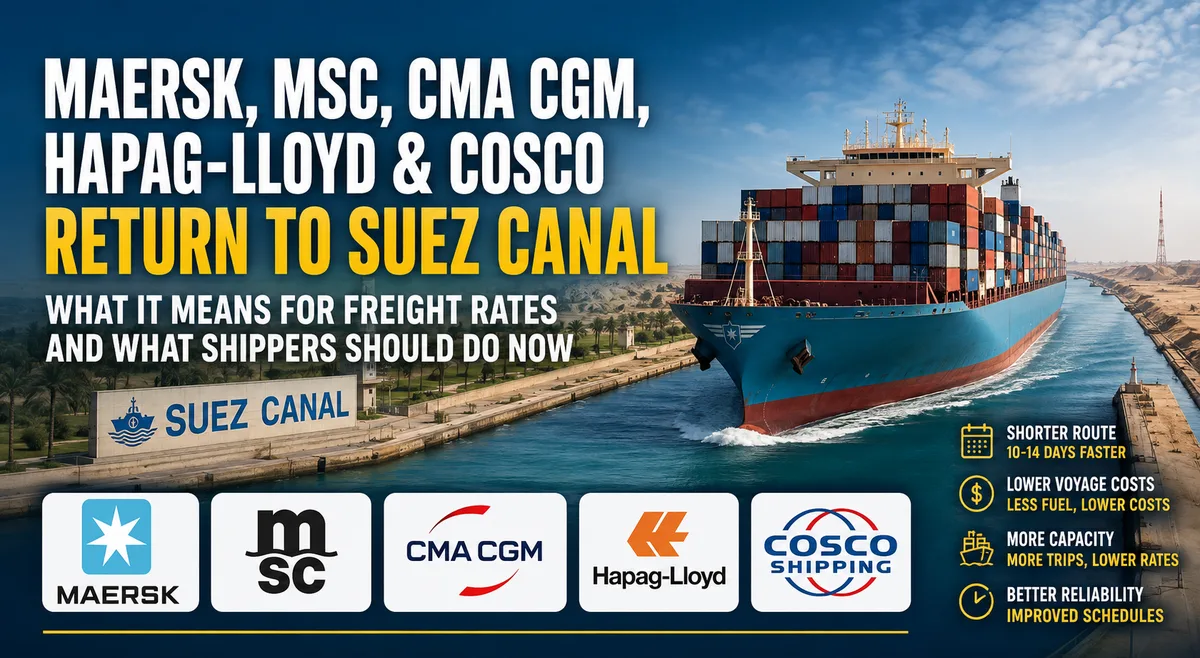
For almost three years, the world's biggest container shipping lines avoided the Red Sea and the Suez Canal completely. After Houthi rebels began attacking commercial ships in October 2023, the major carriers all diverted their vessels around Africa — adding 10-14 extra days to Asia-Europe voyages, burning more fuel, and driving freight rates sharply higher.
But as of August 18, 2026, something significant is changing. One by one — quietly and carefully — the world's largest shipping lines are sending ships back through the Suez Canal.
Here is where each major carrier stands today:
- Maersk: In July, Maersk and Hapag-Lloyd began sending the Gemini AE11 India-Mediterranean service back through the Red Sea and Suez Canal, and also switched the AE19 Asia-Mediterranean service to the route. Their latest resumption involves the AE2 Asia-North Europe service, with the 20,568 TEU Manchester Maersk making a westbound Suez Canal transit yesterday. Four Maersk services have switched back since early July, the most recent in mid-August, while nine others continue to sail around Africa.
- CMA CGM: CMA CGM has been increasing its Suez exposure. Since July 22, the French carrier has returned to Suez with its eastbound FAL3 Asia-North Europe voyages — three already completed with more sailings due. However, westbound voyages are still using the longer Cape route.
- Hapag-Lloyd: Returned to Suez on the Gemini AE11 and AE19 services together with Maersk in July. Still maintaining caution on most other services.
- Cosco: China's Cosco has announced it will return to the Bab-el-Mandeb Strait after a two-year absence, reviving the mothballed RES4 service.
- MSC: As of August 18, 2026, MSC — the world's largest container line — has joined its peers in resuming Suez Canal transits, sending seven ships through the waterway.
This is not a small development. When MSC — which operates the world's largest container fleet — starts sending ships through the Suez Canal again, the entire industry takes notice.
Why Are They Going Back Now? The Math Has Changed
Shipping companies are not sentimental. They do not return to dangerous routes because they miss the shortcut. They return when the economics force them to — when the cost of avoiding the route becomes higher than the cost and risk of using it.
Right now, that calculation is shifting. The question for a liner operator is not simply whether the Red Sea is safe — it is whether the risk of using Suez is lower than the economic cost of avoiding it.
Here are the numbers driving the decision:
- Cape route fuel cost: At current VLSFO prices, sailing around the Cape of Good Hope could mean fuel expenses of $4 million to $5.5 million for a 16,000 TEU ship. That is a massive cost per voyage — multiplied across hundreds of services per year.
- War-risk insurance for Suez: Insurance brokers are pricing the Bab el-Mandeb as a war-risk zone. Marsh put an additional premium for a vessel transiting the strait at about 0.5% of hull value — up from roughly 0.3% before the latest Houthi escalation. For a $100 million vessel, that is $500,000 for war-risk exposure.
- The verdict: For a large containership carrying thousands of boxes, the economics can easily justify the insurance bill if the premium and operational risk can be passed to customers. Cape route costs more than war-risk insurance in many cases.
- Port congestion making it worse: Container shipping consultancy Linerlytica said these moves aimed to overcome shortages of vessels and containers exacerbated by protracted port congestion across North Asia and Europe. The longer Cape route ties up ships for extra weeks — and with congestion already choking ports, getting vessels back faster via Suez helps.
Is the Red Sea Actually Safe Again?
This is the most important question — and the honest answer is: not fully, but the threat level has changed.
The Houthis have not stopped threatening ships entirely. But their attacks have become less frequent and less effective. US and allied naval forces have significantly degraded Houthi missile and drone capabilities since early 2026. The Iran-US ceasefire — fragile as it is — has also reduced the political backing for Houthi operations.
However, a seafarer was killed in the latest attack on merchant shipping in the Strait of Hormuz as recently as August 18 — a reminder that the region remains dangerous. The carriers returning to Suez are not saying the Red Sea is safe. They are saying the risk is now manageable and insurable at a cost that makes economic sense compared to the Cape alternative.
The strategy carriers are using is called "selective optionality" — a carrier does not need to announce the Red Sea as "open". It can send certain services through Suez, monitor the threat, impose appropriate surcharges, and retain the ability to divert vessels at short notice.
That is exactly what Maersk, CMA CGM, Hapag-Lloyd, Cosco, and MSC are all doing right now.
What Does This Mean for Freight Rates?
Here is where it gets very interesting for shippers and importers. The Suez Canal route between Asia and Europe is approximately 10-14 days shorter than the Cape of Good Hope route. When ships use a shorter route, several things happen:
- Voyage costs drop. Less fuel burned per trip means lower operating costs per container — which eventually flows into lower rates.
- More capacity becomes available. When ships travel shorter distances, they complete more round trips per year — effectively adding capacity to the market without building new ships. More capacity puts downward pressure on rates.
- Emergency surcharges come under pressure. Carriers have been collecting Red Sea surcharges on Asia-Europe cargo for nearly three years. As more ships return to Suez safely, the justification for maintaining these surcharges weakens.
- Schedule reliability improves. Shorter, more predictable routes mean more reliable arrival times — better for shippers planning inventory and warehouse operations.
However — and this is important — rates will not fall immediately or dramatically. Bunker prices are rising amid renewed Middle East hostilities, and the war-risk insurance premium is actually going up, not down, as Houthi threats persist. The transition back to Suez will be gradual, not sudden.
What the Carriers Are NOT Doing
It is equally important to understand what is not happening:
- No carrier has declared the Red Sea fully open. Every line is being very careful with its language — calling these "selective" or "stepwise" returns, not full resumptions.
- Most services are still going around Africa. Maersk has four services back through Suez but nine still going the long way. CMA CGM's westbound voyages still use the Cape. This is a partial, cautious shift — not a wholesale return.
- Diversions remain possible at any time. Every carrier has made clear they will redirect ships away from the Red Sea immediately if the security situation deteriorates. This flexibility is built into every current Suez routing decision.
What Should Shippers and Freight Forwarders Do?
- Ask your carrier which route your specific service uses. With some services going via Suez and others still via Cape, the route your cargo takes depends entirely on which specific service it is booked on. Do not assume — ask directly.
- Check transit time estimates carefully. If your cargo moves onto a Suez-routed service, your transit time drops by up to 14 days versus a Cape routing. This changes your delivery window — and your inventory planning.
- Watch for surcharge changes. As more carriers return to Suez, Red Sea surcharges (which have been adding hundreds of dollars per container) may start to be reduced or removed on affected services. Ask your forwarder to track these for your lanes.
- Do not over-plan around a full return yet. The situation remains fluid. A single major Houthi attack on a large container ship could quickly reverse the trend. Maintain flexible routing options rather than committing entirely to Suez-dependent planning.
- Review Asia-Europe contract rates. If you are locked into high contract rates agreed during peak Cape-routing costs, a return to Suez by your carrier may give you grounds to renegotiate. Check your contract terms.
Key Takeaways — August 18, 2026
- Maersk, CMA CGM, Hapag-Lloyd, Cosco, and MSC are all now routing some services through the Suez Canal.
- MSC — the world's largest container line — sent seven ships through Suez as of today, August 18.
- Maersk has four services back through Suez but nine still going around Africa.
- The economics are driving the return: Cape route costs $4M–$5.5M in extra fuel per large vessel per voyage.
- War-risk insurance for Suez is rising (now 0.5% of hull value) — but still cheaper than Cape route costs for large ships.
- This is a selective, cautious return — NOT a full reopening declaration.
- Carriers can and will divert back to Cape at short notice if security deteriorates.
- Freight rates will not fall immediately — but downward pressure is building on Asia-Europe lanes.
- Ask your carrier and forwarder which route your specific service uses — right now.
The world's biggest shipping lines are voting with their hulls. When MSC, Maersk, CMA CGM, Hapag-Lloyd, and Cosco all start sending ships back through the Suez Canal in the same month, the direction of travel is clear. The question for shippers is not whether rates will eventually come down on Asia-Europe lanes — it is how fast, and how to position your freight contracts to benefit when they do.


Comments
No comments yet. Be the first to share your thoughts!