
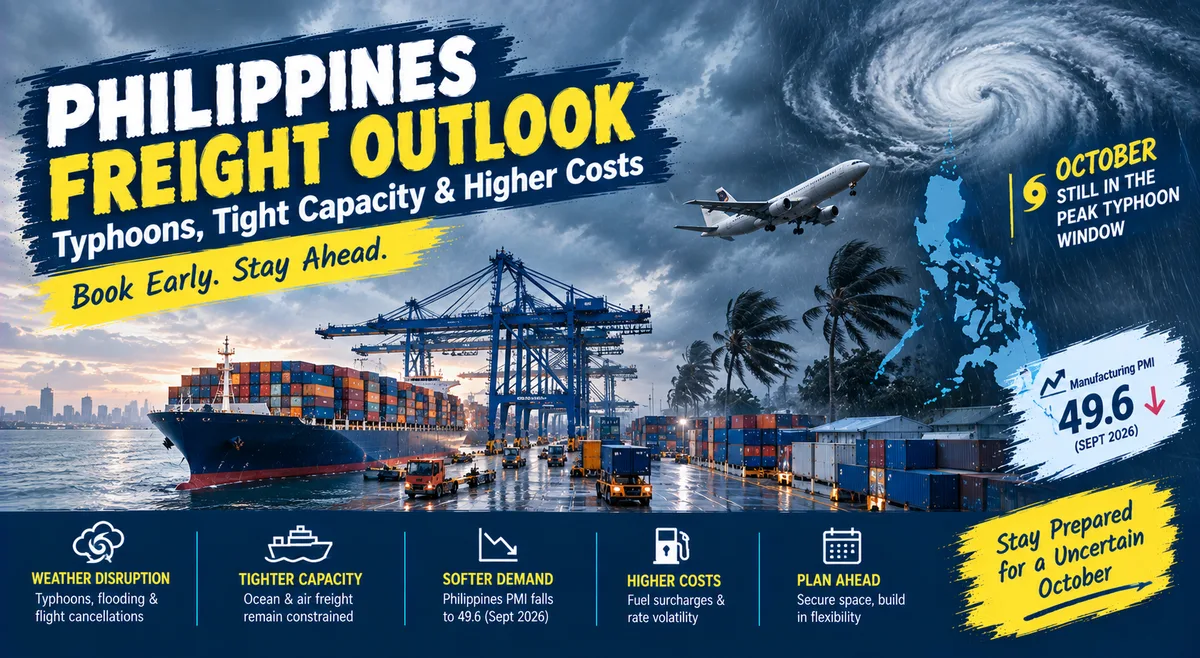
Philippine shippers should book freight early in October, as typhoon-related disruptions, tighter air capacity, and higher fuel surcharges could complicate cargo movements, logistics firm Dimerco Express Group warned in its latest Asia-Pacific freight report. Vessel schedules and freight rates are expected to remain volatile through the month, making early planning more important than usual for anyone moving cargo in or out of the country.
A tough month for weather, and for manufacturing
"October is still in the peak typhoon window, so flight disruption, flooding and vessel bunching at Manila and Luzon are likely," Dimerco said in the report. The company expects Philippine air-freight capacity to remain soft throughout October, though rates are generally expected to stay stable rather than spike sharply, a somewhat unusual combination that reflects just how unpredictable this particular month has become for Philippine logistics.
The warning lands alongside weaker economic data. The Philippines' Manufacturing Purchasing Managers' Index fell to 49.6 in September, down from 54.9 in August, signaling a renewed contraction in operating conditions. A reading below 50 indicates contraction, meaning Philippine manufacturers reported shrinking output and new orders just as the peak typhoon season threatens to disrupt the cargo networks that move their goods. The size of the drop, nearly five full points in a single month, is itself notable, suggesting the slowdown is not a minor blip but a meaningful shift in the country's industrial activity.
Why this double pressure matters
For Philippine shippers, the combination of weakening manufacturing demand and heightened weather risk creates an unusually tricky environment to plan around. In a typical month, softer manufacturing output might be expected to ease pressure on freight capacity, as fewer goods move through the supply chain. But when that softness coincides with the kind of physical disruption typhoons bring, flooded roads, grounded flights, and vessels bunching up outside congested ports, the result isn't necessarily lower freight costs. Instead, shippers can face a stop-start pattern where capacity becomes unpredictable even if headline demand is cooling, making advance booking more valuable than ever.
Global freight pressure building into Q4
Beyond the Philippines, Dimerco pointed to broader forces shaping global freight demand heading into the fourth quarter. Artificial intelligence investment, semiconductor demand, and year-end retail shipments are all expected to support global freight activity, keeping overall capacity tight even as some regional markets soften. This global backdrop matters for Philippine shippers too, since tight capacity elsewhere in Asia-Pacific can make it harder to secure alternative routing or last-minute space if local disruptions hit.
In ocean freight specifically, Dimerco noted that carriers are keeping capacity tight even as the traditional peak season extends further into the fourth quarter than usual. "Everyone expected October to mark the start of the slowdown, but the cargo hasn't stopped and the overflow is still rolling forward," said Ted Chen, Dimerco's director for Ocean Freight Global Sales and Marketing. That extended peak season effectively narrows the margin for error if Philippine-specific disruptions, whether weather or manufacturing-related, compound with an already strained regional network.
Why it matters for the industry
The Philippines' vulnerability to typhoon disruption is a recurring seasonal challenge, with the archipelago of more than 7,000 islands regularly experiencing flight cancellations, flooded roads, and port closures during the June-to-October rainy season. Just weeks earlier, Super Typhoon Ragasa caused severe disruption to freight operations across the Philippines, Taiwan, Hong Kong, and southern China, triggering air service suspensions and evacuations across northern Luzon. That event is a fresh reminder of how quickly a single storm can ripple across multiple countries' supply chains simultaneously, not just within the Philippines itself.
Combined with softening manufacturing conditions, the current environment creates a tricky planning window for Philippine importers and exporters, who must balance the risk of weather-driven delays against a backdrop of already slowing domestic industrial activity. For businesses that rely on just-in-time inventory models, this kind of dual pressure, unpredictable logistics layered on top of softening demand signals, can be harder to manage than either factor would be on its own.
Key takeaways
- Dimerco Express Group is urging Philippine shippers to book October freight early due to likely typhoon disruption.
- Philippine air-freight capacity is expected to stay soft through October, though rates should remain relatively stable.
- The Philippines' Manufacturing PMI fell to 49.6 in September from 54.9 in August, signaling contraction.
- Global ocean freight capacity remains tight even as peak season extends further into Q4 than expected.
- AI investment, semiconductor demand, and year-end retail shipments are supporting broader global freight activity.
- Super Typhoon Ragasa's recent disruption across the Philippines, Taiwan, Hong Kong, and southern China underscores the scale of risk still in play this month.
For freight forwarders and shippers moving cargo in and out of the Philippines, booking early and building in flexibility around typhoon-prone windows will be essential to avoiding costly delays this month, particularly given how tightly global ocean capacity is already running heading into the fourth quarter.


Comments
No comments yet. Be the first to share your thoughts!