
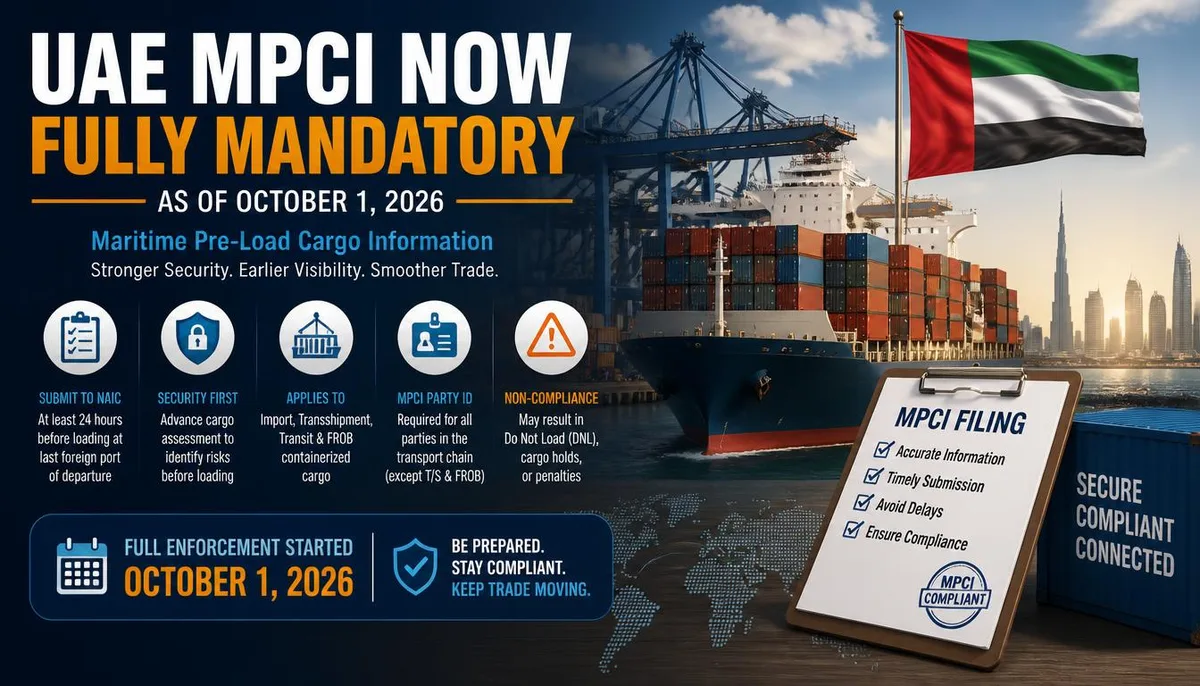
The UAE's Maritime Pre-Load Cargo Information (MPCI) program has moved into full mandatory enforcement as of October 1, 2026, marking the end of an extended transition period that began when the program first launched in July 2025. The requirement applies to shipping companies, freight forwarders, and NVOCCs moving containerized cargo into, through, or via the UAE, and represents one of the most significant changes to UAE cargo security procedures in recent years.
What the program requires
MPCI requires electronic submission of detailed Bill of Lading information to the UAE's National Advance Information Centre (NAIC) at least 24 hours before cargo is loaded at the last foreign port of departure. The program applies to all containerized maritime cargo in four categories: imports into the UAE, transshipment through the UAE, transit via the UAE, and freight remaining on board (FROB) at UAE ports. It is a security-focused filing, separate and independent from existing UAE Customs processes, meaning compliance with MPCI does not replace or reduce any existing customs documentation requirements.
Every entity filing cargo data, including shipping lines, NVOCCs, and freight forwarders, must now include a valid MPCI Party ID and the identifiers of all parties involved in the transport chain. For direct bills of lading, the liner submits using its own MPCI number, with no house bill of lading involved. For consolidated or master bills of lading, the liner must include both its own MPCI number and the consignee's freight forwarder's MPCI number, while freight forwarders issuing house bills must include identifiers for the master co-loader or shipping line. Companies without an existing code must complete a one-time registration through the NAIC portal before they can file, and transshipment or FROB bills of lading do not require an MPCI ID at all.
What happens if filings are missing or wrong
Once NAIC reviews a submission, it issues one of three decisions: acceptance (ACT), request for information (RFI), or do not load (DNL). Carriers including Hapag-Lloyd have reminded customers that missing, incomplete, or inaccurate shipment information could now result in DNL instructions, cargo holds, loading restrictions, or regulatory penalties. Freight forwarders and NVOCCs issuing house bills of lading must complete their filings at least 24 hours before loading at the last foreign port before the UAE, with liability for accuracy resting on the UAE-based legal entity responsible for the filing. Importantly, an overseas forwarder can delegate the actual filing task to a UAE-based partner, but legal responsibility for the accuracy of the submitted data remains with that UAE entity regardless of who physically files it.
Background on the rollout
MPCI operates under UAE Federal Law #52 of 2022 and is managed by the National Advance Information Centre under the Federal Authority for Identity, Citizenship, Customs, and Ports Security. The program was first introduced with a go-live date of July 31, 2025, but authorities granted the shipping industry an extended grace period, originally set to run through March 31, 2026, and later pushed further, to allow carriers, forwarders, and NVOCCs time to adapt their systems and processes. That transition period has now concluded, with full enforcement beginning October 1, 2026, following what industry sources describe as a series of phased system enhancements, including planned integration with platforms like INTTRA to make MPCI ID capture easier during shipping instruction submission.
Previously, vessels calling at UAE ports only had to submit cargo data for goods being offloaded in the country, and only 48 hours before arrival. MPCI represents a shift toward advance cargo security assessment, allowing authorities to identify and address potential risks before cargo is even loaded, rather than after it reaches the UAE. The approach mirrors similar pre-departure cargo security frameworks already in place elsewhere, including the US Importer Security Filing (ISF) and the EU's Import Control System 2 (ICS2), placing the UAE alongside a growing list of jurisdictions tightening pre-arrival cargo screening as part of broader global trade security trends.
Why it matters for the industry
With full enforcement now active, freight forwarders, NVOCCs, and shipping lines handling any cargo destined for, transiting through, or transshipping via the UAE must ensure MPCI filings are accurate and submitted on time, or risk shipment delays and penalties. Late or incomplete information may result in cargo not being authorized for loading, creating potential rollovers and schedule disruptions that could ripple through tightly scheduled supply chains, particularly for companies managing time-sensitive or high-volume UAE trade lanes.
Several accredited service providers, including Trade Tech and CargoX, have been authorized to support companies with filing and compliance as the industry adjusts to the new standard, offering training, technical support, and automation tools designed to help shippers and forwarders meet the filing requirements without disrupting existing booking workflows.
Key takeaways
- UAE's MPCI program became fully mandatory on October 1, 2026, ending its extended transition period.
- Filings must be submitted to NAIC at least 24 hours before loading at the last foreign port of departure.
- Non-compliant shipments can face Do Not Load (DNL) instructions, cargo holds, or regulatory penalties.
- The program applies to all containerized cargo for import, transshipment, transit, and FROB.
- Liability for filing accuracy rests with the UAE-based legal entity, even when filing is delegated to an overseas partner.
- MPCI aligns the UAE with similar global pre-arrival cargo security systems like the US ISF and EU ICS2.
For freight forwarders and shippers moving cargo through the UAE, now is the time to confirm MPCI Party ID registration and filing processes are fully in place, as even minor documentation gaps could result in costly loading delays under the newly enforced rules.




Comments
No comments yet. Be the first to share your thoughts!