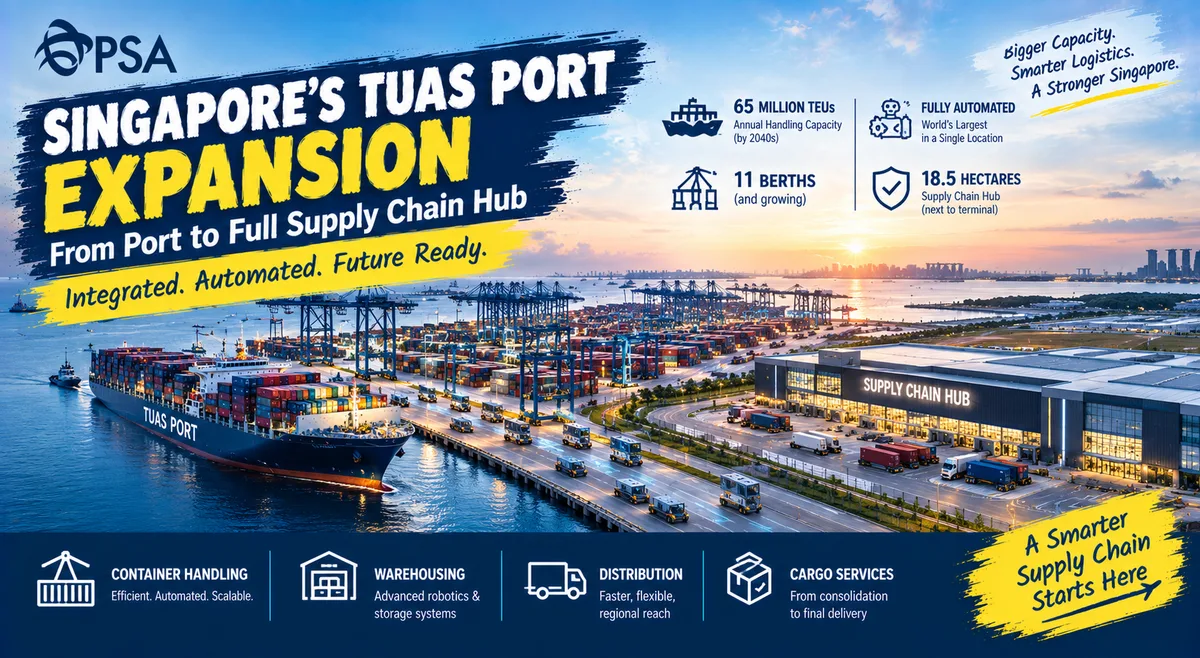
Singapore's Tuas port expansion is moving beyond conventional container handling, with port operator PSA developing a technology-driven supply chain hub designed to connect port operations, warehousing, distribution, and cargo services within a single ecosystem.
What's being built
Rather than treating the port simply as a location where containers are transferred between ships and land transport, the development reflects a broader shift toward integrated logistics. The planned hub will provide regional distribution and container-freight-station capabilities alongside additional value-added cargo services, allowing companies to manage more stages of their supply chains within Singapore rather than relying on multiple separate facilities and providers.
The scale of Tuas Port
This latest development builds on what is already one of the most ambitious port projects in the world. Tuas Port opened its first three berths in September 2022 and has since grown to 11 berths in operation, with PSA reporting it crossed the 10 million TEU handling milestone by early 2025. Once fully completed in the 2040s, Tuas is set to become the world's largest fully automated container terminal in a single location, with an annual handling capacity of 65 million TEUs, roughly double Singapore's current overall handling capacity, and the ability to service vessels longer than 400 meters.
The port already relies heavily on automation, with a fleet of more than 200 Automated Guided Vehicles moving containers around the clock, and PSA has said it plans to more than double that fleet as later development phases come online. Alongside the terminal itself, PSA has also been building out a dedicated Supply Chain Hub covering more than 18.5 hectares next to the container terminal, equipped with advanced robotics and an automated storage and retrieval system standing 40 metres high, forming part of the same broader push to integrate warehousing and distribution directly into port operations.
Why this approach
One of the key objectives behind the development is to respond to changing cargo requirements. Singapore handles substantial volumes of transshipment cargo, but businesses do not always require an entire container for every shipment. Some cargo needs to be consolidated before export, while other shipments need to be separated and distributed to different destinations after arriving in Singapore. By building these capabilities directly into the port ecosystem, PSA aims to reduce the friction and time businesses currently spend coordinating between separate port, warehousing, and distribution providers.
PSA International Group CEO Ong Kim Pong has previously described this strategy as a "Node to Network" approach, positioning Tuas as the flagship super-hub anchoring PSA's global network, with the goal of providing long-term capacity assurance and stronger connectivity for customers relying on Singapore as a trade gateway.
Why it matters for the industry
This move reflects a wider pattern playing out across major global ports, where operators are increasingly positioning themselves as full-service supply chain partners rather than pure transshipment points. As trade routes shift and companies look to reduce complexity in their logistics networks, ports that can offer bundled services, from container handling to warehousing to final distribution, are positioned to capture a larger share of the value chain and build stickier relationships with shippers and freight forwarders.
For Singapore specifically, strengthening Tuas as an integrated hub reinforces its position as one of the world's most important transshipment centers at a time when regional competition for cargo volumes, particularly from other Southeast Asian ports, continues to intensify. PSA has also pursued partnerships to support this positioning, including a joint venture with Evergreen Marine Corporation aimed at offering long-term terminal capacity assurance to Evergreen's expanding global fleet.
Key takeaways
- PSA is developing an integrated logistics hub at Singapore's Tuas mega-port, combining container handling with warehousing and distribution.
- The hub will offer container-freight-station capabilities to support cargo consolidation and distribution needs.
- Tuas Port is on track to become the world's largest fully automated container terminal, with 65 million TEU annual capacity once complete in the 2040s.
- The development responds to demand for more flexible, less-than-container-load shipping solutions.
- The move reflects a broader global trend of ports evolving into full-service supply chain ecosystems.
For freight forwarders and shippers routing cargo through Singapore, this development could mean more streamlined options for consolidation and distribution without needing to coordinate across multiple separate providers, reinforcing Singapore's role as a long-term anchor point in Asia-Pacific supply chains.
Comments
No comments yet. Be the first to share your thoughts!