
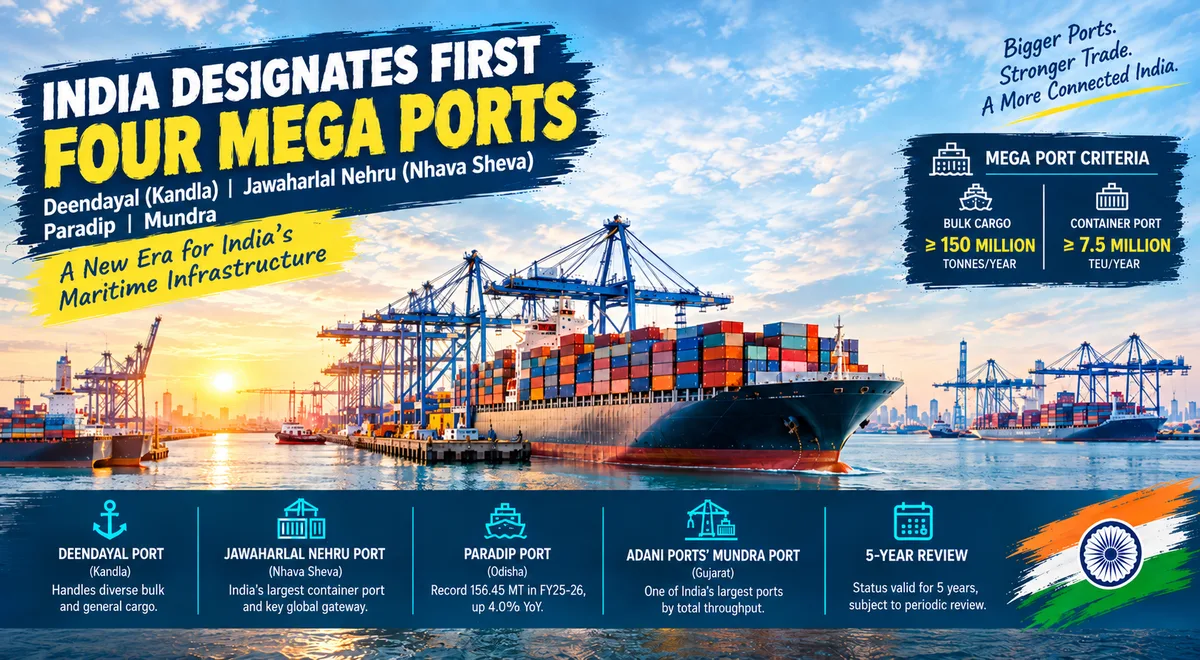
India's Ministry of Ports, Shipping and Waterways has created an entirely new tier in the country's port hierarchy — and named its first four members. Through a gazette notification dated September 25, 2026, the government classified Deendayal Port (Kandla), Jawaharlal Nehru Port (Nhava Sheva), Paradip Port, and Adani Ports' Mundra Port as India's first "mega ports" under Section 73 of the Indian Ports Act, 2025. The notification took effect immediately upon publication.
What "Mega Port" Actually Means
The mega port classification is new, performance-based, and deliberately indifferent to ownership structure. Three of the four designated facilities — Deendayal, Jawaharlal Nehru, and Paradip — are existing government-run "major ports." The fourth, Mundra, is privately operated by Adani Ports and Special Economic Zone and had previously been classified as a "port other than a major port." Under the new framework, that underlying legal classification does not change: mega port status sits on top of it as an additional, performance-driven designation rather than replacing it.
To qualify, a bulk-cargo port must handle at least 150 million tonnes of cargo annually, while a container port must handle at least 7.5 million TEUs a year. Ports that handle both bulk and containerized cargo can convert their container volumes into tonnage-equivalent figures using the methodology already in use at that specific port. The criteria themselves were established in a separate gazette notification on July 30, 2026, meaning the September 25 announcement is the first practical application of a framework the government had signaled roughly two months earlier.
Once granted, mega port status remains valid for five years, after which it is subject to periodic review — meaning ports that fail to sustain the qualifying throughput could, in principle, lose the designation at the next assessment cycle.
Why These Four Ports
Each of the four selected ports represents a different pillar of India's maritime trade. Jawaharlal Nehru Port, commonly known as JNPA and located at Nhava Sheva near Mumbai, is India's largest container port and one of its most important gateways for containerized trade with the rest of the world. Deendayal Port at Kandla in Gujarat is one of India's busiest ports by overall cargo tonnage, handling a wide mix of bulk and general cargo. Mundra, also in Gujarat and operated by Adani Ports, has grown into one of the country's largest ports by total throughput under private management.
Paradip's inclusion is the most geographically notable of the four: it is the only mega port located on India's eastern coast, a distinction that matters given how heavily India's largest ports — and its export-import trade generally — remain concentrated on the west coast facing the Arabian Sea. Paradip, located in Odisha, handled 156.45 million tonnes of cargo in fiscal year 2025-26, its highest annual throughput on record and a 4.02% increase over the prior year, driven primarily by coal, iron ore, fertilizers, and crude oil moving through the port to serve eastern and central India.
The Policy Logic Behind the Classification
The stated purpose of the mega port tier is to concentrate infrastructure investment and regulatory attention on the handful of facilities that already carry a disproportionate share of India's maritime trade, rather than spreading limited government resources evenly across the country's much larger population of major and minor ports. By tying the designation strictly to cargo-throughput performance rather than ownership or legacy status, the framework also creates an explicit incentive structure: private operators like Adani, alongside the government-run major ports, are competing for the same recognition and the policy support that is expected to follow it.
That performance-based design is a deliberate departure from how Indian port policy has traditionally worked, where "major port" status has historically been a fixed, largely permanent classification tied to when a port was established and who governs it, rather than a rolling assessment of current operational scale. The five-year review cycle embedded in the mega port framework introduces an ongoing accountability mechanism that India's traditional major-port system has not had.
What This Means for Shippers and Logistics Operators
- Expect infrastructure investment to concentrate at these four gateways first. With the government explicitly framing mega port status as a mechanism to focus investment and policy support, shippers and forwarders routing cargo through JNPA, Mundra, Deendayal, or Paradip should anticipate faster capacity expansion, dredging, and connectivity projects at these facilities relative to India's other major ports over the coming years.
- Mundra's private-sector inclusion signals continued growth for Adani-operated infrastructure. Mundra qualifying for the top tier alongside three government ports validates the scale Adani Ports has built at the facility and suggests the port will remain a priority routing option for both bulk and containerized cargo moving through Gujarat.
- Paradip's designation strengthens the case for east-coast routing. As the only mega port on India's eastern seaboard, Paradip's new status — combined with its record 156.45-million-tonne year — makes it a stronger long-term option for bulk commodity flows serving eastern and central India, an area historically underserved relative to west-coast capacity.
- The five-year review creates a genuine performance incentive worth tracking. Because mega port status is not permanent, port authorities and terminal operators at these four facilities have a direct incentive to sustain or grow throughput over the coming years. Shippers with long-term India routing strategies should monitor whether any of the four maintain their qualifying volumes at the next review, since the classification itself functions as a proxy indicator of sustained port performance.
- This adds a new data point to India's broader logistics infrastructure buildout. The mega port designation follows India's continued investment in its Dedicated Freight Corridors and other rail and port infrastructure this year — collectively signaling that India's largest gateways are positioned for continued capacity growth as global shippers increasingly diversify sourcing and routing beyond China.
Key Takeaways — September 27, 2026
- India's Ministry of Ports, Shipping and Waterways designated Deendayal (Kandla), Jawaharlal Nehru (Nhava Sheva), Paradip, and Mundra as the country's first "mega ports" via a gazette notification dated September 25, 2026, under Section 73 of the Indian Ports Act, 2025.
- Qualifying criteria, set in a July 30, 2026 notification, require 150 million tonnes of annual bulk cargo or 7.5 million TEU of annual container throughput.
- Mundra, operated by Adani Ports and Special Economic Zone, is the only private-sector facility among the four and the only one previously classified as a "port other than a major port."
- Mega port status does not alter a port's underlying legal classification and remains valid for five years, subject to periodic review.
- Paradip is the only mega port on India's east coast, having handled a record 156.45 million tonnes of cargo in fiscal year 2025-26, up 4.02% year-on-year.
- The classification is designed to concentrate infrastructure investment and policy support on India's highest-performing maritime gateways, marking a shift toward performance-based rather than ownership-based port policy.



Comments
No comments yet. Be the first to share your thoughts!