
What Is Happening With Trans-Pacific Rates Right Now?
Container shipping rates from Asia to the United States are holding stubbornly close to their peak-season highs — even as the traditional peak season should be starting to wind down.
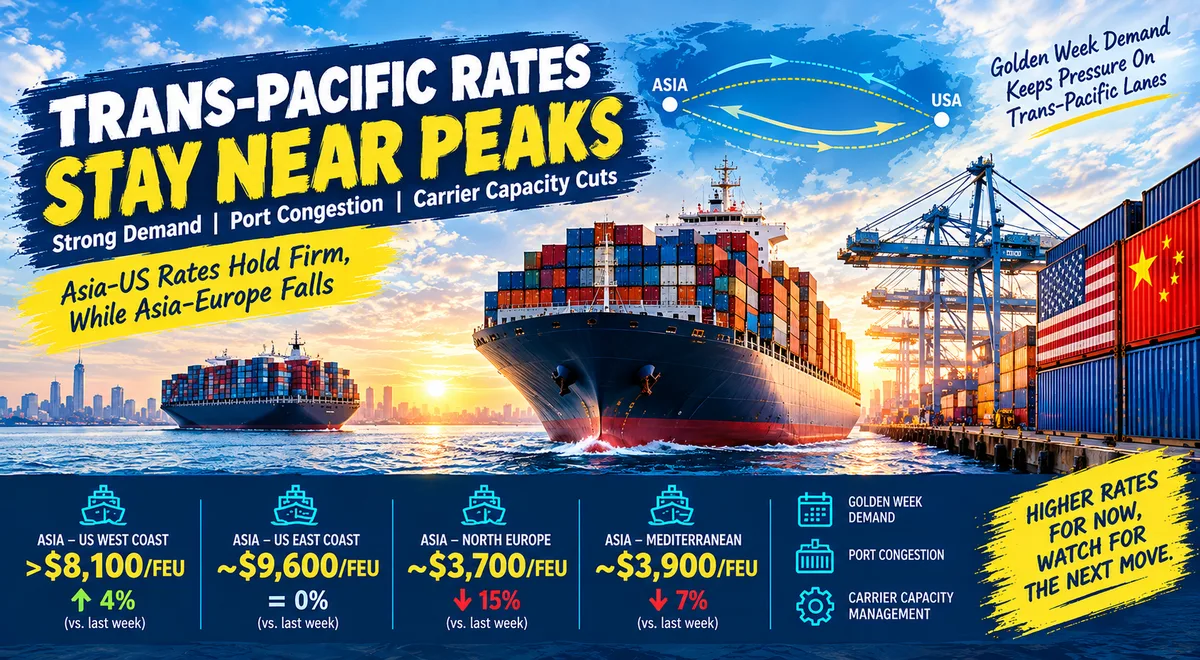
Resilient U.S.-bound demand, Far East port congestion and blanked sailings are keeping trans-Pacific spot rates near their early July highs, even as Asia-Europe pricing continues to slide from peak-season levels.
Here are the latest numbers, as of the week ending September 24, 2026:
- Asia–US West Coast: increased 4% last week to more than $8,100 per 40-foot container (FEU)
- Asia–US East Coast: essentially unchanged at about $9,600 per FEU
Both figures remain near their peak-season highs — a signal that the usual seasonal cooldown has not yet arrived on the transpacific trade lane.
Why Are Rates Staying So High?
Three separate forces are working together to keep prices elevated on the Asia-US routes:
1. Shippers Are Racing China's Golden Week Holiday
The divergence follows an unusually early east-west peak season that began in May and lifted container spot rates sharply through early July, according to analyst and SONAR data contributor Freightos. On the trans-Pacific, shippers appear to be sustaining demand ahead of China's Golden Week holiday, while the absence of a late-July tariff increase may have removed an incentive for an abrupt pullback in US-bound imports.
In simple terms: Chinese factories and ports slow down significantly during Golden Week (China's national holiday period in early October). Shippers know this, so they are pushing to get cargo out before the shutdown — keeping demand, and prices, elevated right up to the holiday.
2. Far East Port Congestion
The elevated levels reflect a combination of strong cargo demand, weather-related port congestion in the Far East and carrier capacity management through blanked sailings. Some canceled sailings are likely the result of vessel delays and network disruptions caused by congestion, the analyst said.
3. Carriers Are Deliberately Managing Capacity
Carriers are also reducing capacity in anticipation of softer volumes during the Golden Week period and a broader easing in demand once the peak season ends later in October. This is a classic carrier pricing strategy: by cancelling some sailings (known as "blanking"), carriers reduce available space — which keeps prices from falling even as the market approaches its seasonal peak.
Cancellation data still points to relatively firm demand compared with prior years, suggesting carriers have less need to withdraw capacity than they typically would as the traditional peak-season window closes. In other words, even the carriers themselves are seeing stronger-than-usual demand for this time of year.
Is This a Repeat of the Pandemic Rate Spike?
Current trans-Pacific pricing has prompted comparisons with the pandemic-era market, but the latest levels remain well below the extremes reached during the Covid-19 import surge.
Freightos Baltic Index data show that Asia-West Coast prices exceeded $20,000 per FEU in September 2021, when extraordinary US import demand collided with severe port congestion. During that period, carriers often did not move spot cargo booked at base rates unless shippers paid premium surcharges, pushing benchmark levels to historic highs.
Today's rates — at roughly $8,100 to $9,600 per FEU — are elevated and painful for shippers, but they are nowhere near that 2021 extreme. Freightos said that the current market is more comparable to the 2024 peak season, when Red Sea diversions constrained effective vessel capacity.
The bottom line: today's trans-Pacific rates are placing considerable pressure on shippers, but they are still far from the unprecedented levels of 2021.
What Is Happening on Asia-Europe Routes, By Comparison?
While Asia-US rates hold firm, the picture looks very different on Asia-Europe lanes — and the contrast is instructive.
- Asia–North Europe: fell 15% last week to about $3,700 per FEU — down from a July high near $6,000 per FEU, though still roughly $1,000 per FEU above pre-peak-season levels from late May
- Asia–Mediterranean: fell 7% to approximately $3,900 per FEU, after exceeding $7,000 per FEU in July — now back to roughly its May level
The sharper retreat in Mediterranean prices likely reflects a greater increase in effective capacity on that lane as more vessels resume Red Sea transits, Freightos said. North Europe trades, by contrast, continue to face constraints from congestion at regional hubs and inland disruptions, including low water on the Rhine River.
A Complete Rate Snapshot — Week Ending September 24, 2026
| Trade Lane | Latest Rate | Weekly Change | vs Recent Peak |
|---|---|---|---|
| Far East–US West Coast | More than $8,100/FEU | Up 4% | Near peak-season highs |
| Far East–US East Coast | About $9,600/FEU | Roughly flat | Near peak-season highs |
| Asia–North Europe | About $3,700/FEU | Down 15% | Down from nearly $6,000/FEU in July |
| Asia–Mediterranean | About $3,900/FEU | Down 7% | Down from more than $7,000/FEU in July |
A Possible German Port Strike Could Add New Pressure
One more factor is worth watching closely on the Europe side of the market. A possible indefinite strike at German ports could add to the pressure. The Verdi labor union is voting on a job action that could begin as early as October, potentially worsening terminal congestion and constraining carrier capacity on Asia-North Europe services.
If this strike materializes, it could reverse some of the recent softening in Asia-Europe rates — adding yet another layer of complexity for shippers trying to plan Q4 bookings.
What Does This Mean for Your Shipments?
- Do not expect a quick post-peak rate drop on Asia-US lanes. With demand holding firm ahead of Golden Week and carriers actively managing capacity, a sharp rate correction is not guaranteed in the immediate term — even though October is traditionally when peak-season rates begin to ease.
- Watch for the post-Golden Week effect. Once China's holiday period passes in early October, watch closely for whether bookings genuinely soften or whether firm demand continues — this will be the clearest signal of where rates head next.
- Asia-Europe shippers have more room to negotiate right now. With European lane rates falling 7-15% in just one week, this may be a better window to lock in Asia-Europe bookings — but keep an eye on the potential German port strike, which could reverse this trend quickly.
- Blanked sailings mean less predictable capacity. If your cargo moves on Asia-US routes, confirm your specific sailing has not been cancelled or consolidated — carrier capacity management through blanked sailings can affect individual bookings even when headline rates stay flat.
- Keep perspective on the numbers. While $9,600 per FEU feels high, it remains far below the $20,000+ seen during the 2021 pandemic peak. This is an elevated, difficult market — not a repeat of the historic 2021 crisis.
Key Takeaways — September 25, 2026
- Asia-US East Coast container rates: about $9,600/FEU, roughly flat week-over-week. (FreightWaves, September 24, 2026)
- Asia-US West Coast rates: up 4% to more than $8,100/FEU.
- Both remain near peak-season highs, driven by strong demand ahead of China's Golden Week, Far East port congestion, and deliberate carrier capacity management.
- Rates remain well below the 2021 pandemic peak of over $20,000/FEU — more comparable to 2024's Red-Sea-driven peak season.
- Asia-North Europe rates fell 15% to about $3,700/FEU; Asia-Mediterranean fell 7% to about $3,900/FEU.
- A possible indefinite German port strike (Verdi union vote, potentially starting October) could reverse the recent Europe-lane softening.
- Watch for the post-Golden Week period in early October as the key signal for whether Asia-US rates finally begin to ease.
The transpacific trade lane is defying the usual late-September seasonal pattern, staying firm as shippers race China's Golden Week holiday and carriers keep capacity tight. For importers and freight forwarders, this means budgeting for continued elevated rates through early October — with the real test coming once the holiday period passes and everyone finds out whether demand genuinely cools, or keeps holding firm.




Comments
No comments yet. Be the first to share your thoughts!