
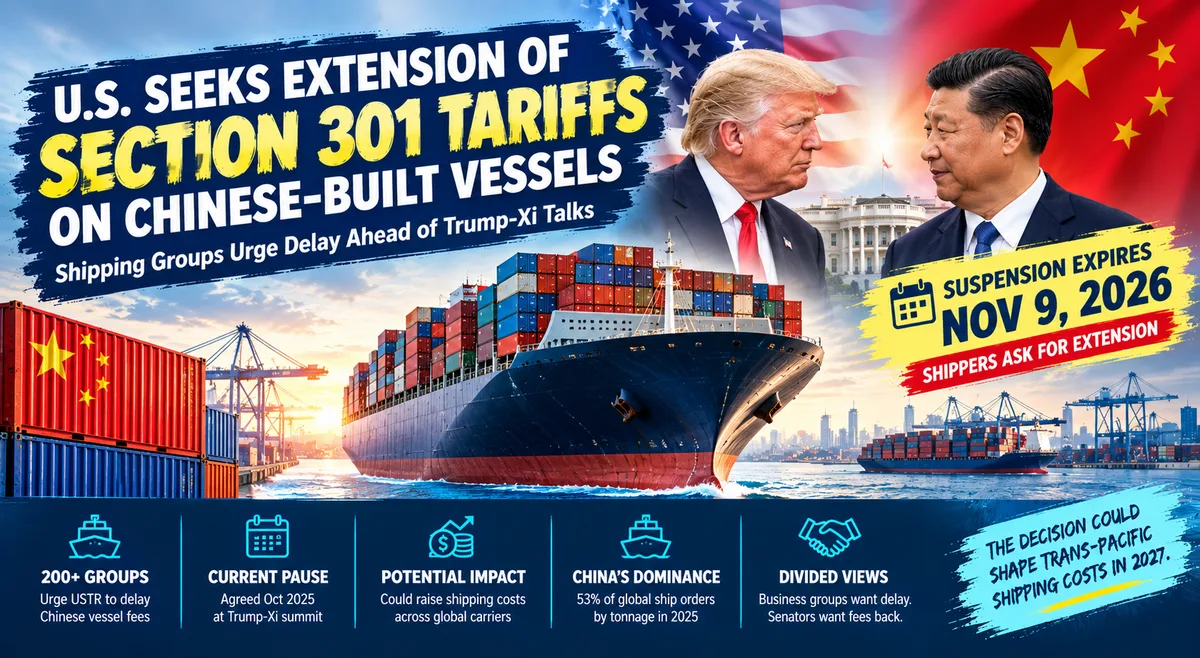
A broad coalition of American business and maritime shipping organizations has called on the US Trade Representative to extend the suspension of Section 301 tariffs and fees on Chinese-built vessels, timed to land just as President Donald Trump and Chinese President Xi Jinping meet at the White House this week for trade talks that could shape the future of the trans-Pacific shipping relationship.
What's happening
In a joint letter sent September 23 to USTR Jamieson Greer, more than 200 importers, exporters, and transportation groups, including the International Chamber of Shipping, the World Shipping Council, and the Chamber of Shipping of America, urged the administration to delay the fees before the current one-year suspension expires on November 9. The coalition warned that because China-built vessels represent a meaningful share of global ocean carrier capacity, reinstating the fees would not be limited to a narrow set of market participants but would ripple across the wider shipping industry, touching nearly every carrier operating trans-Pacific routes in some form.
The letter comes as US supply chains continue to face pressure from broader trade lane uncertainty. The coalition emphasized that many businesses are still working through higher costs for ocean freight, trucking, warehousing, insurance, and inventory management, costs they say compound quickly and are ultimately borne by American businesses, workers, farmers, and consumers. The timing of the letter, arriving just as Trump and Xi sit down for talks, signals how closely the shipping industry is watching this particular summit for signals on where trade policy is headed next.
Background on the fee dispute
The Section 301 fees originated from a petition filed in March 2024 by the United Steelworkers and labor coalition partners, accusing China of using non-market industrial policies and heavy state subsidies to dominate global shipbuilding. Following an investigation, the fees were scheduled to take effect in October 2025, targeting Chinese-owned, Chinese-operated, and Chinese-built vessels calling at US ports, with penalties reportedly reaching as high as $1.5 million per port call for some Chinese-built ships, and additional charges of up to $1,000 per net ton of vessel capacity in certain cases.
China responded with its own retaliatory port fees on American-linked vessels, escalating tensions ahead of a Trump-Xi meeting in South Korea last October on the sidelines of the Asia-Pacific Economic Cooperation forum. At that summit, the two leaders agreed to a 12-month mutual pause on the fees, providing what was estimated as a $3.2 billion annual reprieve for large Chinese-built vessels sailing to US ports. The suspension took effect November 10, 2025, and covers penalties on Chinese-owned vessels, operators of Chinese-built ships, foreign-built vehicle carriers, and proposed tariffs on Chinese-made ship-to-shore cranes and cargo handling equipment. China reciprocated by suspending its own countermeasures against US-linked vessels for the same period.
The impact the first time around
Even though the fees never actually took effect, their looming threat had a real impact on the global shipbuilding market. US Treasury Secretary Scott Bessent noted at the time that just the possibility of the Section 301 tariffs was enough to reduce demand for China-built ships, with Chinese shipbuilders reporting substantial declines in their order books. Ship operators including China-owned COSCO and US-based Matson had reportedly already incurred costs and schedule disruptions tied to the initial fee announcement before the pause took effect, according to maritime industry reports from the time.
Divided opinions ahead of the deadline
Not everyone wants the suspension extended. Democratic Senators Mark Kelly of Arizona and Elizabeth Warren of Massachusetts have separately pressed the administration to reinstate the fees, arguing they are critical to rebuilding US shipbuilding capacity and reducing reliance on China's maritime sector. In a letter to USTR Greer, the senators wrote that Section 301 port fees are critical to revitalizing US shipbuilding, and that presidents of both parties have long recognized the serious threat that Chinese shipbuilding dominance poses to the United States.
The senators cited data showing orders at Chinese shipyards fell 23.5% during the first nine months of 2025 following the original fee announcement, arguing the mere threat of penalties was already reshaping the market in America's favor. Their push reflects a broader trend among lawmakers from both parties who increasingly frame shipbuilding capacity as a national security issue, particularly amid ongoing global supply chain disruptions and continuing regional conflicts affecting shipping routes elsewhere in the world.
Despite that dip in orders, China continues to dominate global ship construction overall, capturing 53% of all global ship orders by tonnage during the first eight months of 2025, according to Center for Strategic and International Studies analysis of S&P Global data, and 70% of upcoming ship orders more broadly according to separate industry tracking. That continued dominance is central to why shipbuilding advocates want the fees reinstated, while shipping and trade groups argue the fees ultimately raise costs across the entire ocean freight market rather than meaningfully shifting shipbuilding capacity back to the United States in any short timeframe.
Why it matters for the industry
With the suspension deadline just weeks away and the Trump-Xi summit now underway, the outcome of these talks could significantly affect trans-Pacific trade lane costs and vessel deployment planning heading into 2027. If the fees are reinstated, ocean carriers operating Chinese-built vessels, which make up a substantial share of global capacity, would face new cost pressures likely to be passed on to shippers in the form of higher freight rates and surcharges. Given that China builds a majority of the world's new vessels, a return of the fees would affect far more than just Chinese-flagged carriers, touching nearly every major shipping line with Chinese-built ships in its fleet.
For US importers and exporters already navigating elevated freight costs tied to other global disruptions, from the Strait of Hormuz to Panama Canal restrictions, the prospect of an additional cost layer on trans-Pacific shipping adds another variable to an already complicated planning environment heading into next year.
Key takeaways
- Over 200 business and maritime groups sent a joint letter on September 23 urging the USTR to delay Chinese vessel port fees.
- The current Section 301 fee suspension, agreed at the October 2025 Trump-Xi summit in South Korea, expires November 9, 2026.
- Reinstating the fees could affect a meaningful share of global ocean carrier capacity, given China's dominance in shipbuilding.
- Senators Kelly and Warren have pushed in the opposite direction, calling for the fees to be reinstated to support US shipbuilding.
- China continues to capture over half of global ship orders by tonnage despite the earlier dip tied to the fee threat.
- The decision comes as Trump and Xi meet for trade talks, with the outcome likely to shape trans-Pacific shipping costs into 2027.
For freight forwarders and shippers relying on trans-Pacific capacity, the coming weeks are worth watching closely, as the fate of these fees could directly affect ocean freight costs and vessel availability heading into next year, layering on top of an already volatile global shipping environment.


Comments
No comments yet. Be the first to share your thoughts!