
What Just Happened?
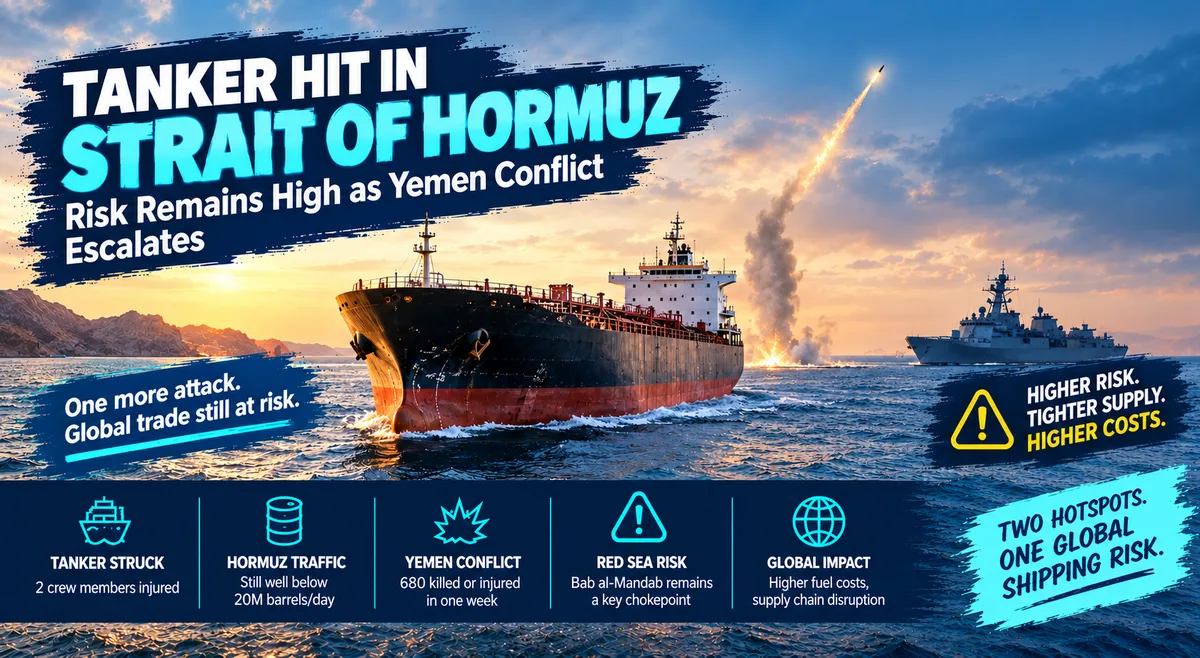
The British military said an "unknown projectile" struck a tanker as it entered the Strait of Hormuz on Monday, September 21, 2026, injuring two crew members. The vessel continued toward port under its own power, according to reporting confirmed by multiple outlets.
The incident is the latest in a long line of attacks on commercial and Iranian-linked shipping in and around the strait since the war between the US, Israel, and Iran began on February 28, 2026 — a conflict now in its seventh month.
Where Things Stand in the Strait Right Now
Tehran has asserted control over much of the Strait of Hormuz since the US and Israel launched the war on February 28. In peacetime, about 20 million barrels — roughly a fifth of the world's oil supply — passed through Hormuz each day. Some tankers are again traversing the strait, but traffic remains well below what it once was.
This partial, cautious return of tankers is consistent with what we reported on September 7: US and Iranian forces have been engaged in a sustained tit-for-tat campaign of tanker strikes, naval blockades, and warnings against "unauthorised" transit routes through the strait. Monday's incident shows that pattern of sporadic attacks on vessels attempting the crossing has continued, even as some shipping activity has cautiously resumed.
Why This Keeps Happening
The core dynamic remains unchanged from our earlier coverage: Iran continues to warn commercial vessels against using routes through the strait that it has not specifically authorised, while the US maintains a naval blockade aimed at cutting off Iranian oil exports and degrading Iran's ability to threaten shipping.
Both sides have periodically escalated and de-escalated over recent months — including a memorandum of understanding signed in June aimed at ending the broader war — but attacks on tankers entering or transiting Hormuz have continued at irregular intervals since, making the strait one of the most unpredictable shipping corridors in the world right now.
The Wider Regional Picture — Yemen Fighting Intensifies
Monday's tanker incident came alongside a sharp escalation in a related conflict. The World Health Organization said 680 people were killed or injured across Yemen over the course of a week, as fighting between Iran-backed Houthi rebels and Saudi-backed government forces continues. The WHO reported that 164 people were killed and 516 injured between September 13 and September 18 alone.
This brings the total number of casualties in Yemen since August 6 to 3,672, including 674 deaths and 2,998 injuries. Lahj province in southwestern Yemen is currently an active front line, where 58 deaths and 226 injuries were reported within a six-day period, according to the UN.
This matters for shipping because the Houthi-controlled areas of Yemen sit directly along the Bab al-Mandab Strait — the chokepoint connecting the Red Sea to the Gulf of Aden that carriers have been cautiously returning to (as we covered in our September 18 report on Gemini Cooperation services resuming Suez transits). Intensifying ground fighting in Yemen raises the risk of renewed disruption to that route as well, even as some carriers had been growing more confident about it.
What Does This Mean for Shipping and Logistics?
- Hormuz remains an active-risk zone, not a reopened waterway. The fact that some tankers are transiting again does not mean the strait is safe. Monday's attack is a reminder that any vessel entering Hormuz right now faces a real, ongoing risk of being struck.
- Traffic volumes remain well below normal. With roughly 20 million barrels a day normally passing through Hormuz, and current traffic still well below that level, global oil supply from this route remains constrained — a factor that continues to support elevated fuel costs and shipping surcharges globally.
- Crew safety remains a serious concern. Two more crew members were injured in this latest incident, adding to the ongoing human toll on seafarers navigating this route. Shipping companies with vessels operating anywhere near Hormuz should ensure crew safety protocols and war risk insurance coverage are current and adequate.
- Yemen escalation adds risk to the Red Sea recovery. Carriers that have begun cautiously returning services to the Suez Canal and Red Sea route should watch the intensifying Yemen conflict closely — a further escalation there could threaten the gradual normalization that has been underway on Asia-Europe services in recent weeks.
- No sign of near-term resolution. With the war now in its seventh month and periodic attacks continuing despite an earlier memorandum of understanding, shippers should continue planning for sustained disruption in the Gulf region rather than assuming a quick return to normal.
Key Takeaways — September 22, 2026
- A tanker was struck by an unidentified projectile entering the Strait of Hormuz on September 21, 2026 — 2 crew members injured.
- The vessel continued to port under its own power; the British military confirmed the incident.
- Hormuz traffic remains well below the roughly 20 million barrels/day that passed through before the war began.
- Fighting in Yemen has intensified sharply — 680 people killed or injured in the week of September 13-18 alone.
- Total Yemen casualties since August 6 have reached 3,672, including 674 deaths.
- The Yemen conflict sits along the Bab al-Mandab Strait, raising risk for carriers cautiously returning to Red Sea routing.
- Both the Hormuz and Red Sea corridors remain high-risk, unpredictable shipping environments as of today.
Seven months into this conflict, the pattern remains consistent: partial, cautious shipping activity resumes through key waterways, only to be interrupted by fresh attacks. For the logistics industry, the message from Monday's incident is the same one we've been tracking for months — treat any transit through Hormuz or the broader Middle East shipping corridors as high-risk until the underlying conflict is genuinely resolved, not merely paused.



Comments
No comments yet. Be the first to share your thoughts!