
What Is Happening Right Now?
Pakistan's road freight industry — the backbone that moves nearly everything from Karachi Port to the rest of the country — is in serious trouble.
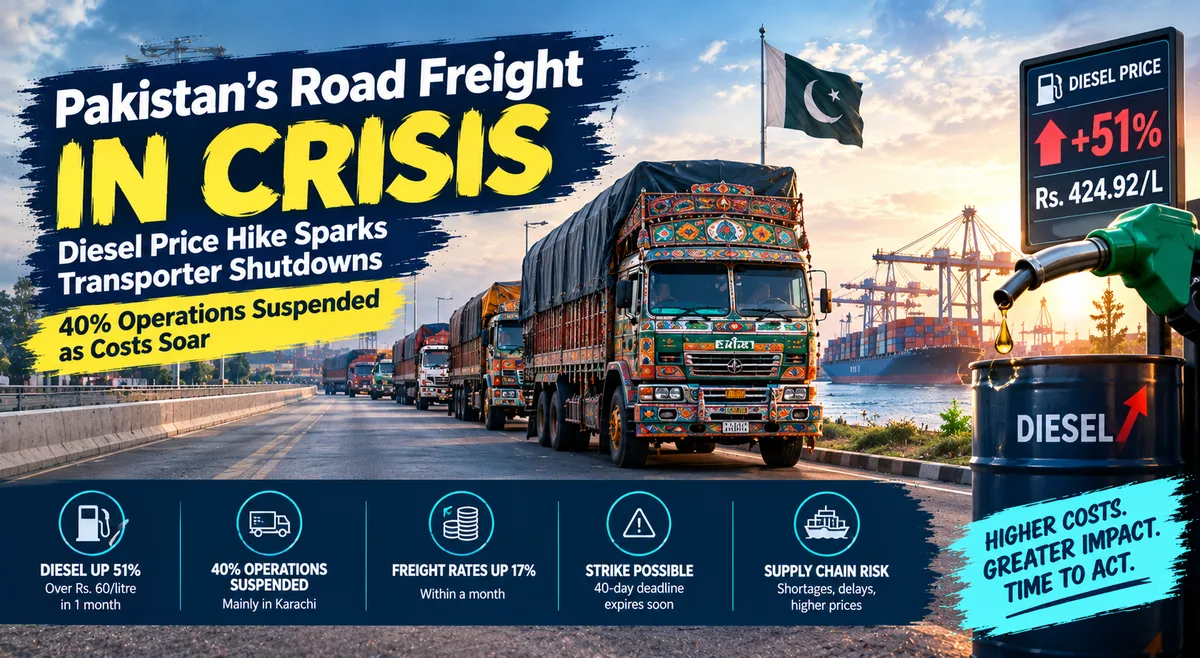
A 51 percent surge in diesel prices in Pakistan since the commencement of the US-Iran conflict has brought the country's goods transport sector to the brink of collapse, with nearly 40 percent of freight operations already suspended, according to a report published on September 20, 2026.
According to data shared by goods transporters, diesel prices have increased by over Rs. 60 per litre in the last one month alone. That is a staggering jump for any business that depends on diesel to move goods across the country every single day.
How Fast Have Prices Actually Risen?
The scale and speed of the increase is what makes this situation so severe. Here is the recent timeline of diesel price movements in Pakistan:
- September 4: Diesel at Rs. 374.31 per litre
- September 8: Diesel rises to Rs. 381.77 per litre
- September 12: Diesel climbs to Rs. 403.32 per litre — crossing the Rs. 400 mark
- September 18: Diesel hits Rs. 424.92 per litre — up another Rs. 3.47
All Pakistan Goods Transport Alliance President Malik Shehzad Awan said diesel prices increased by Rs. 26.88 per litre over the past seven days alone, while petrol prices rose by Rs. 20 per litre during the same period. These are not small, gradual adjustments — they represent some of the sharpest short-term fuel price movements the sector has faced in recent memory.
How Are Transporters Responding?
Faced with operating costs rising faster than they can plan for, goods transporters across the country have repeatedly raised their freight charges just to stay afloat:
- An earlier 5% fare hike took effect from September 12, after diesel rose by Rs. 5.28 per litre in a short window.
- A further 7% fare hike was announced following the September 18 diesel increase.
- Cumulatively, transport owners have raised freight charges by 17 percent within a single month — a cost that is now being passed on to wholesale and retail markets.
Malik Shehzad Awan explained the pressure transporters are under: "The increase in fuel prices has raised operating costs for the goods transport sector, making it difficult for transporters to maintain existing freight rates."
Why Are 40% of Trucks Already Off the Road?
Raising freight rates has not been enough to keep the sector viable. Goods transporters say the sector is no longer financially viable. Transporters report that operational expenses — including tyres, spare parts, toll taxes, withholding tax, and driver salaries — have now exceeded monthly income.
As a direct result, a large number of fleet owners in Karachi, the country's main logistics hub, have parked their vehicles rather than operate at a loss. This is not a minor inconvenience — Karachi Port is the primary entry point for imports into Pakistan, and trucks moving cargo from the port to up-country destinations form the critical first link in the domestic supply chain.
What Are Transporters Demanding From the Government?
Malik Shahzad Awan, President of the All Pakistan Goods Transport Ittehad, has demanded immediate intervention from the federal government. Specifically, the alliance is seeking:
- A targeted subsidy on diesel for the commercial transport sector
- A rationalization of withholding tax and toll taxes on goods vehicles
Awan said the current tax structure was formulated without consulting stakeholders and does not reflect ground realities.
What Happens If This Continues?
Industry leaders are warning of serious knock-on effects for the entire economy if the situation is not resolved quickly.
Owais Chaudhry, President of the All Pakistan Goods Transport Owners Association, stated that if heavy vehicles remain off the roads, the internal supply chain from Karachi Port to up-country will be severely disrupted. He warned that this could lead to shortages of essential commodities, fruits, vegetables, and industrial raw materials, ultimately triggering a fresh wave of inflation.
Industry experts note that the goods transport sector serves as the backbone of the national economy. Any prolonged disruption could result in factory inventories piling up in warehouses, delays in export consignments, and a 10 to 15 percent increase in the prices of daily-use items.
Is a Nationwide Strike Coming?
This crisis did not appear out of nowhere — it follows an earlier round of tension between transporters and the government. Transporters had previously postponed a nationwide strike for 40 days following assurances from the federal and provincial governments that their concerns would be addressed. That strike had originally been announced over fuel-price adjustments and other outstanding issues, before being deferred in August in what transporters described as the broader national interest.
The situation is now further complicated by that 40-day deadline, which is set to expire within a week. Transporters have not ruled out resuming their nationwide strike if their demands are not met this time.
The government has yet to announce a relief package for the sector.
What Does This Mean for the Logistics Industry?
For anyone involved in moving goods within Pakistan — shippers, importers, distributors, and retailers alike — this developing situation carries immediate practical implications:
- Expect higher inland transport costs immediately. With freight rates already up 17% in a month, and further increases likely if diesel keeps climbing, businesses should factor higher trucking costs into their budgets right away.
- Plan for possible capacity shortages. With roughly 40% of freight operations reportedly suspended in Karachi, finding available trucks — especially on short notice — may become harder and more expensive in the coming weeks.
- Build buffer time into supply chains. If trucks are parked or a strike materializes, cargo movement from Karachi Port to up-country destinations could face significant delays. Importers and exporters should build extra time into their delivery schedules.
- Watch for a possible nationwide strike. With the 40-day deadline expiring within a week and no government relief package announced yet, businesses dependent on road freight should have contingency plans ready in case transporters follow through on strike threats.
- Monitor consumer goods pricing. Industry experts are warning of a 10-15% rise in daily-use item prices if the disruption continues — a signal worth watching for anyone in retail, distribution, or consumer goods supply chains.
Key Takeaways — September 20, 2026
- Diesel prices in Pakistan have risen 51% since the US-Iran conflict began, with over Rs. 60/litre added in the past month alone.
- Nearly 40% of goods transport operations are reportedly already suspended, especially in Karachi.
- Diesel reached Rs. 424.92 per litre as of September 18, 2026.
- Transporters have raised freight charges by a cumulative 17% within one month.
- Many Karachi fleet owners have parked vehicles as operating costs now exceed monthly income.
- Transporters are demanding a targeted diesel subsidy and rationalized withholding/toll taxes.
- A previously postponed 40-day strike deadline expires within the week — a nationwide strike remains possible.
- Industry warns of shortages, export delays, and a 10-15% rise in daily-use goods prices if unresolved.
- No government relief package has been announced yet.
Pakistan's road freight sector — the vital link connecting Karachi Port to the rest of the country — is under more financial pressure than it has faced in years. With transporters warning of a possible nationwide strike within days and no government response yet, businesses that depend on trucking for their supply chains should prepare now for continued cost increases and potential disruption in the weeks ahead.



Comments
No comments yet. Be the first to share your thoughts!