
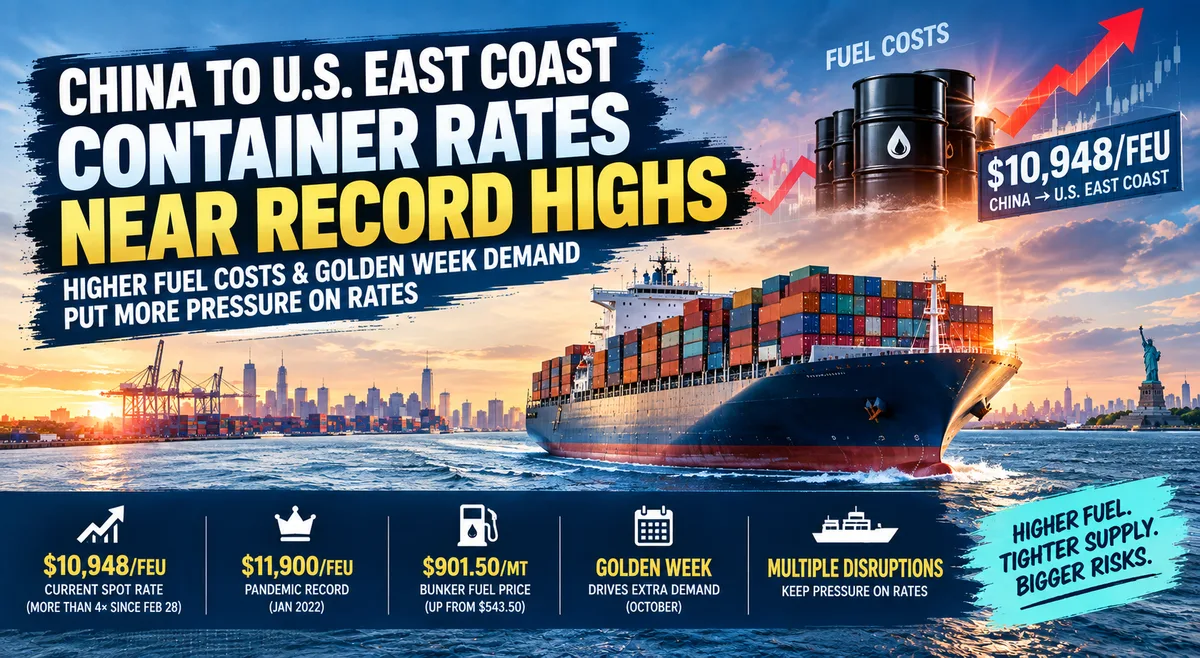
The off-contract ocean container shipping rate from China to the U.S. East Coast has returned to levels last seen after COVID-19 upended global trade, and could set new record highs as the U.S. and Israeli war on Iran continues to drive fuel costs higher. Spot rates on the route hit $10,948 per 40-foot container, more than quadrupling since the start of the Iran war on February 28, according to data from freight pricing platform Xeneta.
How close to a record?
That leaves freight rates on this critical trade lane just short of the all-time high set during the COVID-19 disruption, when rates hit a record $11,900 in January 2022, according to Peter Sand, Xeneta's chief analyst. The Shanghai to New York route is among the busiest and most profitable for global container carriers, including MSC, Maersk, COSCO, and CMA CGM, making any sustained rate surge on this lane significant for the wider market. Given how close current rates already sit to that pandemic-era ceiling, even a modest additional push from fuel costs or demand could be enough to set a new all-time high.
What's driving the fuel cost spike
Crude oil prices soared after hostilities intensified between the U.S., Israel, and Iran, including attacks on oil tankers in the Strait of Hormuz and the closure of Saudi Arabia's key East-West pipeline. Those events pushed the global 20-port average price for very low sulphur fuel oil, the bunker fuel used by many container ships, to $901.50 per metric ton, up sharply from $543.50 per metric ton on February 27, though still below the March 20 peak of $1,053 per metric ton, according to marine fuel price publisher Ship & Bunker.
Container ship owners typically recoup higher fuel costs through surcharges and other pricing mechanisms passed on to shippers, meaning the cost of the conflict is being felt well beyond the tanker market and directly on container invoices. "With bunker prices pushing fuel surcharges higher, surpassing the pandemic peak cannot be ruled out," Sand said of the China to East Coast container spot rate. The fact that bunker prices remain below their March peak suggests there is still room for further increases if the conflict escalates or fuel costs climb again.
Why a new record could come this month
Analysts expect a new record could arrive as soon as this month, driven by the traditional Golden Week volume spike as shippers, including major retailers like Walmart and Amazon, rush goods out of China before factories close in early October for the mandatory national holiday. This seasonal front-loading happens every year, but this year it is layering directly on top of already-elevated war-driven fuel costs, a combination analysts say could tip rates over the edge into record territory.
Week-over-week spot rates from Shanghai to New York jumped nearly 7% to $10,394 per 40-foot container, according to Drewry's World Container Index, underscoring how quickly conditions are moving even before the Golden Week rush fully takes hold. That kind of single-week jump on one of the world's most closely watched trade lanes signals that the market is repricing risk in real time rather than gradually.
A market under pressure from multiple directions
This fuel-driven pressure is compounding a set of disruptions that have kept ocean freight elevated for months, including continued tensions near the Strait of Hormuz, weather-related congestion at Chinese ports, Panama Canal draft restrictions, and disruptions at European ports. Each of these individually would put upward pressure on rates; together, they have created a market where cost relief in one area is quickly offset by pressure building somewhere else.
While peak-season cargo demand shows some early signs of easing on certain lanes, rising bunker costs could establish a stronger floor beneath container rates even if underlying demand softens. In other words, even a cooling in shipper demand later this year may not translate into meaningfully lower rates, because fuel costs alone are now doing much of the work in keeping prices elevated.
Key takeaways
- China to U.S. East Coast spot rates hit $10,948/FEU, more than quadrupling since the Iran war began on February 28.
- Rates are just short of the all-time record of $11,900/FEU set in January 2022 during the pandemic.
- Bunker fuel prices have climbed to $901.50/metric ton, up from $543.50 in late February, though still below the March peak of $1,053.
- A new record could arrive this month as shippers rush cargo out of China ahead of Golden Week factory closures.
- Shanghai to New York rates jumped nearly 7% week-over-week to $10,394/FEU per Drewry's index.
- Elevated fuel costs may keep rates high even if broader peak-season demand begins to soften.
For freight forwarders and shippers, this combination of war-driven fuel costs and seasonal demand makes the coming weeks critical for East Coast-bound cargo. Locking in capacity and understanding fuel surcharge exposure now could help avoid the sharpest edge of any record-breaking rate spike, particularly for shipments that need to move before Golden Week disruptions and fuel volatility compound further.


Comments
No comments yet. Be the first to share your thoughts!