
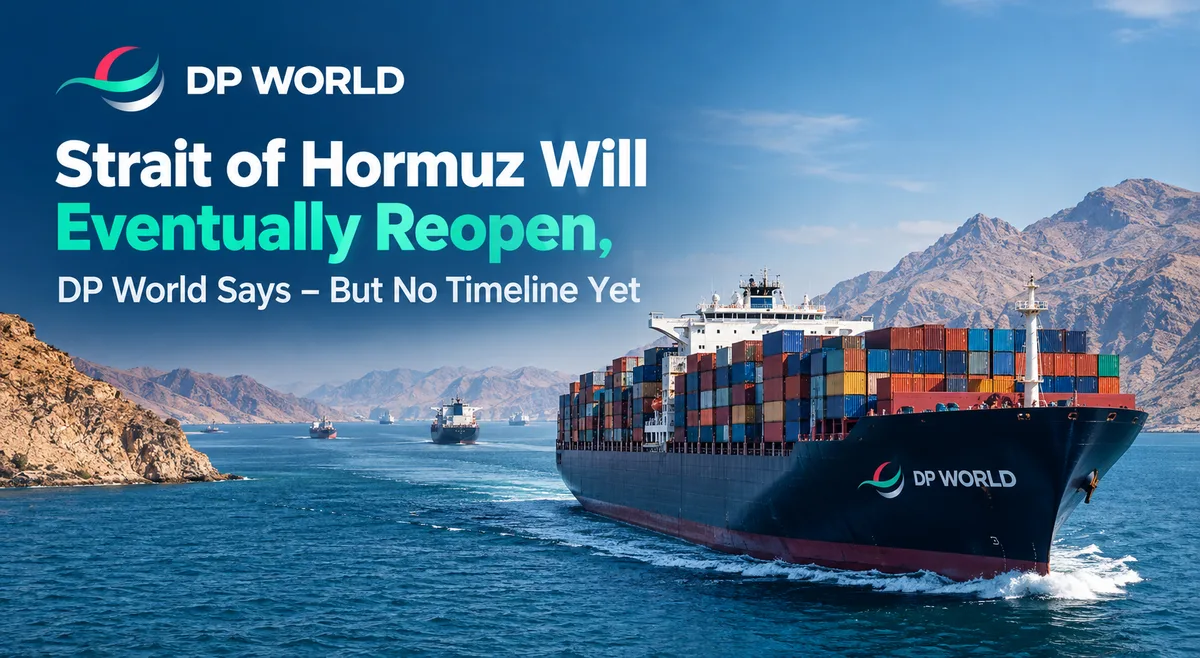
DP World says it remains confident that the Strait of Hormuz will eventually reopen, even though the company has no clear sense of when that might happen. Abdulla Al Hashemi, DP World's Global Chief Operating Officer for Parks & Economic Zones, made the comments at a closed-door briefing during the Arab Media Summit in Dubai, arguing that the strait's central role in regional trade makes a return to normal operations inevitable over the long run.
What was said
"The Strait will reopen," Al Hashemi told attendees. "When, I don't know. In what shape or format, I don't know." He described Hormuz as forming a "natural water path that leads cargo to where it's supposed to be," pointing out that the strait leads directly into the Arabian Gulf and serves a population of more than 100 million people living along its route. For Al Hashemi, that scale of dependency is precisely why he believes conditions will eventually normalize, even if the timeline remains uncertain.
He also credited DP World's diversified global footprint for helping the company manage its assets through the disruption, saying the UAE is currently in "a much more resilient position" given its geography relative to the strait's chokepoint. Rather than framing the closure as a crisis to simply endure, Al Hashemi positioned it as a period the company is actively navigating through operational flexibility.
Why the closure has dragged on for months
The Strait of Hormuz, which under normal conditions carries roughly a fifth of the world's daily oil supply and a comparable share of global LNG trade, was effectively closed following military strikes in late February 2026. In the months since, commercial transit volumes have stayed sharply below pre-conflict levels, with reports earlier in the year showing some days seeing as few as 8 vessel transits compared with around 130 per day before the escalation.
The disruption forced carriers and energy exporters to lean on longer, more expensive alternatives. Many shipping lines rerouted vessels around the Cape of Good Hope, adding 10 to 14 days to voyages that would normally pass through Hormuz. On the energy side, Saudi Arabia's East-West pipeline has reportedly been pumping crude toward Red Sea terminals at close to its full capacity, helping offset some of the lost throughput, though analysts say these workarounds only partially replace what the strait normally handles.
How Gulf trade patterns have shifted
The prolonged closure has already reshaped the regional port landscape. Dubai's Jebel Ali, historically one of the world's busiest transshipment hubs and the primary gateway for cargo moving into the Middle East, East Africa, and South Asia, saw its global ranking fall sharply as vessels diverted away from the Gulf entirely. Meanwhile, ports positioned outside the immediate conflict zone, including facilities along the Red Sea and in Southeast Asia, have picked up some of the diverted volume.
In response, DP World has reportedly been exploring the development of a new port and container terminal in Fujairah, located on the UAE's east coast outside the strait. The project is designed to ease pressure on Jebel Ali and, more importantly, allow cargo to reach the UAE without transiting Hormuz at all. While the timeline and investment figures for the Fujairah project have not been publicly disclosed, the plan reflects a broader assumption taking hold across the region: that the strait may not return to its pre-war role even once transit resumes.
Why it matters for the wider industry
DP World's comments capture a strategic shift playing out across Gulf logistics more broadly. Rather than treating the closure as a temporary disruption to wait out, operators are treating it as a structural risk to design around, investing in new terminal capacity, expanding pipeline infrastructure, and building redundancy into supply routes that previously depended heavily on a single chokepoint.
Despite the disruption, DP World's underlying business has continued to perform. The company reported first-half 2026 revenue of $12.7 billion, up 13.1% compared with the same period the previous year, suggesting that its diversified global operations have helped cushion the impact of reduced Hormuz-linked volumes at any single hub.
Key takeaways
- DP World expects the Strait of Hormuz to eventually reopen but has no timeline to offer.
- The strait has remained largely closed since military strikes in late February 2026, nearly seven months ago.
- Jebel Ali's global port ranking has dropped sharply as vessels reroute away from the Gulf.
- DP World is reportedly exploring new port and terminal capacity in Fujairah to bypass Hormuz entirely.
- DP World's H1 2026 revenue rose 13.1% year-on-year to $12.7 billion despite the ongoing disruption.
For freight forwarders and shippers with exposure to Gulf trade routes, DP World's outlook reinforces a simple but important point: route diversification is no longer a contingency plan, it has become standard practice as long as Hormuz's reopening timeline remains unknown.


Comments
No comments yet. Be the first to share your thoughts!