
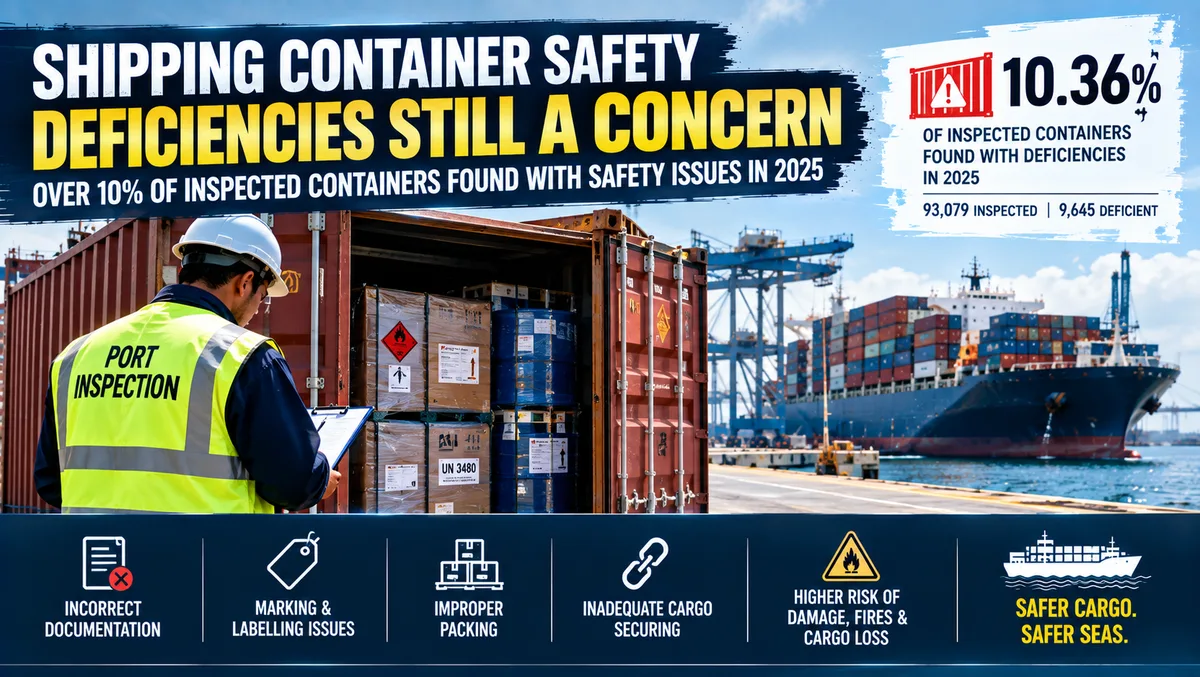
More than one in ten shipping containers inspected by port authorities in 2025 were found to have safety deficiencies, according to new data released by the World Shipping Council (WSC), the leading lobby group for the liner shipping industry. The findings add fresh urgency to long-running concerns about cargo declaration and packing standards across global supply chains.
What the data shows
Authorities in seven countries, Chile, Finland, Germany, the Netherlands, South Korea, Sweden, and the United States, inspected a total of 93,079 cargo transport units last year, most of them shipping containers, though the figure also includes ro-ro units and trailers. Of those, 9,645 were found to have deficiencies, putting the overall failure rate at 10.36%.
That figure is slightly lower than the rates recorded in 2023 and 2024, when deficiency rates stood at around 11% and 11.39% respectively, marking a small but notable improvement. Even so, the WSC argues the current level remains far above where the industry believes it should be, given how much is at stake when a single mislabeled or poorly packed container makes it onto a vessel.
The deficiencies identified ranged from incorrect documentation, marking, and labelling to improper packing and inadequate cargo securing. Individually, each of these might seem like a paperwork or logistics issue, but together they significantly increase the risk of cargo damage, containers being lost overboard, and fires breaking out at sea, three of the most costly and dangerous outcomes in modern container shipping.
What industry leaders are saying
"Finding deficiencies in more than one in ten inspected units is far too high," said Joe Kramek, President and CEO of the World Shipping Council. "Correct declaration, packing, securing and marking are fundamental safety obligations. When these requirements are not met, people's lives are put at risk."
The report draws on port state inspection data and continues a data series that dates back to 2011, tracking how well shippers comply with international regulations on the safe declaration and packing of dangerous goods. The series was previously compiled by the International Maritime Organization (IMO) before being discontinued, and the WSC has since taken over publishing the consolidated figures to keep the historical trend line intact for the industry.
Why it matters for the industry
Misdeclared or improperly packed cargo remains one of the leading causes of serious incidents on container ships. According to maritime safety experts, undeclared or mislabeled dangerous goods, particularly chemical cargoes, carry the risk of thermal runaway and explosions at sea, events that crews are often neither trained nor equipped to manage once they occur mid-voyage. Heavy boxes placed incorrectly or undeclared weights can also destabilize a vessel, increasing the risk of excessive rolling, stack collapse, and containers being lost overboard in rough seas.
Industry data has previously identified cargo misdeclaration as one of the top causes of containership accidents, a pattern that has repeated across several major vessel fires and losses in recent years. Because a single non-compliant container can sit among thousands of others on a mega vessel, the risk it introduces is rarely contained to just that one box, it can threaten the safety of the entire ship, its crew, and every other shipper's cargo on board.
The WSC's findings come amid growing concern across the industry about cargo safety more broadly, including ongoing calls for stricter rules around the declaration of lithium-ion battery shipments. Battery-related fires have become an increasingly prominent issue for carriers as the volume of lithium-ion cargo, driven by electric vehicles, energy storage systems, and consumer electronics, continues to rise sharply. Industry groups have been pushing regulators to close gaps that currently allow some battery shipments to move without carriers being fully informed of their contents.
Key takeaways
- 10.36% of inspected containers showed safety deficiencies in 2025, based on data from seven countries.
- 93,079 units were inspected, with 9,645 flagged for issues including mislabeling and improper packing.
- The failure rate is slightly down from 2023 and 2024, but remains well above acceptable levels, according to the WSC.
- Common deficiencies included incorrect documentation, poor labelling, and inadequate cargo securing.
- Concerns over cargo safety are intensifying alongside a rise in lithium-ion battery shipments and related fire risks.
For freight forwarders and shippers, this report is a reminder of how critical proper declaration and packing remain, not just for compliance, but for the safety of vessels, crews, and cargo across the entire supply chain. As inspection standards tighten and scrutiny grows, getting documentation and packing right the first time is quickly becoming a competitive necessity, not just a regulatory checkbox.



Comments
No comments yet. Be the first to share your thoughts!