
What Was Just Announced?
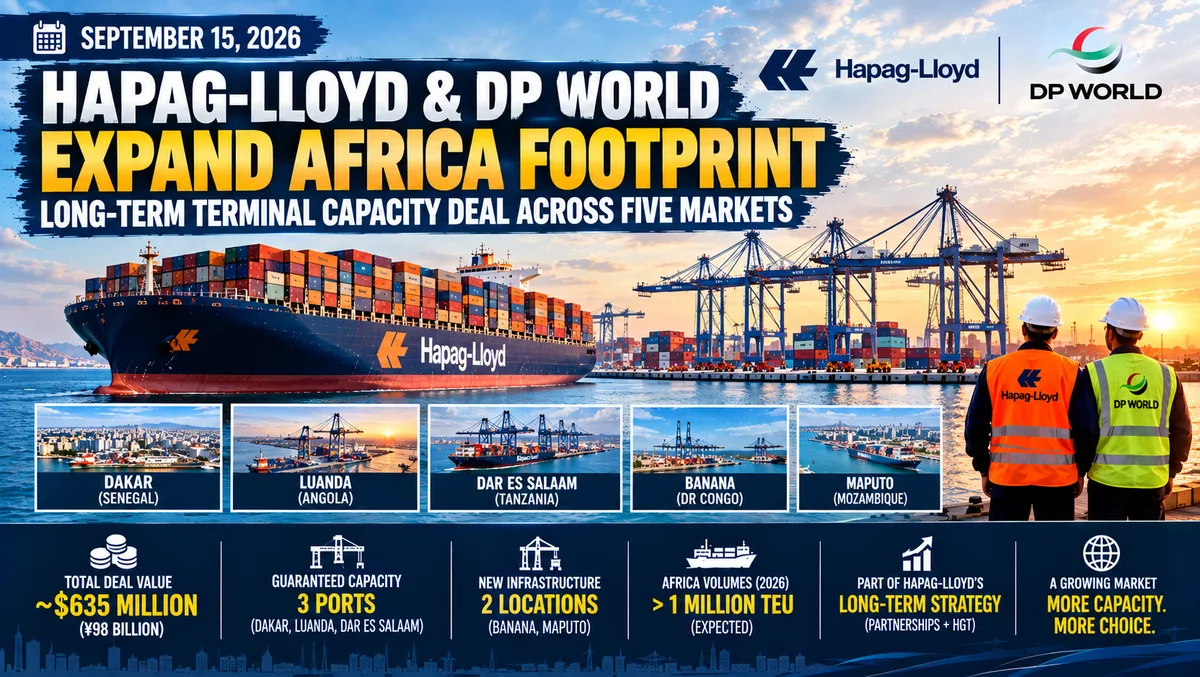
On September 15, 2026, Hapag-Lloyd — the world's fifth-largest container line — announced a major long-term agreement with global port operator DP World, securing terminal capacity across five African markets.
Hapag-Lloyd has struck a long-term agreement with DP World covering terminal capacity and port infrastructure across five African markets as the German carrier builds its presence on the continent.
The deal has two parts:
- Guaranteed long-term terminal capacity at three existing DP World facilities: Dakar (Senegal), Luanda (Angola), and Dar es Salaam (Tanzania)
- Joint support for new port infrastructure development at two additional locations: Banana (Democratic Republic of the Congo) and Maputo (Mozambique)
This is not simply Hapag-Lloyd booking berth slots. It is a strategic, multi-year commitment that ties the carrier's growth directly to specific port infrastructure across the African continent.
Why Is Hapag-Lloyd Doing This Now?
The answer is straightforward: Africa is growing fast for Hapag-Lloyd, and the company needs guaranteed capacity to keep up.
Hapag-Lloyd expects its African transport volumes to exceed 1 million TEU this year and said securing sufficient terminal capacity is central to expanding its network across the continent.
CEO Rolf Habben Jansen explained the thinking behind the deal: "Africa is one of Hapag-Lloyd's most important growth markets, and we see significant long-term potential across the continent. To support this growth, we need reliable infrastructure, sufficient terminal capacity and a network that can scale with our customers. By strengthening our cooperation with DP World across the Africa continent, we are taking an important step to further improve the foundations of our service offering in Africa."
In plain English: Hapag-Lloyd sees Africa as one of its biggest future growth opportunities — and it does not want to be caught short on port capacity as demand rises. Locking in terminal access now, years in advance, protects against future congestion and gives the carrier a competitive edge over rivals who have not made similar commitments.
Why These Specific Ports?
Each location in this deal plays a distinct strategic role:
- Dakar, Senegal — West Africa's key gateway port, serving Senegal and neighbouring landlocked countries in the region.
- Luanda, Angola — Angola's main port, critical for Southern and Central African trade, particularly linked to the country's oil and resource exports.
- Dar es Salaam, Tanzania — East Africa's most important gateway, serving not just Tanzania but landlocked neighbours including Zambia, Malawi, and parts of the Democratic Republic of Congo via inland corridors.
- Banana, DR Congo — an emerging port location that DP World and Hapag-Lloyd will jointly help develop, expanding options for Central African cargo.
- Maputo, Mozambique — another infrastructure development location, strengthening the Southern African corridor connecting to landlocked countries like Zimbabwe, Eswatini, and parts of South Africa.
Together, these five locations give Hapag-Lloyd meaningful coverage across West, East, Central, and Southern Africa — not just a single regional foothold.
How Does This Fit Hapag-Lloyd's Broader Strategy?
This African deal is part of a much larger pattern. The agreement forms part of the carrier's broader terminal strategy, which combines long-term access agreements with third-party terminal operators and expansion of its own portfolio through Hanseatic Global Terminals (HGT).
This is the same strategy we have tracked throughout 2026 — Hapag-Lloyd taking a 25% stake in Rotterdam's Maasvlakte II terminal in August, building stakes in Eurogate Hamburg and Tangier Med earlier in the year, and now securing African capacity through DP World. The pattern is consistent: Hapag-Lloyd is transforming from a company that simply operates ships into one that also secures guaranteed access to the physical infrastructure its ships depend on.
The carrier said it will continue working with several terminal operators to secure flexible access to port and landside infrastructure, while also expanding its own terminal portfolio through HGT — a dual approach of strategic partnerships plus direct ownership.
Is Hapag-Lloyd Alone in This African Push?
No — and that is an important part of this story. Africa has been attracting the attention of the major container lines for some time, with carriers increasingly moving beyond serving the continent's ports to investing in the infrastructure that supports their networks.
MSC — the world's largest container line — is perhaps the clearest example of this trend. Through Terminal Investment Limited and Africa Global Logistics, the group has built a broad infrastructure presence across the continent, including key facilities in West Africa such as Lomé Container Terminal in Togo, and terminals in Abidjan and San Pedro in Côte d'Ivoire, along with facilities in Ghana, Benin, and elsewhere.
In other words: the world's biggest shipping lines are quietly racing to secure African port infrastructure before their competitors do. Hapag-Lloyd's DP World deal is its latest move in that broader competitive race.
Why Is Africa Suddenly So Attractive to Global Carriers?
Several factors are driving this surge of carrier interest in African infrastructure:
- Population and economic growth. Africa has some of the fastest-growing populations and consumer markets in the world. Rising incomes mean rising import demand for consumer goods, machinery, and industrial materials.
- Resource exports. Ports like Luanda are critical gateways for oil, minerals, and agricultural commodities that African nations export to the rest of the world.
- Landlocked country dependency. Many African nations without direct sea access — such as Zambia, Malawi, Zimbabwe, and parts of DR Congo — depend entirely on gateway ports like Dar es Salaam and Maputo to reach international markets. Carriers that control capacity at these gateways gain influence over entire regional supply chains, not just the coastal country itself.
- Historically underinvested infrastructure. Compared to Asia, Europe, and North America, African port infrastructure has historically lagged in capacity and automation. This creates both a challenge and an opportunity — carriers willing to invest early can secure long-term competitive advantages as the infrastructure catches up to demand.
What Does This Mean for Shippers and Freight Forwarders?
- More reliable capacity on African trade lanes. For shippers moving cargo to or from West, East, or Southern Africa via Hapag-Lloyd, this deal should translate into more consistent terminal access and potentially fewer capacity-related delays over the coming years.
- New infrastructure means future options. The Banana and Maputo infrastructure development commitments signal that new or expanded port capacity is coming to these locations — worth watching if you have long-term supply chain plans involving Central or Southern Africa.
- Competition among carriers benefits shippers over time. With Hapag-Lloyd, MSC, and other major lines all racing to secure African terminal capacity, the resulting infrastructure investment should gradually improve reliability and potentially service frequency across African trade routes — a positive long-term signal for importers and exporters in the region.
- Landlocked country supply chains may become more efficient. If Dar es Salaam and Maputo see improved capacity and infrastructure, cargo moving to and from landlocked neighbouring countries could see faster, more predictable transit times through these gateway ports.
- No immediate rate or schedule changes expected. This is a long-term capacity and infrastructure agreement, not an announcement of new services or rate changes. Shippers should not expect immediate operational changes, but should view this as a positive signal for the future reliability of African routes served by Hapag-Lloyd.
Key Takeaways — September 16, 2026
- Hapag-Lloyd signed a long-term terminal capacity agreement with DP World across five African markets — announced September 15, 2026.
- Guaranteed capacity secured at Dakar (Senegal), Luanda (Angola), and Dar es Salaam (Tanzania).
- Joint infrastructure development planned at Banana (DR Congo) and Maputo (Mozambique).
- Hapag-Lloyd expects African transport volumes to exceed 1 million TEU in 2026.
- Deal is part of Hapag-Lloyd's broader terminal strategy, combining partnerships (like this one) with direct ownership through Hanseatic Global Terminals.
- MSC has been pursuing a similar African infrastructure strategy through Terminal Investment Limited and Africa Global Logistics.
- Major carriers are increasingly racing to secure African port capacity ahead of rising demand.
- Landlocked African nations depending on these gateway ports may benefit from improved long-term capacity and reliability.
Africa is quietly becoming one of the most contested growth markets in global container shipping. As Hapag-Lloyd locks in terminal capacity across five African markets, the message is clear: the world's biggest carriers see the continent's ports as strategic assets worth securing years in advance — not just destinations to call at when convenient. For shippers and freight forwarders operating in or planning entry into African trade lanes, this kind of infrastructure investment is a meaningful signal of where reliable capacity will be in the years ahead.


Comments
No comments yet. Be the first to share your thoughts!