
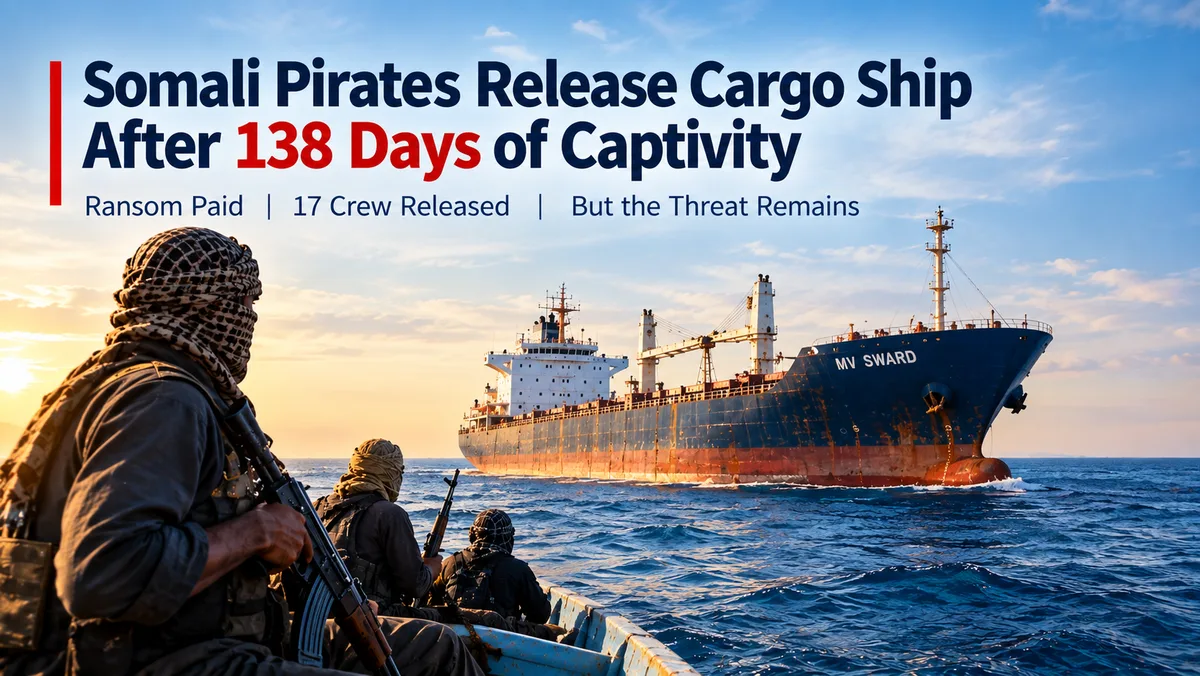
Somali pirates released the cargo ship MV Sward on September 11 after holding the vessel and its 17-member crew for 138 days. The 8,500 dwt ship, registered in St. Kitts and Nevis, was carrying fertilizer bound for Mombasa, Kenya, when it was boarded off the Somali coast on April 26. The crew consisted of 15 Syrian nationals and two Indian nationals, and remained on board throughout the ordeal.
Puntland security sources told AFP that a ransom was paid, with reported figures ranging from $1.7 million to $2.7 million, though no amount has been officially confirmed. The vessel was released near Garacad, a port in Somalia's semi-autonomous Puntland region. Security sources noted that vehicles were waiting on shore for the pirates before they reached Garacad, suggesting the group maintained contact with a support network on land while holding the ship at sea.
What's happening off the Horn of Africa
The Sward's release does not signal an easing of the threat. Four commercial vessels remain in pirate hands: the tankers Honour 25, hijacked April 21, Eureka, taken May 2, Asana, seized July 17, and Sibu I, also known as Seamull, hijacked August 20. The Global Initiative Against Transnational Organized Crime, which has been tracking the 2026 resurgence, reported that pirates demanded as much as $10 million for the release of the Eureka.
EU NAVFOR Atalanta, the EU's monitoring and security operation in the region, reported that a show of force successfully scared off a pirate group that had boarded the Greek-owned bulker Glamor on September 10. The 24,000 dwt vessel, registered in Saint Vincent and the Grenadines, was targeted roughly 98 nautical miles southwest of Al Mukalla, Yemen. That assault was the 25th incident reported to Atalanta since the start of 2026.
The International Maritime Organization has recorded at least 15 attacks in the region this year, the highest number since 2013, compared with just five in all of 2025. Ransom payments have also been climbing. Puntland sources told AFP that $2.5 million was paid to release the Cameroon-flagged MV Lutuf in late August, while the Chinese fishing vessel Liao Dong Yu 578, hijacked in January, was freed in March after a reported payment of between $1.2 million and $1.5 million.
Why piracy has returned
The resurgence is closely tied to the broader regional crisis. Naval attention has shifted heavily toward the Red Sea and the Iran conflict, thinning out the patrol coverage that had suppressed Somali piracy for years. Armed guards aboard merchant vessels have also become less common as owners scaled back security spending during the quieter period between 2013 and 2025. Meanwhile, the underlying economics of piracy have not changed, and with oil prices climbing above $100 per barrel, the value of energy tankers transiting these waters has only increased.
Pirates have also adapted tactically. The MV Sward was itself used as a "mothership," a hijacked vessel serving as a mobile base that lets pirate groups extend their range far offshore and bypass traditional naval patrol zones. While held, the Sward was reportedly used to capture two Iranian fishing boats and the Cameroon-flagged cargo ship MV Lutuf. Analysts have pointed to mothership tactics as a key reason pirates have been able to strike targets well beyond the near-shore areas that patrols typically focus on.
There is also concern about the proximity of piracy networks to other armed actors in the region. Security analysts have warned that if Houthi technology such as drones and missile capability were to become available to Somali pirate groups, the risk profile for commercial shipping in the Gulf of Aden would escalate sharply beyond what small-arms boardings currently represent.
When force has worked
Not every release has come through ransom. Somalia's federal government said the MV Lutuf was released following sustained military pressure by the Turkish navy and Somali armed forces, during which four pirate boats were destroyed and 14 pirates were killed. The September 10 incident involving the Glamor also ended without a hijacking after a naval show of force. These cases suggest visible enforcement still works, but the resources to deliver it consistently are currently spread thin across multiple regional crises.
What it means for shippers
For freight forwarders and shipowners routing cargo through the Gulf of Aden and around the Horn of Africa, this is a compounding risk. Vessels transiting the region already face Houthi threats in the southern Red Sea, unstable conditions around Bab el-Mandeb following the Houthi advance along Yemen's coastline, and elevated war-risk insurance premiums. Piracy at 2013-era levels adds another cost and planning variable on top of all of it.
The commercial impact extends beyond the vessels directly targeted. Longer captivity periods, the Sward was held 138 days, mean cargo sitting idle for months, contracts in default, and crew welfare situations that carry serious reputational and legal exposure for owners and charterers. Insurance markets have taken note, and premiums for Gulf of Aden transits reflect the combined war-risk and piracy picture rather than either threat in isolation.
Practical steps matter here. Re-evaluating armed guard deployment, reviewing BMP5 best management practices with crews, confirming that war-risk and kidnap-and-ransom coverage is current and adequate, registering transits with Atalanta and UKMTO, and building voyage plans around live regional advisories rather than historical risk assumptions are all worth revisiting for any passage through these waters.
Key takeaways
- MV Sward was released on September 11 after 138 days, with a reported ransom of $1.7-2.7 million.
- Four tankers remain held: Honour 25, Eureka, Asana, and Sibu I (Seamull).
- 25 incidents reported to EU NAVFOR Atalanta in 2026, the most active period since 2013.
- IMO has logged at least 15 attacks this year, up from five in 2025.
- Ransom demands have reached as high as $10 million for a single vessel.
- Reduced naval presence, fewer armed guards, mothership tactics, and rising tanker values are driving the resurgence.
- Naval show-of-force responses have successfully prevented several hijackings, including the Glamor on September 10.
With regional naval resources stretched thin and no quick resolution in sight, shippers moving cargo through the Gulf of Aden should treat piracy risk as an active planning factor rather than a historical concern. For anyone routing cargo through this corridor, working with forwarders who track live regional security conditions is no longer optional.



Comments
No comments yet. Be the first to share your thoughts!