What Was Just Launched?
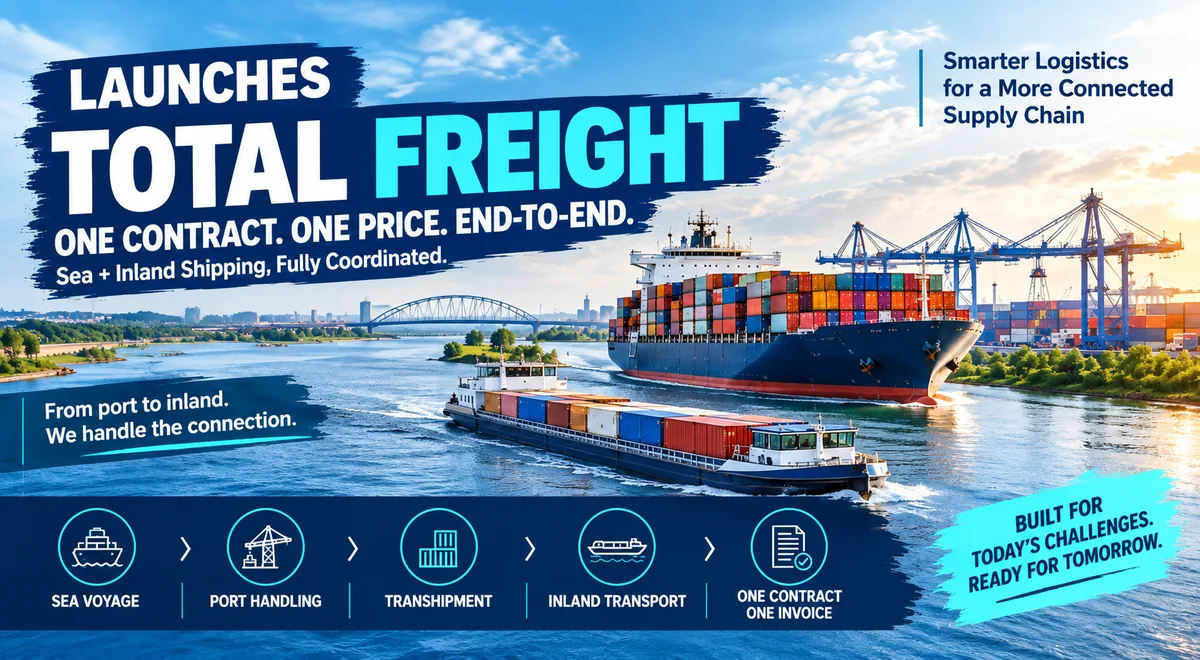
On September 17, 2026, Dutch chartering company Transito announced a new service called "Total Freight" — one that combines sea freight and inland shipping under a single contract, at a time when low water levels and other disruptions are putting increasing pressure on cargo movements between European seaports and the hinterland.
The service covers the entire journey: the sea voyage, port handling, transhipment, and onward transport by inland vessel. Shippers get one price per tonne, one contract, and one invoice for the whole movement — instead of managing several separate contracts and providers for what is really a single shipment.
What Problem Is This Actually Solving?
To understand why this matters, you need to understand a coordination headache that has quietly been costing shippers money for years.
Bas Weinberg of Transito explained it simply: "A seagoing vessel waits for an inland vessel, an inland vessel waits at the quay, and the terminal waits for paperwork. Those days end up with the cargo owner."
Here is what that looks like in practice. A shipment moving from, say, Scandinavia or the UK into the German or Dutch hinterland can involve four separate contracts: one for the sea voyage, one for port handling, one for transhipment, and one for the inland vessel that carries the cargo the rest of the way. Each of these is typically arranged with a different provider.
When everything runs on schedule, this system works fine. But when low water, port congestion, vessel delays, or missing documentation disrupt the connection between the sea leg and the inland leg — which happens often, especially with the Rhine's water levels fluctuating seasonally — someone has to absorb the resulting waiting time and cost. Under the traditional multi-contract setup, that someone has usually been the cargo owner.
Why Is This Especially Relevant Right Now?
The timing of this launch is directly connected to a real, ongoing problem. Reuters reported last week that declining water levels on the Rhine are forcing cargo vessels to sail with reduced loads, increasing transport costs for commodity traders.
When Rhine water levels drop, inland vessels cannot load as much cargo per trip — meaning more trips are needed to move the same volume, or vessels sail partially empty to stay safely above the riverbed. This directly disrupts the timing coordination between when a seagoing vessel arrives at a European port and when an inland vessel is available and able to carry that cargo onward.
How Does Transito's Solution Actually Work?
The key innovation here is not a new mode of transport — it is risk transfer and coordination. Instead of the cargo owner juggling separate contracts with a shipping line, a port handler, a transhipment operator, and an inland barge company, Transito arranges both vessels itself.
Weinberg explained the practical benefit: "We arrange both vessels ourselves, so if one runs late, we move the other with it."
In other words, if the seagoing vessel is delayed, Transito can adjust the inland vessel's schedule accordingly — because it controls both legs of the journey. This is a fundamentally different approach from the traditional model, where four separate parties each optimize for their own schedule with limited visibility into what the others are doing.
Within an agreed range, Transito also takes on the waiting time between the seagoing vessel and the inland vessel on its own account — meaning the company itself absorbs some of the cost of delays, rather than passing all of it through to the shipper.
Who Is This Service Designed For?
Total Freight is specifically targeted at industrial buyers and mid-sized traders without an in-house freight department. These are companies that need reliable, predictable logistics but do not have the internal resources to coordinate multiple contracts and monitor connections between different transport legs themselves.
The service particularly targets companies shipping:
- Agribulk — bulk agricultural commodities like grain
- Building materials
- Fertilisers
- Minerals
- Recycling cargo
- Project cargo — oversized or specialized industrial equipment shipments
Weinberg summarized the core value proposition clearly: "The difficult part is often not finding a vessel. It is making sure the seagoing vessel, terminal and inland vessel connect. If something changes at sea, in port or on the river, we can manage that connection rather than leaving the cargo owner to coordinate between different parties."
Which Trade Routes Does This Cover?
The service addresses a coordination problem that is especially familiar to shippers moving dry cargo from Scandinavia, the United Kingdom, Poland, and northern Spain into the German and Dutch hinterland.
These routes typically involve a European seaport as the entry point, followed by inland transport via the Rhine river system into Germany's industrial heartland or Dutch inland destinations — a corridor that is economically vital but has become increasingly vulnerable to the low-water disruptions that have affected the Rhine in recent years.
What Does This Mean for the Broader Logistics Industry?
This launch reflects a wider pattern worth watching in European logistics: as climate-related disruptions like low river water become more frequent and less predictable, logistics providers are increasingly bundling services and absorbing coordination risk themselves, rather than leaving cargo owners to manage fragmented, multi-party supply chains.
For an industry that has spent the past few years dealing with Red Sea rerouting, Panama Canal restrictions, and Hormuz disruption, this Rhine-focused innovation is a reminder that not all supply chain risk comes from geopolitics — seasonal weather and water levels remain a persistent, recurring operational challenge that requires its own dedicated solutions.
What Should Shippers Do If This Applies to Them?
- Review your current sea-to-inland routing setup. If your cargo currently moves from a Scandinavian, UK, Polish, or northern Spanish port into the German or Dutch hinterland through multiple separate contracts, calculate how much waiting-time cost you have absorbed over the past year due to connection delays.
- Compare single-contract versus multi-contract costs. A bundled service like Total Freight may carry a different pricing structure than arranging each leg separately — weigh the predictability and reduced coordination burden against your current setup's flexibility.
- Consider this if you lack an in-house freight team. Mid-sized companies without dedicated logistics staff are the primary beneficiaries of this kind of bundled service — it removes the need to actively monitor and coordinate between multiple transport providers.
- Watch for similar services from other providers. If this bundled approach proves successful, expect other chartering companies and forwarders serving the Rhine corridor to introduce comparable combined sea-inland offerings.
- Factor in seasonal Rhine water risk regardless of your contract structure. Even with a bundled service absorbing some waiting-time cost, low water season remains a period of elevated schedule risk for any cargo moving through this corridor — build in extra buffer time during typically low-water months.
Key Takeaways — September 18, 2026
- Transito launched "Total Freight" on September 17, 2026 — a combined sea and inland shipping service under one contract.
- The service covers sea voyage, port handling, transhipment, and inland vessel transport as a single package.
- Shippers get one price per tonne, one contract, and one invoice for the entire movement.
- Transito absorbs agreed waiting-time costs between the sea and inland legs — shifting risk away from cargo owners.
- The service directly responds to ongoing low Rhine water levels, which Reuters reported are forcing reduced vessel loads and higher costs.
- Targeted at industrial buyers and mid-sized traders without in-house freight departments.
- Covers agribulk, building materials, fertilisers, minerals, recycling cargo, and project cargo.
- Main routes: Scandinavia, UK, Poland, and northern Spain into the German and Dutch hinterland via the Rhine corridor.
Not every supply chain problem comes from geopolitics or war-zone chokepoints — sometimes it is simply a river running low on water and four separate contracts that were never designed to talk to each other. Transito's Total Freight service is a practical, well-timed response to a real coordination gap, and it is worth watching whether other providers follow with similar bundled offerings on Europe's inland waterway corridors.
Comments
No comments yet. Be the first to share your thoughts!