
What Just Changed?
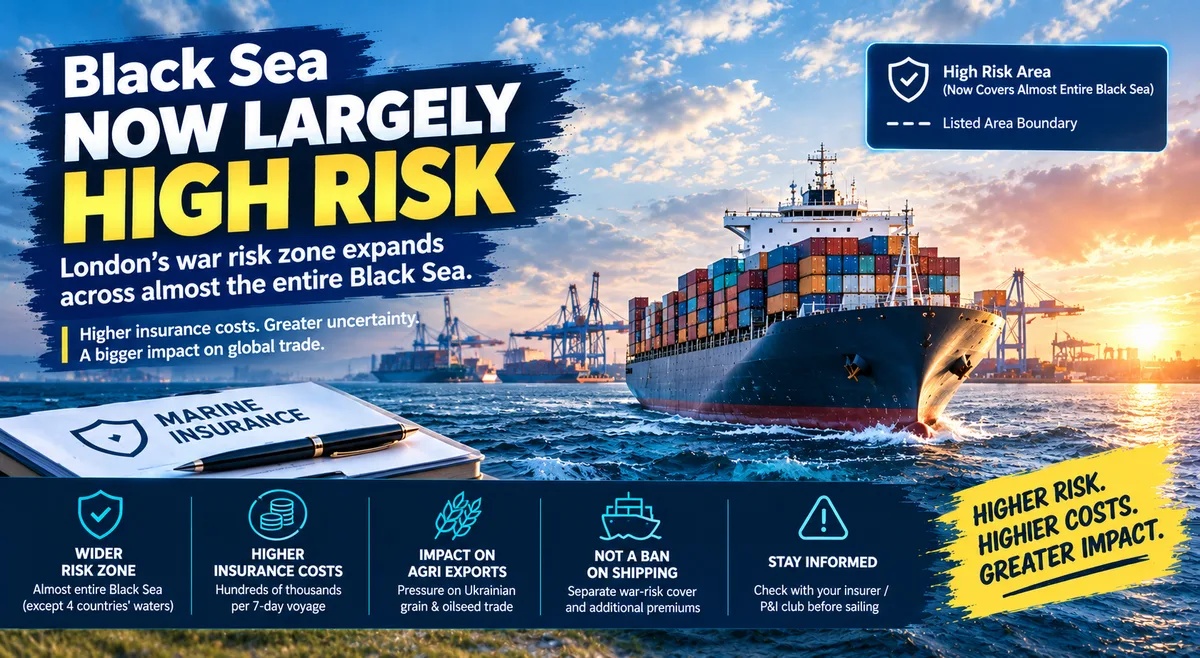
London's marine insurance market has widened the area in the Black Sea it deems as high risk, as the Ukraine-Russia conflict escalates, according to an advisory issued this week and reported by Reuters on September 18, 2026.
The Joint War Committee (JWC) has expanded the list of areas of increased military risk to almost the entire Black Sea. The updated notice, known as JWLA-035, is dated September 16, and the new conditions are expected to apply from September 19, 2026 — today.
In practical terms, the Listed Areas now cover almost all of the Black Sea, with the exception of the territorial waters of Turkey, Georgia, Bulgaria and Romania. Previously, only the coastal waters of Russia and Ukraine themselves were listed as high risk.
Who Decides This — And Why Does It Matter?
The Joint War Committee (JWC) comprises syndicate members from the Lloyd's Market Association and representatives from the London insurance company market, and its guidance influences underwriters' considerations over insurance premiums.
This is not a government body or a shipping regulator — it is a committee of insurance market professionals. But its designations carry enormous practical weight, because most large ocean-going vessels need war risk insurance to operate in conflict-adjacent waters, and insurers around the world look to the JWC's Listed Areas as the benchmark for pricing that risk.
Neil Roberts, head of marine and aviation at the LMA and secretary of the Joint War Committee, explained the change: "This week, the JWC has expanded the Black Sea reporting requirements to the whole of the Black Sea area. The coastal waters of Russia and Ukraine were already listed. However, voyages within the territorial waters of adjacent countries still do not require notification."
That last point is an important nuance for shippers: territorial waters belonging to Turkey, Georgia, Bulgaria, and Romania remain outside the expanded zone, even though they border the same sea.
Why Is the Black Sea So Important for Global Trade?
The Black Sea is a vital route for shipments of grain, crude oil and refined products. Its waters are shared by Russia and Ukraine as well as Bulgaria, Georgia, Romania and Turkey.
This is one of the world's most important agricultural export corridors. Ukraine, in particular, is one of the largest wheat, corn, and sunflower oil exporters on Earth — and nearly all of that trade depends on ships being able to safely load and sail from Black Sea ports. The region also carries substantial volumes of Russian and Kazakh crude oil and refined petroleum products bound for global markets.
Any increase in the cost or difficulty of insuring these voyages has direct knock-on effects for global food and energy prices — not just for the shipping companies themselves.
Why Is This Happening Now?
The expansion follows a clear and troubling trend. Russia and Ukraine have stepped up attacks on each other's commercial shipping in the past two months, in an escalation of their war, now in its fifth year.
Reporting from the Financial Times in August described an intensifying Russian campaign against Odesa's ports and commercial shipping, with data showing that traffic through the port had effectively halted at points during the campaign. On the other side, Ukrainian drone strikes on tankers near the Russian port of Novorossiysk have also driven up war risk rates in recent months, as Ukraine targets vessels connected to Russia's oil export trade.
In short: this is not a one-sided conflict confined to a small stretch of coastline. Both sides have been targeting commercial shipping connected to the other, and the attacks have spread widely enough across the sea that insurers concluded a full-Black-Sea designation was now the more accurate reflection of risk.
How Much More Expensive Will Shipping Become?
War risk premiums, which are adding hundreds of thousands of dollars in additional costs for every seven-day voyage, have surged in recent weeks as dozens of ships have been attacked in the Black Sea.
Inclusion in the Listed Areas does not itself mean a ban on shipping — vessels can still sail through these waters. But it does mean insurers may require separate war-risk cover and an additional premium for voyages through these areas. The size of the additional premium will be determined individually depending on the vessel, route, insurer and current risk assessment.
For context on how these premiums have moved recently: in the Black Sea specifically, war risk additional premiums (APs) for Ukrainian port calls have climbed above 1% of vessel value, with Russian ports quoted at 0.6-0.8%, according to recent industry assessments. Insurers have also been reviewing these rates far more frequently than in calmer periods — some policies that used to be reviewed every 48 hours are now being reassessed every 24 hours, reflecting how quickly conditions can change.
Market participants expect this latest expansion could raise the cost of insuring Black Sea voyages further. For Ukrainian agricultural exports specifically, the wider risk zone could add pressure to logistics costs and freight rates, particularly on routes to the Greater Mediterranean and beyond.
How Does This Compare to Other Global Shipping Risk Zones?
The Black Sea is not the only major chokepoint where war risk insurance has spiked in 2026 — but the scale of the increase looks different depending on the region.
In the Strait of Hormuz, additional war-risk premiums for vessels transiting the strait reached approximately 7.5 to 10 percent of hull value during peak tension periods this year, according to insurance broker Marsh — a dramatic jump from the pre-conflict range of 1-3 percent. That is a far steeper increase than what the Black Sea has seen so far, where rates remain in the roughly 0.6-1.5% range even after this expansion.
This gap reflects the different nature of the two conflicts: Hormuz has seen direct missile strikes disabling tankers and a near-total halt to commercial transits, while the Black Sea, despite escalating attacks, has continued to see meaningfully more shipping activity move through it.
What Should Shippers, Charterers, and Cargo Owners Do Right Now?
- Check your vessel's routing against the new Listed Area boundaries. With almost the entire Black Sea now covered — except territorial waters of Turkey, Georgia, Bulgaria, and Romania — confirm with your insurer or broker whether your planned route now requires separate war-risk notification and cover.
- Budget for higher, more volatile insurance costs. With premiums already adding hundreds of thousands of dollars per seven-day voyage, and rates being reviewed as frequently as every 24 hours in some cases, build flexibility into freight cost estimates for any Black Sea-linked shipments.
- Watch grain and agricultural export costs closely. If your supply chain depends on Ukrainian or Black Sea-region grain, oilseed, or agricultural exports, expect potential upward pressure on landed costs as shipping lines and exporters pass on higher insurance expenses.
- Confirm notification requirements with your P&I club. Shipowners are already receiving relevant notices from Protection & Indemnity (P&I) clubs regarding the expanded zone — make sure your operations team has reviewed the latest requirements before scheduling voyages.
- Monitor the situation as highly dynamic. Given that both Russia and Ukraine have escalated attacks over the past two months, and insurers are reassessing rates daily in some cases, treat this as an evolving risk rather than a one-time, static change.
Key Takeaways — September 19, 2026
- London's Joint War Committee expanded its Black Sea high-risk zone to cover almost the entire sea, effective today, September 19, 2026.
- Previously only Russian and Ukrainian coastal waters were listed; territorial waters of Turkey, Georgia, Bulgaria, and Romania remain excluded.
- The expansion follows two months of escalating attacks on commercial shipping by both Russia and Ukraine.
- War risk premiums are already adding hundreds of thousands of dollars per seven-day voyage.
- Black Sea war risk rates currently run roughly 0.6-1.5% of vessel value — far below Hormuz's 7.5-10% peak, but rising.
- Ukrainian agricultural exports face particular cost pressure from the wider risk zone.
- Inclusion in the Listed Areas does not ban shipping, but typically requires separate war-risk cover and additional premiums.
- Shipowners are already receiving updated notices from P&I clubs — confirm compliance before scheduling voyages.
The Black Sea has quietly become one of the most consequential — and increasingly expensive — waterways in global shipping. With almost the entire sea now classified as high risk, and both sides of the Russia-Ukraine conflict continuing to target commercial vessels, shippers, insurers, and agricultural exporters alike are bracing for a costlier and more unpredictable operating environment in the months ahead.


Comments
No comments yet. Be the first to share your thoughts!