
What Is Happening Right Now?
Container shipping rates are splitting into two completely different worlds — and the gap between them has never been wider.
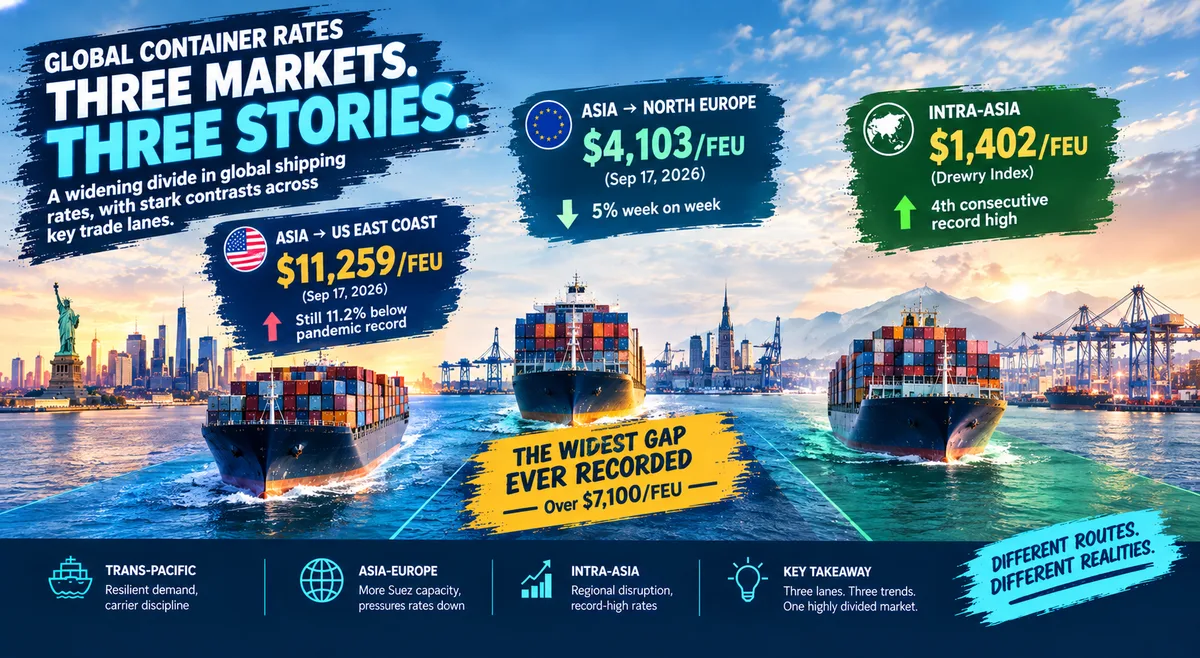
Clarksons Research said in its latest Shipping Intelligence Weekly that "geographic divergence" continued in the container freight market, with Shanghai-North Europe rates falling 5% week on week to $2,425 per TEU, while transpacific rates continued to climb on resilient demand. Clarksons said the differential between the two trades has now reached "the widest levels ever seen by some margin."
Just How Big Is the Gap?
The scale of the split is even clearer in Xeneta's latest like-for-like FEU data. On September 17, 2026, Asia-US East Coast spot rates stood at $11,259 per FEU, compared with just $4,103 per FEU from Asia to North Europe — a gap of more than $7,100 per FEU.
To put that in context: shipping a container from Asia to the US East Coast right now costs nearly three times more than shipping the same container to North Europe. That kind of gap between two of the world's biggest trade lanes is historically unusual.
How Close Are We to Pandemic-Era Records?
The US East Coast market is now within touching distance of pandemic records. Xeneta calculates current rates are only 11.2% below the all-time high of $12,683 per FEU set in January 2022 — the peak of the pandemic-era shipping crisis, when global supply chains were in chaos and rates hit levels never seen before or since.
Asia-US West Coast rates, at $7,960 per FEU, are also elevated — sitting 17.9% below their COVID peak, but still historically very high.
Why Are Transpacific Rates Staying So High?
The transpacific market is being supported by resilient cargo demand and carrier discipline. Xeneta said offered capacity from Asia to the US East Coast is 6-7% higher in September than August — yet rates have continued climbing despite that extra capacity.
This is an important detail: normally, more available ship space pushes rates down. The fact that rates are rising even as capacity increases shows just how strong demand currently is on this specific lane.
Xeneta's chief analyst Peter Sand said carriers were "seizing the opportunity while the market is hot," with Sand expecting another rate push around the start of October and China's Golden Week — the week-long national holiday when factories typically front-load shipments before closing.
Why Are Asia-Europe Rates Falling at the Same Time?
While the transpacific booms, the Asia-Europe trade is heading in the opposite direction. Shanghai-North Europe rates fell 5% week-on-week to $2,425 per TEU — continuing a downward trend that connects directly to a story we covered last week: Maersk and Hapag-Lloyd's Gemini Cooperation returning more services to the Suez Canal.
As carriers restore faster Suez routing on Asia-Europe lanes (rather than the longer Cape of Good Hope diversion), the effective capacity on this trade increases significantly — each ship can complete more round trips per year on the shorter route. More effective capacity on a stable-demand lane naturally pushes rates down.
What About Intra-Asia Rates?
While the two major East-West trades pull in opposite directions, the world's largest container trade zone by volume — the intra-Asia trades — continues to report record-high earnings.
Drewry's Intra-Asia Container Index rose 6% last week to $1,402 per FEU, marking a fourth consecutive record high. The consultancy blamed geopolitical disruption, typhoons, and constrained capacity, with pre-Golden Week demand also lifting rates from China.
What Does This Three-Way Split Mean for Shippers?
- Asia-US shippers should expect continued high costs. With another rate push expected around China's Golden Week (early October), and demand showing no signs of softening, US importers sourcing from Asia should budget for elevated rates through at least mid-October.
- Asia-Europe shippers may see continued relief. As more Gemini services return to Suez routing, effective capacity on this lane should keep rising — meaning further downward pressure on rates is plausible, though not guaranteed given demand fluctuations.
- Book Asia-US capacity early, especially ahead of Golden Week. Chinese factories typically rush shipments out before the national holiday shutdown. Combined with already-tight transpacific capacity, this period historically sees the sharpest rate spikes of the year.
- Intra-Asia shippers face their own tight market. With rates at record highs for four straight weeks, businesses moving goods within the region — not just to the US or Europe — should also factor in continued cost pressure.
- Watch for further divergence. This is not a temporary blip — it reflects two genuinely different sets of market forces (resilient US demand vs. returning Suez capacity) that could continue pulling rates in opposite directions for weeks to come.
Key Takeaways — September 21, 2026
- Asia-US East Coast rates hit $11,259/FEU on September 17 — just 11.2% below the January 2022 pandemic-era record.
- Asia-North Europe rates fell to $4,103/FEU — a gap of over $7,100/FEU between the two lanes.
- Clarksons Research calls the divergence "the widest levels ever seen by some margin."
- Transpacific rates are climbing despite 6-7% more capacity in September vs. August — a sign of exceptionally strong demand.
- Another rate push is expected around early October, tied to China's Golden Week holiday.
- Asia-Europe rates are falling as more capacity returns via the Suez Canal (Gemini Cooperation services).
- Intra-Asia rates hit a fourth consecutive record high at $1,402/FEU, driven by typhoons, geopolitical disruption, and Golden Week demand.
Global container shipping is currently telling three very different stories at once: a red-hot transpacific market nearing pandemic records, a cooling Asia-Europe trade as Suez capacity returns, and a record-breaking intra-Asia market squeezed by regional disruption. For shippers on any of these lanes, understanding which story applies to your specific route has never mattered more.



Comments
No comments yet. Be the first to share your thoughts!