
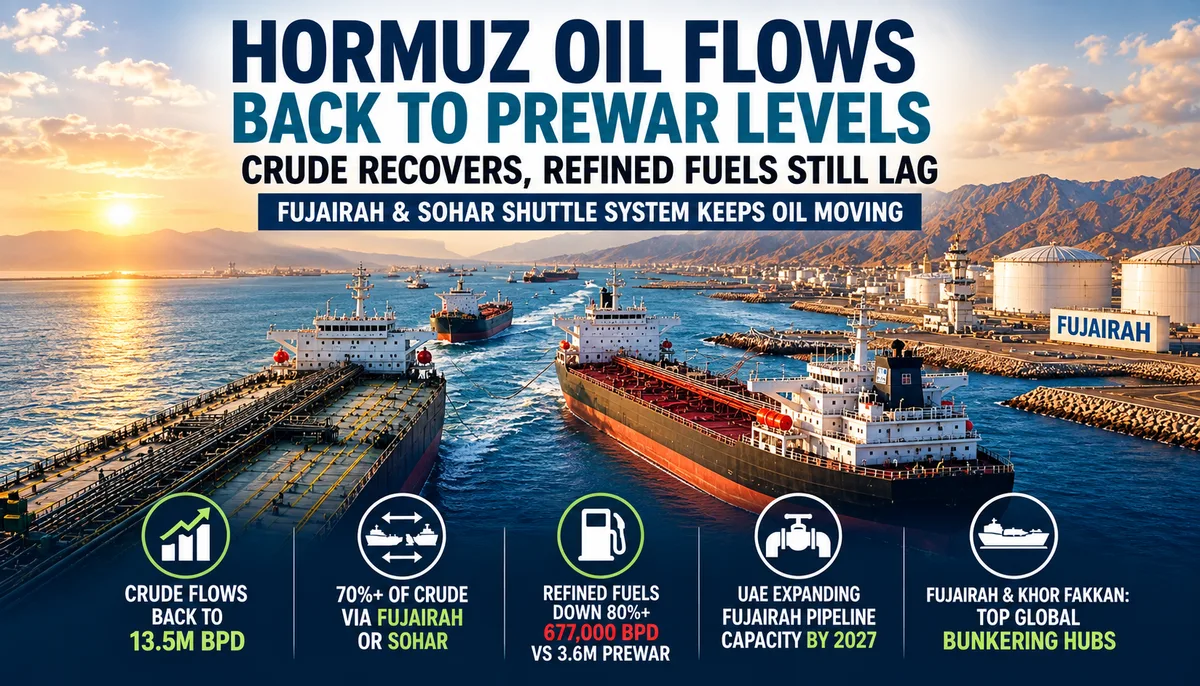
Crude oil shipments through the Strait of Hormuz have climbed back to prewar levels, according to tanker-tracking firm Kpler, even as the strategic waterway continues to operate under the strain of regional conflict that began in February. Crude transiting Hormuz reached a seven-day average of 13.5 million barrels per day, matching the prewar baseline, a notable recovery given the severe disruption the corridor has faced over recent months, including repeated attacks on vessels and shoreside infrastructure throughout the conflict.
How the recovery is happening
The rebound has relied heavily on Fujairah and Sohar, two ports on the Gulf of Oman positioned just outside the strait itself. In August, more than 70% of crude that crossed Hormuz changed tankers off Fujairah or Sohar through a shuttle system, where smaller tankers move oil through the strait before transferring cargo to larger vessels continuing on to buyers. This workaround has helped restore crude supplies, though it remains considerably more complex and costly to operate than the normal prewar export network, adding extra handling steps and transfer risk to every shipment that moves through the corridor.
Fujairah's role as a bypass hub has grown steadily more important throughout the conflict. Positioned on the UAE's east coast outside the strait, the port has become central to maintaining Gulf oil flows, supported by the Abu Dhabi Crude Oil Pipeline linking onshore fields at Habshan to Fujairah, along with substantial crude and fuel storage capacity built up over the past two decades, including the large Mandous underground storage facility near the port. Fujairah's storage capacity is estimated at around 70 million barrels, with ongoing expansion projects designed to increase that further, cementing its position as one of the world's most important oil storage, blending, and logistics centers even before the current conflict began.
The UAE has also been accelerating construction of additional pipeline capacity to Fujairah, aiming to roughly double its Hormuz-bypassing export capacity by 2027, a project that predates the current conflict but has taken on new urgency because of it. Notably, neither the Fujairah route nor Saudi Arabia's comparable pipeline to its Red Sea terminal at Yanbu is a complete failsafe, as infrastructure at both ends of these bypass routes has itself come under attack during the conflict, including strikes on a gas-processing facility near the pipeline's starting point and repeated damage to Fujairah's port facilities.
Refined fuel still lagging far behind
While crude flows have recovered, the picture for refined products looks very different. Refined fuel shipments through Hormuz averaged just 677,000 barrels per day over the most recent seven-day period, compared with 3.6 million barrels per day before the war, a drop of more than 80%. This gap reflects ongoing refinery damage in the region and continued shipping disruption that has made it harder to move diesel, gasoline, and other refined products at anywhere close to normal volumes.
The imbalance between crude and refined fuel recovery highlights an important distinction in how the crisis has played out. Crude oil has more flexible routing options, including the Fujairah shuttle system and overland pipeline capacity, while refined fuel movement depends more heavily on functioning regional refineries and direct tanker routes that have been harder to restore. Compounding the issue, Fujairah's own bunker fuel market has faced its own supply squeeze, with certain grades like high-sulphur fuel oil and marine gas oil reported in short supply earlier in the conflict due to the port's heavy reliance on imports from Iran and Iraq, both of which faced their own disruptions.
Why it matters for the industry
For shippers and energy buyers, the divergence between recovering crude flows and lagging refined fuel supplies means continued price pressure and availability challenges for products like diesel and jet fuel, even as headline crude numbers suggest the worst of the disruption may be easing. The shuttle-tanker workaround through Fujairah and Sohar, while effective, also adds cost and complexity to the supply chain, a burden that is likely to persist as long as direct Hormuz transit remains constrained.
For the broader shipping industry, Fujairah's expanded role also matters beyond oil exports. The port and nearby Khor Fakkan rank among the top three bunkering hubs globally, supplying fuel to thousands of vessels transiting between Europe and Asia. Continued strain on fuel availability there has ripple effects for vessel operators across multiple trade lanes, not just those directly involved in Gulf oil exports.
Key takeaways
- Crude oil shipments through the Strait of Hormuz have returned to a prewar-level average of 13.5 million barrels per day.
- More than 70% of crude crossing Hormuz in August moved through a shuttle-tanker system via Fujairah or Sohar.
- Refined fuel shipments remain severely constrained, averaging just 677,000 barrels per day versus 3.6 million prewar.
- The UAE is accelerating pipeline expansion to Fujairah, aiming to roughly double Hormuz-bypassing export capacity by 2027.
- Fujairah and nearby Khor Fakkan remain critical global bunkering hubs, meaning fuel constraints there affect vessels well beyond the Gulf region.
For freight forwarders and energy logistics providers, this split recovery is worth tracking closely, as crude supply normalization doesn't necessarily translate into relief for refined fuel markets or shipping costs tied to diesel and bunker fuel availability.



Comments
No comments yet. Be the first to share your thoughts!