
What Happened This Week — The Simple Version
The United States and Canada — two of the world's closest trading partners, sharing the longest undefended border on Earth — have fallen into a full-scale trade war.
Here is the timeline of events:
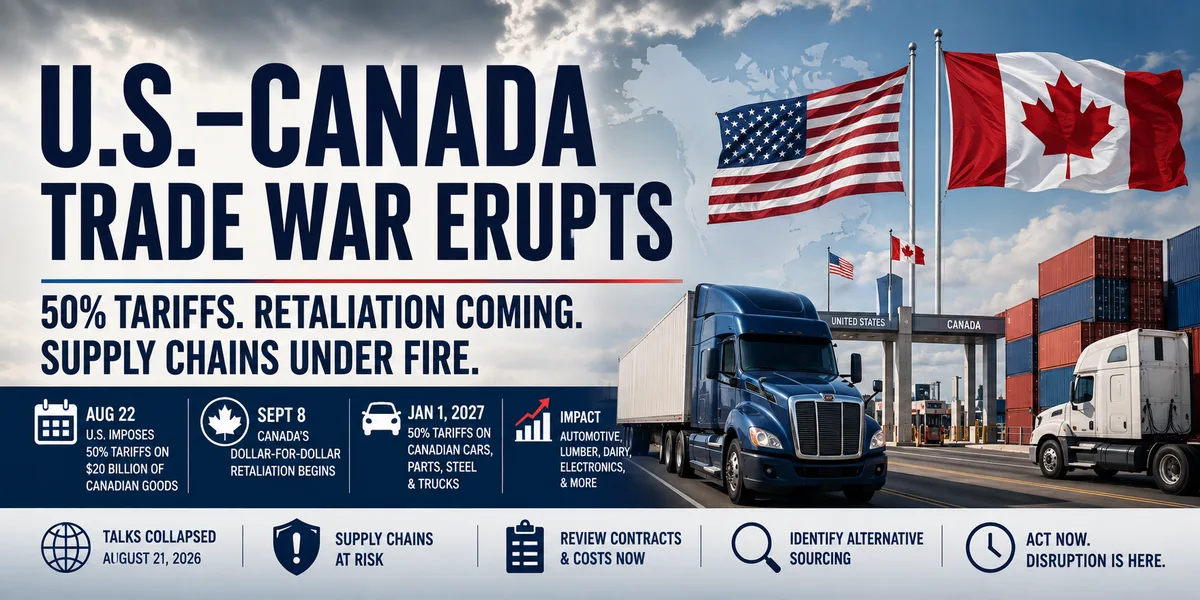
- Friday August 21, midnight: Three days of trade talks in Washington DC collapsed. Negotiators from both sides could not reach agreement before a midnight deadline.
- Saturday August 22, 12:01 AM: < cite index="93-1">The US imposed 50% tariffs on $20 billion worth of Canadian goods. The tariffs hit immediately — with no grace period.
- Saturday August 22, morning: < cite index="96-1">Canadian Prime Minister Mark Carney said Canada will match those tariffs "dollar for dollar" starting September 8. At a press conference, Carney compared the US actions to a military conflict: "You're at war when you get attacked. We got attacked."
- Monday August 24: President Trump escalated further, announcing a 50% increase in tariffs on all cars, trucks, automotive parts, and steel entering the US from Canada — beginning January 1, 2027.
In just 72 hours, the US-Canada trade relationship went from difficult negotiations to an active, escalating trade war — with both sides now committed to imposing punishing tariffs on each other's goods.
What Exactly Is Being Taxed at 50%?
The August 22 tariffs cover a surprisingly wide range of Canadian goods. < cite index="95-1">Impacted products include dairy, alcohol, and a wide range of items across numerous industries from electronics and building materials to apparel and agricultural goods. Notably, the tariffs apply even to CUSMA-compliant goods and have no expiry date.
The specific product categories include:
- Dairy products — milk, cream, whey, and related ingredients
- Electronics and telecom equipment
- Furniture and home goods
- Building materials — lumber, plywood, doors, cement
- Plastics and packaging
- Clothing, footwear, and luggage
- Toys and sporting goods — including hockey sticks
- Machinery and manufacturing inputs
- Agricultural products — flowers, plants, seeds
- Cosmetics and fragrances
And from January 1, 2027: < cite index="99-1">vehicles such as trucks and cars of any size, steel, and automotive parts will be subjected to a 50% tariff.
The critical point for importers: < cite index="95-1">the tariffs apply even to CUSMA-compliant goods. This means products that previously qualified for zero tariffs under the US-Mexico-Canada Agreement — because they met the agreement's rules of origin requirements — are now subject to 50% duties anyway. This effectively overrides the trade agreement that has governed North American trade for years.
Why Did Talks Collapse?
Both sides blamed each other for the breakdown — but the core disagreement is clear.
< cite index="100-1">USTR Ambassador Jamieson Greer said the 50% duties on Canada were effectively payback for Ottawa's retaliation against prior tranches of Trump's tariffs: "The policy basis for those duties are related to measures that Canada took against the United States. I've got two countries in the world that have retaliated against the United States for trade measures: the People's Republic of China and Canada."
< cite index="100-1">Canadian PM Carney blamed the breakdown on what he said were the Trump administration's "uneconomic" and "unfair" demands, and called the 50% tariffs "a miscalculation."
The White House says Canada has been "discriminating" against US dairy, alcohol, and motor vehicle exports for years. Canada says it is simply defending its domestic industries under longstanding trade rules. Neither side is backing down — and Canada has now set September 8 as the date its retaliatory tariffs begin.
What Does This Mean for Canada-US Supply Chains?
The US and Canada have one of the most deeply integrated trading relationships in the world. Goods cross the border multiple times during the manufacturing process — a car built in Ontario might have an engine made in Michigan, which was assembled from steel rolled in Indiana. Supply chains do not have a simple "Canadian" or "American" origin — they are woven together.
That integration is what makes this tariff war so damaging. Here is the direct supply chain impact:
Cross-Border Manufacturing
The automotive industry is the most exposed. Canadian auto plants — many of them owned by Ford, GM, and Stellantis — ship vehicles and parts across the border constantly. < cite index="99-1">Trucks, cars, and automotive parts will face 50% tariffs from January 1, 2027. For automakers operating integrated North American supply chains, this is a potentially catastrophic cost increase. A vehicle that crosses the border twice during production could face tariffs both times.
Lumber and Building Materials
Canada is the largest supplier of softwood lumber to the United States — used in homebuilding, construction, and packaging. < cite index="95-1">Lumber, plywood, and doors are now subject to 50% tariffs. US homebuilders and construction companies will see material costs rise sharply — at a time when housing construction is already expensive.
Food and Agricultural Products
Canadian dairy, agricultural products, and food items now face 50% duties. For US food importers sourcing from Canada — particularly in border states like New York, Michigan, and Washington — supply chains need immediate review. Alternative sourcing from US domestic producers or other countries may be needed.
Electronics and Industrial Equipment
Many electronics and manufacturing inputs imported from Canada — or assembled in Canada from US-sourced components — now face 50% tariffs. For industrial manufacturers, this creates immediate cost pressure and potential supply disruption.
Canada's Retaliatory Tariffs — September 8
Canada's retaliation starts September 8. While the specific product list has not yet been announced, Carney has promised dollar-for-dollar matching — meaning approximately $20 billion of US goods will face equivalent Canadian tariffs. US exporters to Canada — agricultural producers, manufacturers, service companies — should expect their Canadian customers to face higher costs and potentially reduce orders.
What About USMCA / CUSMA?
One of the most alarming aspects of this escalation is what it means for the US-Mexico-Canada Agreement (USMCA — called CUSMA in Canada).
USMCA was supposed to be the framework that governs North American trade until at least 2036. < cite index="95-1">The tariffs apply even to CUSMA-compliant goods and have no expiry date. If the US can impose 50% tariffs on goods that fully comply with USMCA's rules of origin, then the agreement's core promise — tariff-free trade for qualifying goods — is effectively meaningless.
The USMCA six-year review is currently underway. The collapse of this week's negotiations and the imposition of 50% tariffs make a productive review outcome significantly less likely.
What Should Logistics Professionals and Importers Do Right Now?
- Identify every Canadian-origin product in your supply chain immediately. Create a complete list of goods you import from Canada — or that contain Canadian components — and calculate the cost impact of a 50% tariff on each. This is urgent. The tariffs are already in effect on many products.
- Check CUSMA compliance status — but do not assume it protects you. Even CUSMA-compliant goods are now subject to these tariffs. Verify your specific product and HS code classification to understand exactly what applies.
- Review supplier contracts for tariff clauses. Many cross-border supply contracts have provisions for material changes in trade conditions. A 50% tariff qualifies — check whether your contracts allow cost pass-through or renegotiation.
- Identify alternative sourcing options. For products now facing 50% tariffs from Canada, evaluate US domestic suppliers or suppliers in Mexico or other countries. Some sourcing shifts will take time — start the process now.
- Plan for Canada's September 8 retaliation. If you export to Canada or sell to customers who do, prepare for Canadian customers to face higher costs from September 8. This may reduce demand for your products in the Canadian market.
- Watch automotive supply chains closely. The January 2027 date for automotive tariffs gives the auto industry some runway — but the clock is ticking. Supply chain restructuring for integrated North American auto production takes months or years. The planning needs to start now.
- Do not assume this resolves quickly. Both sides have publicly committed to their positions. Carney said talks are suspended — not over. But with Canada saying it is "at war" and Trump escalating to automotive tariffs, a quick resolution looks unlikely.
Key Takeaways — August 25, 2026
- US imposed 50% tariffs on $20 billion of Canadian goods — effective August 22, 2026.
- Products covered: dairy, lumber, electronics, building materials, clothing, machinery, agricultural goods.
- Tariffs apply even to CUSMA-compliant goods — with no expiry date.
- Canada PM Carney: "We got attacked. We are at war." Dollar-for-dollar retaliation starts September 8.
- Trump escalated August 24 — 50% tariffs on Canadian cars, trucks, automotive parts, and steel from January 1, 2027.
- Talks suspended — no resolution in sight as of August 25.
- Most exposed sectors: automotive, lumber/construction, dairy/food, electronics, manufacturing.
- Action needed now: audit Canadian-origin supply chains, check contracts, identify alternatives, plan for September 8 retaliation.
The US-Canada trade war just went from a slow burn to an open fire. With 50% tariffs already in effect, Canadian retaliation 14 days away, and automotive tariffs coming in January, the most integrated bilateral trade relationship in the world is being fundamentally disrupted. For logistics professionals and importers on both sides of the border — the time to act is right now, not after the next escalation.



Comments
No comments yet. Be the first to share your thoughts!