
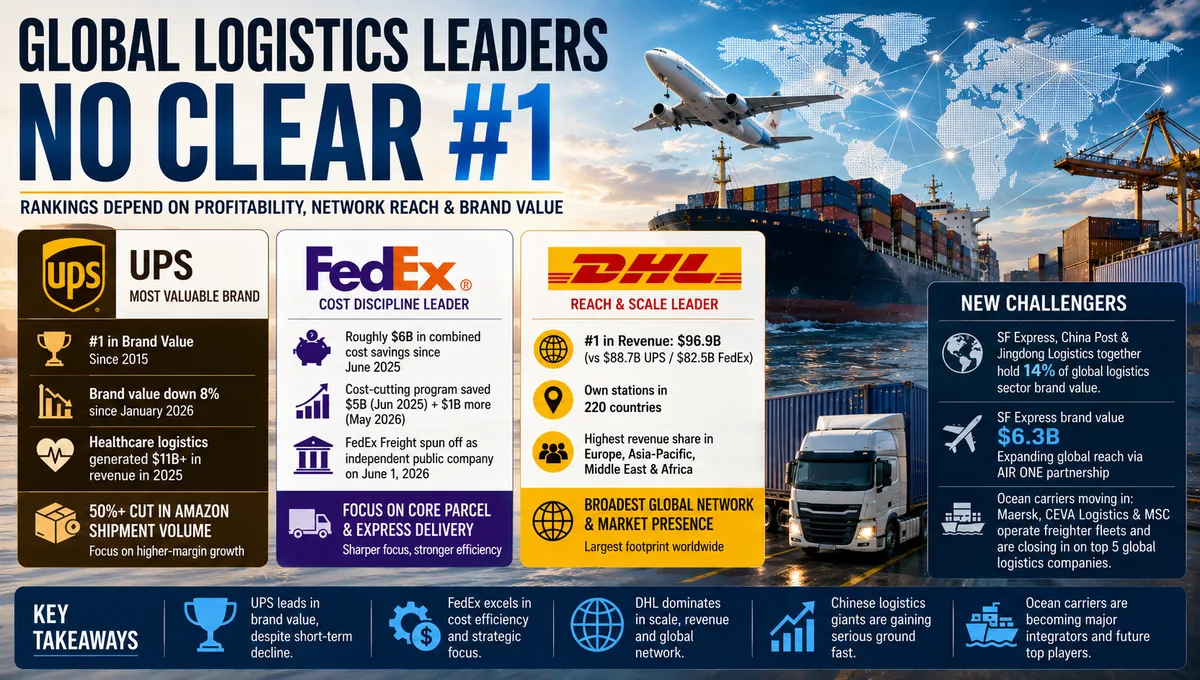
Who leads global logistics really depends on how you measure it. According to the latest survey from Brand Finance, a London-based brand valuation consultancy that closely tracks the logistics industry, there is no clear number one among UPS, FedEx, and DHL. Rankings shift depending on whether the criteria used is profitability, geographic reach and network footprint, or overall brand value. What is consistent across all three companies is that they are each facing headwinds this year, to varying degrees, stemming from U.S.-imposed tariffs, geopolitical tensions, and ongoing supply chain disruption.
UPS holds the brand crown, but at a cost
UPS defended its position as the world's most valuable logistics brand in the first half of 2026, a title it has held continuously since 2015. That said, the company's brand value has dipped 8% since January, a decline that traces directly back to a strategic decision UPS made two years ago to significantly cut its dependency on Amazon.
UPS has reduced Amazon shipment volumes by more than 50% since that decision. The reasoning was straightforward: those high-volume, last-mile parcels were clogging UPS's sorting facilities while generating comparatively lower profits than longer-range, higher-margin deliveries. Amazon has been UPS's largest customer for nearly 30 years and still contributes almost 11% of the company's consolidated revenue, so the pullback was not without near-term cost. But UPS management was willing to sacrifice that near-term revenue to stabilize long-term margins, and the company has been shifting its focus toward more profitable ventures such as healthcare logistics, a segment that generated more than $11 billion in revenue in 2025 alone.
FedEx climbs on cost discipline
FedEx ranks second in brand value, and its sustained performance can be attributed largely to a sustained cost-efficiency strategy that has helped it weather many of the same headwinds affecting the wider industry. A cost-cutting program launched in June 2025 saved the company $5 billion, and a follow-up savings initiative rolled out in May 2026 trimmed an additional $1 billion in costs, bringing total recent savings to roughly $6 billion.
Alongside cost discipline, FedEx has also worked to expand and clarify its revenue channels. The most significant structural move came on June 1, 2026, when FedEx Freight, the company's less-than-truckload freight division, was spun off and established as its own independent, publicly traded company. This has allowed the parent FedEx brand to sharpen its focus on core parcel and express delivery, solidifying its position within the broader industry even as competition intensifies.
DHL leads on scale and global reach
When the criteria shift to reach, shipment volume, and local market presence, DHL remains clearly ahead of both UPS and FedEx. The Deutsche Post subsidiary generated $96.9 billion in revenue last year, compared to $88.7 billion for UPS and $82.5 billion for FedEx, making it the largest of the three by top-line revenue.
DHL operates its own stations in 220 countries, giving it the broadest physical footprint among the major integrators, and it holds the highest revenue share in its core markets across Europe, Asia-Pacific, the Middle East, and Africa. By contrast, UPS and FedEx generate a significantly larger share of their revenue from the domestic U.S. market, where they maintain large-scale coverage through their own extensive station networks, but with comparatively less international depth than DHL.
New challengers are closing in
The current leaderboard may not hold for long. A new wave of heavyweight competitors is emerging from China, and together they are already reshaping the competitive landscape. SF Express, China Post, and Jingdong Logistics now account for a combined 14% of the entire sector's total brand value.
SF Express in particular has shown especially strong momentum, posting a brand value of $6.3 billion and remaining notably steadfast amid industry-wide headwinds this year. Much of that resilience is tied to a partnership with cargo aircraft provider AIR ONE, which has allowed SF Express to expand its routes into Europe and broaden its global network. That partnership is also helping streamline transit times while supporting rising trade and logistics demand between the Far East and Europe, a corridor that has become increasingly important as shipping patterns shift.
Beyond the traditional parcel integrators, ocean carriers are increasingly moving into the integrator space as well. Denmark's Maersk and France's CEVA Logistics, alongside Switzerland's MSC, now each operate their own freighter fleets in addition to their core maritime shipping businesses. Both Maersk and CEVA Logistics, in particular, appear on track to secure a place among the top five largest logistics companies in the world, barring a fundamental crisis in the global economy.
Key takeaways
- UPS remains the most valuable logistics brand, a title held continuously since 2015, despite an 8% year-to-date decline tied to a deliberate 50%+ cut in Amazon shipment volume.
- FedEx ranks second in brand value, boosted by roughly $6 billion in combined cost savings since June 2025 and the June 2026 spin-off of FedEx Freight as an independent public company.
- DHL leads on both revenue ($96.9 billion) and global network reach, operating its own stations in 220 countries.
- Chinese players SF Express, China Post, and Jingdong Logistics now hold a combined 14% of global logistics sector brand value.
- Ocean carriers Maersk and CEVA Logistics are expanding into freighter operations and closing in on a spot among the industry's top five.
For freight forwarders and shippers choosing between integrators, the "best" carrier increasingly depends on the specific lane, region, and service type needed, rather than a single dominant global leader. As Chinese logistics giants and ocean carriers continue expanding into the integrator space, the competitive picture is likely to keep shifting well beyond 2026.



Comments
No comments yet. Be the first to share your thoughts!