
A Shift That Is Expected to Outlast the Conflict
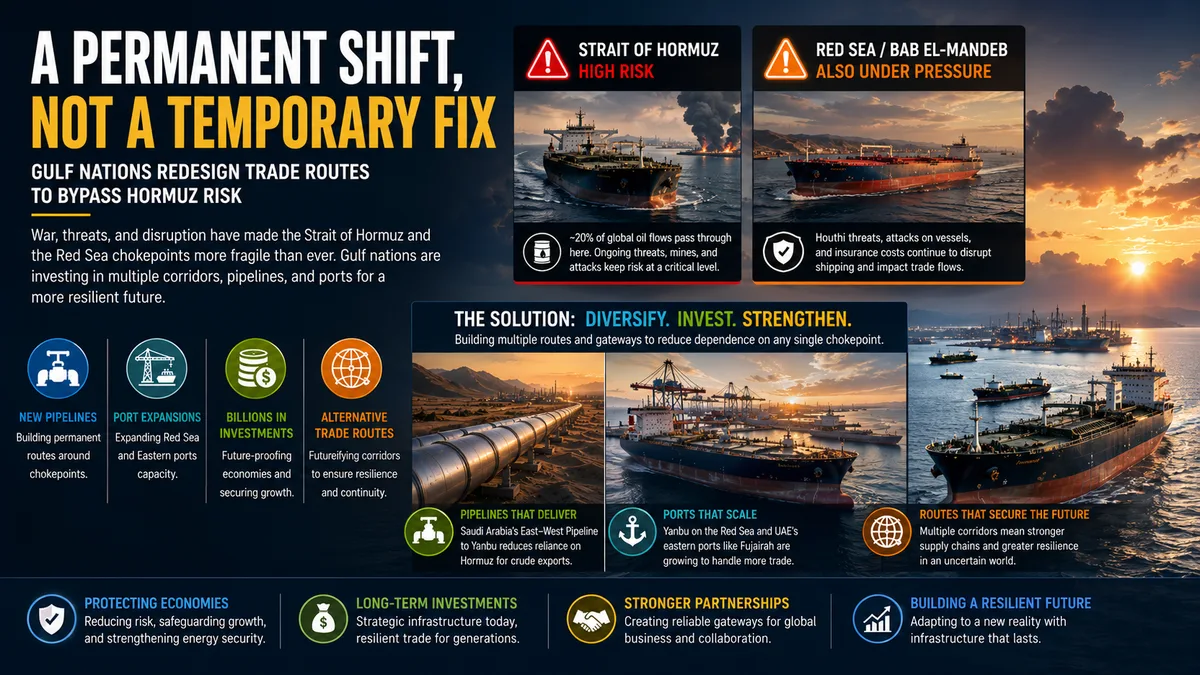
For most of the past six months, the story of the Strait of Hormuz has been about crisis management — dark tankers, military escorts, blacklisted vessels, and desperate workarounds to keep oil flowing during wartime. Now, a different kind of story is emerging: Gulf nations are no longer just managing the crisis. They are investing in infrastructure designed to outlast it.
Reuters reported on August 28, 2026 that the Iran war's redrawing of the global trade map is forcing Gulf nations to retool their investment playbook, ploughing capital into infrastructure — from energy pipelines to ports — to weather the fallout from the conflict.
But there is an important complication that changes how this story should be understood: the routes Gulf states are shifting cargo toward are not simply "safe" alternatives. The Red Sea corridor, in particular, is under serious pressure of its own.
Why Hormuz Became Such an Enormous Vulnerability
The war has highlighted the Gulf's overreliance on the Strait of Hormuz, previously a chokepoint for roughly a fifth of global oil flows but also subject for decades to Iranian threats of disruption.
Since the US-Israel military campaign against Iran began on February 28, 2026, that long-standing theoretical risk became a lived reality: months of attacks, mines, blacklisted tankers, and dark shuttle operations, all centered on a single 21-mile-wide waterway that carries an enormous share of the world's daily oil needs.
With the strait virtually blocked for much of the past six months, a burst of billions of dollars of investment commitments has emerged as Gulf energy exporters try to future-proof their economies now facing a severe slowdown.
Saudi Arabia's Pipeline Push
Saudi Arabia has fast-tracked billion-dollar plans to steer oil away from Hormuz, including a capacity expansion of its crude pipeline to the western Red Sea coast, potentially helping neighbours transport more oil without crossing the strait.
This East-West pipeline — running from the Gulf coast to Red Sea export terminals like Yanbu — has become one of the Kingdom's most important alternative export routes during the crisis. Expanding its capacity signals that Saudi Arabia is not treating this as a temporary detour, but building meaningful additional capacity to reduce, though not eliminate, its exposure to any single maritime chokepoint.
The Critical Catch: The Red Sea Is Not a Safe Harbour Either
This is the part of the story that deserves the most attention — because it changes the entire framing of Gulf diversification efforts.
Since the Houthis declared a maritime blockade against Saudi Arabia on July 20, 2026, Saudi crude transits through the Bab el-Mandeb strait have collapsed. According to Kpler data, weekly Saudi crude transits through Bab el-Mandeb averaged above 3.5 million barrels per day in early July — but had fallen close to zero by August.
The attacks have been direct and repeated. On August 24, 2026, Houthi forces struck the Saudi-flagged VLCC Amzan — a 320,926-deadweight-ton tanker owned by Saudi shipping giant Bahri, capable of carrying roughly 2 million barrels of crude — with a ballistic missile off Yanbu. The vessel caught fire; all crew survived. This was part of a sustained Houthi campaign specifically targeting Saudi-flagged, Saudi-owned, and Saudi-managed vessels in the Red Sea.
In response, Saudi Arabia has pursued a second diversion strategy: redirecting Yanbu exports northward through the Suez Canal and the SUMED pipeline in Egypt, rather than southward through Bab el-Mandeb. Kpler data shows Saudi crude transits via the Suez Canal rose from essentially zero in May-June to nearly 500,000 barrels per day by late July, with crude departures to Ain Sukhna, Egypt reaching the second-highest level on record.
The trade-off is significant: a Saudi oil cargo from Yanbu to Asian buyers takes roughly 24 days via Bab el-Mandeb, compared to around 54 days via Suez and the Cape of Good Hope — more than four extra weeks at sea, with real cost and scheduling implications for every shipment rerouted this way.
In short: the accurate picture is not "Hormuz is dangerous, so the Red Sea is the safe replacement." It is that Hormuz remains the primary chokepoint crisis, while the Red Sea/Bab el-Mandeb corridor is itself under serious and escalating pressure — forcing Gulf states toward an even more diversified network of pipelines, ports, and alternative corridors, rather than a single fallback route.
Trade Redirects to Smaller, Alternative Gateways
Trade is being redirected to Saudi ports on the Red Sea and the United Arab Emirates' eastern ports — but capacity at these alternative gateways remains smaller than what Hormuz-facing infrastructure could historically handle.
This capacity gap is precisely why the current wave of investment matters. Ports like Yanbu on Saudi Arabia's Red Sea coast, and the UAE's eastern gateways such as Fujairah, were never built to carry the full volume that once flowed through the Gulf's traditional export terminals. Investment underway now is aimed at closing that gap — with these facilities being developed toward higher-capacity strategic trade corridors over time, even as the Red Sea security situation remains volatile in the near term.
The Economic Cost Driving This Urgency
The scale of investment being committed reflects just how severe the economic damage has already been. Beyond disruptions to shipping, strikes on production facilities in the Gulf have significantly affected oil refineries, aluminium plants, and data centres, among others, while air traffic remains below pre-war levels, impacting tourism and business flowing through the region.
The economic figures illustrate the divergence in impact across the region, according to a Reuters poll of economists:
- Qatar and Kuwait: Economies are set to shrink by just over 8% this year.
- Saudi Arabia: Economy will expand by 1.4% this year — a sharp slowdown from 4.5% growth in 2025, but still positive, reflecting its head start on alternative export infrastructure.
Qatar's situation is especially difficult. As one of the world's top liquefied natural gas exporters before the Iran war, Qatar relies wholly on the strait to export LNG and also faces massive production shortages due to damage sustained during the conflict. Unlike crude oil, LNG cannot easily be rerouted through a pipeline — it requires specialized export terminals and dedicated LNG carriers, making Qatar's exposure to the Hormuz blockage particularly severe and difficult to engineer around.
Global Oil Supply Cushion Under Watch
There is also a broader supply concern feeding into this urgency, according to energy analytics firms Kpler and Vortexa. Kpler expects China's crude inventory drawdown to accelerate over the next three months, while Vortexa has separately warned of a significant tightening risk as Atlantic Basin oil inflows slow.
This adds further pressure on Gulf producers to secure reliable, diversified export capacity as quickly as possible — both to protect their own revenue and to help stabilize a global oil market that analysts warn is running low on buffer.
What Does This Mean for Global Logistics and Freight?
- A more diversified — not simply relocated — Gulf trade map is emerging. Even if the Iran war ends and Hormuz fully reopens, the pipeline and port capacity being built now is unlikely to disappear. Gulf oil exports are expected to remain more geographically spread than before February 2026 — but this is a diversification across multiple imperfect routes, not a shift to one clearly "safe" corridor.
- Red Sea risk must be tracked separately from Hormuz risk. Shippers and insurers covering Gulf-linked cargo should not treat Red Sea routing as a low-risk fallback. Saudi-flagged and Saudi-linked vessels currently face active, stated targeting by Houthi forces in that corridor.
- Suez/SUMED rerouting adds real time and cost. The roughly 30 extra days required to move Yanbu crude via Suez instead of Bab el-Mandeb has direct implications for vessel scheduling, freight capacity absorption, and delivered costs on affected trade lanes.
- Qatar's LNG constraint has no easy fix. Unlike crude oil, which can be rerouted via pipeline, Qatar's LNG exports remain structurally tied to the strait, meaning LNG shipping and pricing volatility tied to Hormuz risk is likely to persist longer than crude volatility.
- Expect continued project announcements — but verify security conditions alongside capacity news. New berths, pipeline expansions, and terminal upgrades represent genuine new capacity entering the market. But given the current Red Sea situation, capacity growth and route safety need to be assessed as two separate questions, not one.
Key Takeaways — August 29, 2026
- Gulf nations are making billions of dollars in infrastructure investment commitments aimed at reducing — not eliminating — dependence on the Strait of Hormuz.
- Saudi Arabia has fast-tracked expansion of its Red Sea crude pipeline capacity as one of its most important alternative export routes.
- Saudi crude transits through Bab el-Mandeb fell close to zero in August 2026 after Houthi attacks, including a missile strike on the VLCC Amzan off Yanbu on August 24.
- Saudi Arabia is instead rerouting significant volumes via the Suez Canal and SUMED pipeline — adding roughly 30 days of transit time versus the Bab el-Mandeb route.
- Qatar and Kuwait's economies are projected to shrink over 8% this year; Saudi Arabia's growth has slowed sharply but remains positive at 1.4%.
- Qatar's LNG exports remain especially exposed, as LNG cannot be easily rerouted via pipeline like crude oil.
- Kpler and Vortexa both flag a shrinking global oil supply cushion over the next two to three months.
- This infrastructure shift is expected to have lasting effects on Gulf trade routing, though the timeline and shape of that shift remain uncertain given ongoing Red Sea risk.
The Strait of Hormuz crisis has moved well past its initial shock phase — but the lesson emerging from the past two months is not that Gulf states have found a safe way around it. It is that they are now managing risk across multiple imperfect chokepoints simultaneously. For global logistics and energy markets, understanding Hormuz and Red Sea risk as two separate, evolving problems — rather than one solved by the other — is essential to tracking this story accurately going forward.



Comments
No comments yet. Be the first to share your thoughts!