
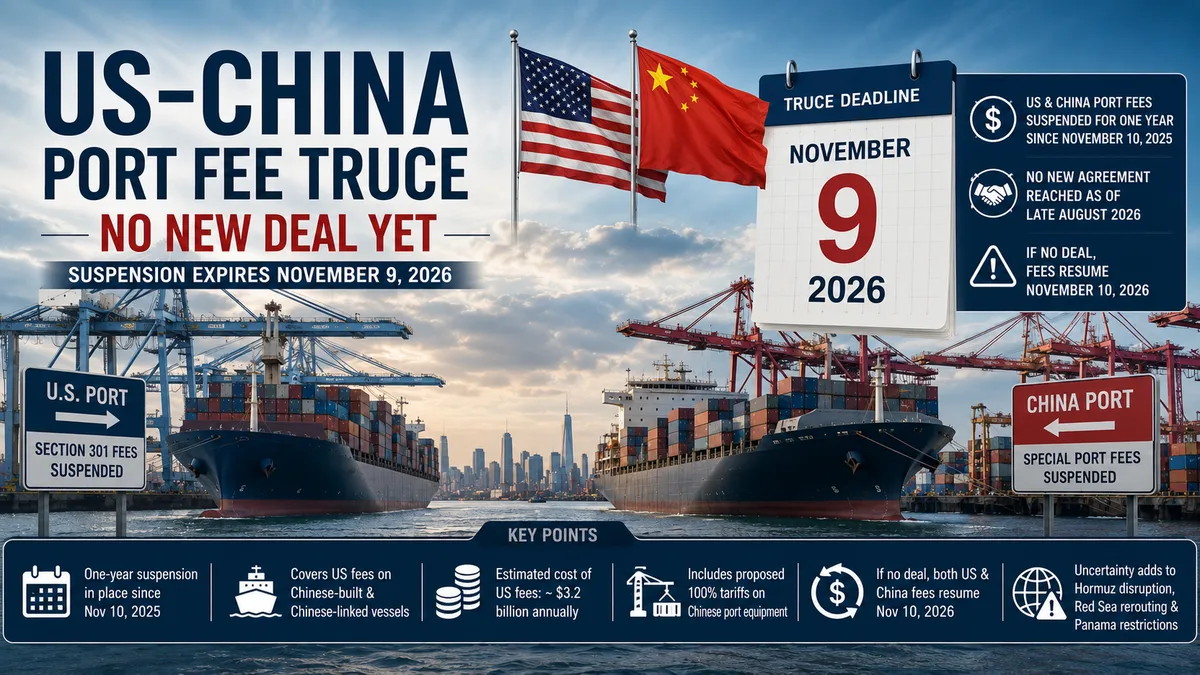
The United States and China have yet to reach a fresh agreement on the maritime port fees both countries suspended last November, according to Seatrade Maritime News. The one-year truce, due to expire on November 10, 2026, was struck as part of a broader trade deal between President Donald Trump and President Xi Jinping following talks in South Korea in late October 2025. With just over ten weeks remaining before the pause lapses, there is still no public sign of a replacement agreement.
What the suspension covered
Under the original agreement, the US Trade Representative (USTR) paused Section 301 fees on Chinese-built vessels and on ships with Chinese owners or operators calling at US ports. In parallel, China's Ministry of Transport suspended its own special port fees on vessels with a US nexus. Both suspensions took effect on November 10, 2025, and were scheduled to run for exactly one year, through November 9, 2026.
The fees being paused were not minor. Estimates at the time put the annual cost to large Chinese-built vessels sailing to US ports at roughly $3.2 billion, had the charges remained in place. The pause also covered proposed 100% tariffs on Chinese-made ship-to-shore cranes and container chassis, equipment that much of the world's port infrastructure, including many US terminals, relies on heavily. Rather than simply letting the fees lapse and restart automatically, the USTR agreed at the time to continue negotiating with China on the broader Section 301 issues underlying the dispute, including concerns over China's dominance of global shipbuilding.
How we got here
The original Section 301 fees were first proposed by the USTR in April 2025, targeting what Washington described as China's unfair targeting of the maritime, logistics, and shipbuilding sectors for global dominance. The fees officially went into effect in October 2025, prompting swift retaliation from Beijing in the form of matching special port charges on US-linked vessels. That tit-for-tat escalation threatened to disrupt shipping schedules and add significant costs across the industry, until the late-October 2025 Trump-Xi meeting in South Korea produced the broader trade and economic deal that included the mutual one-year suspension.
In the months since, both governments have periodically reaffirmed the suspension through formal notices, with the USTR publishing its Notice of Modification in the Federal Register in mid-November 2025 confirming the pause would run through November 9, 2026. But confirmation of the suspension's terms is not the same as progress toward a permanent resolution, and as the industry now enters the final stretch before the deadline, that distinction is becoming more important.
Why the lack of progress matters
With no formal renewal or replacement agreement in place as the deadline approaches, shipping lines and vessel owners with Chinese exposure are left facing renewed uncertainty. If the suspension simply lapses on November 10, both sets of fees would automatically resume, once again adding cost pressure on carriers operating Chinese-built tonnage into US ports and on US-linked vessels calling in China.
This is not a hypothetical concern for the industry. Carriers had already reshuffled port rotations, adjusted vessel deployment schedules, and in some cases altered ownership structures earlier in 2025 specifically to limit their exposure to these fees before the truce was announced. Some shipping companies reportedly saw changes in their US-based directorships as a direct response to the Chinese charges penalizing carriers with American ownership stakes. A return of the charges without a clear transition period or warning could force much of that costly reconfiguration to happen all over again.
The timing compounds the risk. The shipping industry is already absorbing disruption from several other directions at once: the Strait of Hormuz remains largely closed to commercial traffic amid ongoing regional conflict, Red Sea rerouting continues to add transit time and cost on Asia-Europe lanes, and Panama Canal draft restrictions have tightened repeatedly through the second half of 2026. A fourth major disruption, in the form of reinstated port fees, would stack directly on top of costs carriers are already passing through to shippers.
What happens next
Both governments have given no public indication of a breakdown in talks, which is a modestly reassuring sign, but neither have they announced the kind of concrete progress that would give the shipping industry confidence heading into the November deadline. Historically, trade negotiations of this scale have often come down to the wire, with announcements arriving in the final weeks rather than well in advance, so a lack of news now does not necessarily signal failure.
Still, with just over two months remaining, carriers and shipowners are watching closely for any sign of an extension, a permanent resolution, or, at minimum, confirmation of how the transition would be handled if the fees do return. For an industry that runs on long lead times and advance planning, this kind of prolonged uncertainty is itself a cost, regardless of how the situation is ultimately resolved.
Key takeaways
- The US-China port fee suspension, in place since November 10, 2025, is due to expire November 9, 2026.
- No new agreement has been reached as of late August 2026, despite ongoing negotiations between Washington and Beijing.
- US fees on Chinese-built and Chinese-linked vessels were estimated at roughly $3.2 billion annually before the pause.
- The suspension also covers proposed 100% tariffs on Chinese-made ship-to-shore cranes and container chassis.
- If no deal is reached, both US and Chinese port fees would automatically resume on November 10, 2026.
- The uncertainty adds to existing pressure from Strait of Hormuz disruption, Red Sea rerouting, and Panama Canal restrictions.
For freight forwarders and shippers with Chinese-built tonnage in their supply chains, this is a deadline worth tracking closely over the next two months. A lapse in the truce could bring sudden new costs back into play right as carriers head into the winter shipping season, making early planning and close attention to any USTR or Chinese Ministry of Transport announcements essential in the weeks ahead.



Comments
No comments yet. Be the first to share your thoughts!