What Happened on June 2, 2026?
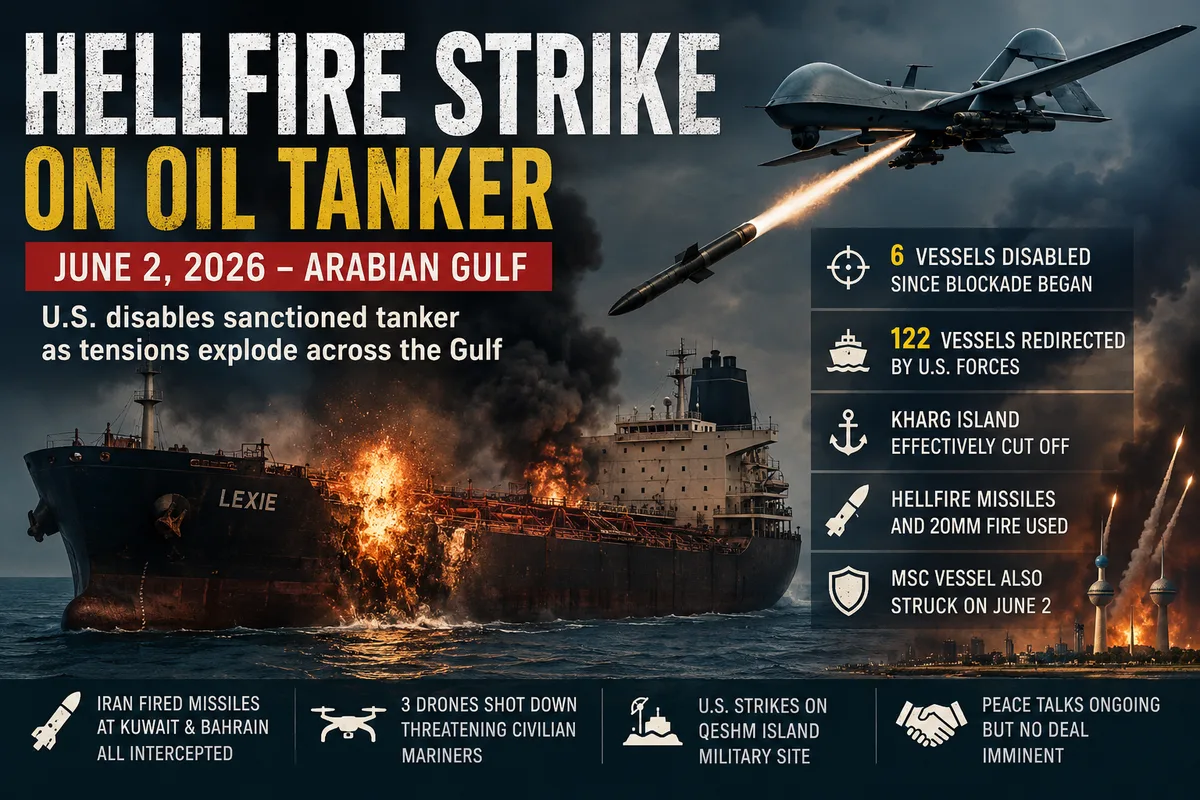
On Tuesday June 2, 2026, the US military's Central Command (CENTCOM) confirmed it had disabled an oil tanker in the Arabian Gulf using a Hellfire missile — one of the most powerful air-to-surface weapons in the US military arsenal.
U.S. forces disabled a sanctioned oil tanker attempting to reach an Iranian port on Tuesday, marking the sixth commercial vessel interdicted since Washington imposed a maritime blockade on Iran nearly two months ago.
In a statement, U.S. Central Command (CENTCOM) said U.S. forces stopped the Botswana-flagged tanker M/T Lexie after its crew allegedly ignored repeated warnings while transiting international waters toward Kharg Island, Iran's primary oil export terminal in the Persian Gulf. According to CENTCOM, the vessel failed to comply with directions from U.S. forces multiple times over a 24-hour period. A U.S. aircraft ultimately fired a Hellfire missile into the ship's engine room, disabling the tanker and preventing it from reaching Iranian waters.
No injuries were immediately reported.
Which Ship Was It and Who Owned It?
The disabled vessel appears to be the same tanker identified by the U.S. Treasury Department as LEXI (also known as LEXIE, IMO 9203277), a former Cameroon-flagged crude oil tanker sanctioned by the Office of Foreign Assets Control (OFAC) in March 2025 for allegedly transporting Iranian crude oil through ship-to-ship transfers. Treasury said the vessel was linked to Suriname-based Sea Services Providers NV and formed part of Iran's so-called "shadow fleet" used to move oil exports despite sanctions.
This is a critical point for the shipping industry: this was not a random commercial vessel innocently passing through the region. The M/T Lexie was already on the US Treasury's sanctions list — meaning any company doing business with this vessel was already in violation of US law before the missile strike.
What Is the US Blockade — And How Big Has It Gotten?
Since the Iran war began on February 28, 2026, the US has been enforcing an increasingly strict maritime blockade of Iranian ports. Here is where things stand as of June 2:
- 6 commercial vessels disabled — struck by US military forces after failing to comply with blockade orders
- 122 vessels redirected — turned around or ordered back to port by US forces since the blockade began
- Kharg Island — Iran's main oil export terminal, now effectively cut off from incoming tanker traffic
- Hellfire missiles and 20mm cannon fire — weapons being used to disable non-compliant vessels by targeting engine rooms and rudders
The blockade is real. It is active. And it is being enforced with live weapons fire on commercial vessels.
MSC Vessel Also Struck on June 2
The M/T Lexie was not the only vessel affected on June 2. The Mediterranean Shipping Company (MSC) confirmed that its vessel, Sariska V, was struck in the region.
MSC is the world's largest container shipping line. The confirmation that one of its vessels was struck — on the same day as the Lexie incident — underlines how dangerous the Arabian Gulf and surrounding waters have become for all commercial shipping, not just sanctioned tankers or vessels connected to Iran.
Iran Also Fired Ballistic Missiles on the Same Day
June 2 was not a quiet day in the region. On the same day as the tanker strike:
- Iran launched several ballistic missiles toward regional neighbors. Two Iranian missiles fired at Kuwait fell short or broke apart en route, and three missiles launched at Bahrain were immediately intercepted by US and Bahrain air defense forces.
- US forces also shot down three one-way attack drones launched by Iran toward civilian mariners that were rightfully transiting regional waters.
- American forces conducted self-defense strikes on an Iranian military ground control station on Qeshm Island.
Qeshm Island sits directly in the Strait of Hormuz. Striking a military installation there on the same day as a tanker missile strike shows just how active and dangerous this entire region has become.
Is There Any Hope of a Deal?
Despite the military activity, diplomatic channels remain open — barely.
Reuters reported Tuesday that Iran is reviewing a proposed agreement with the United States but has not exchanged messages with Washington for several days, according to Iranian media reports. President Donald Trump disputed those reports, insisting negotiations have continued without interruption.
The mixed signals from both sides suggest that while a deal is theoretically possible, it remains far from certain. For the shipping industry, the working assumption must remain that the Strait of Hormuz and Arabian Gulf will stay highly dangerous through at least 2027 — and possibly longer.
What Does This Mean for Commercial Shipping?
For every shipowner, operator, freight forwarder, and cargo insurer, the events of June 2 carry clear messages:
- The Gulf is an active conflict zone. Ships are being struck by missiles. This is not a theoretical risk — it is happening right now, on multiple vessels, on the same day.
- Sanctions compliance is critical. The M/T Lexie was on the US sanctions list before it was struck. Any company with links to sanctioned vessels or Iranian oil trade is at serious legal and physical risk.
- War-risk insurance premiums will keep rising. Insurers price risk based on real events. Missile strikes on commercial vessels in the Arabian Gulf will push premiums higher across the entire region.
- Gulf cargo routing is not normalizing. Despite occasional optimism about peace talks, the military situation on June 2 showed the conflict is intensifying, not winding down.
- Kharg Island is effectively off-limits. Iran's primary oil export terminal — handling a significant portion of global energy exports — remains inaccessible to commercial tankers. This feeds directly into elevated global fuel and freight costs.
Key Takeaways
- US military fired a Hellfire missile into the engine room of oil tanker M/T Lexie on June 2, 2026.
- The vessel was heading toward Kharg Island — Iran's main oil export terminal.
- This is the 6th vessel disabled since the US blockade began in April 2026.
- 122 vessels have been redirected by US forces since the blockade started.
- MSC vessel Sariska V was also struck in the region on the same day.
- Iran fired ballistic missiles at Kuwait and Bahrain — all intercepted.
- US conducted strikes on Qeshm Island military installation.
- Peace talks ongoing but fragile — no deal imminent as of June 2.
- War-risk insurance and fuel surcharges expected to remain elevated well into 2027.
The Arabian Gulf is no longer a zone of uncertainty — it is an active military operational area. Every company moving cargo anywhere near this region needs updated routing plans, current insurance coverage, and a clear understanding of which vessels and operators are on US sanctions lists. The events of June 2 make that more urgent than ever.

Comments
No comments yet. Be the first to share your thoughts!
Join the conversation
You need an account to comment on articles.