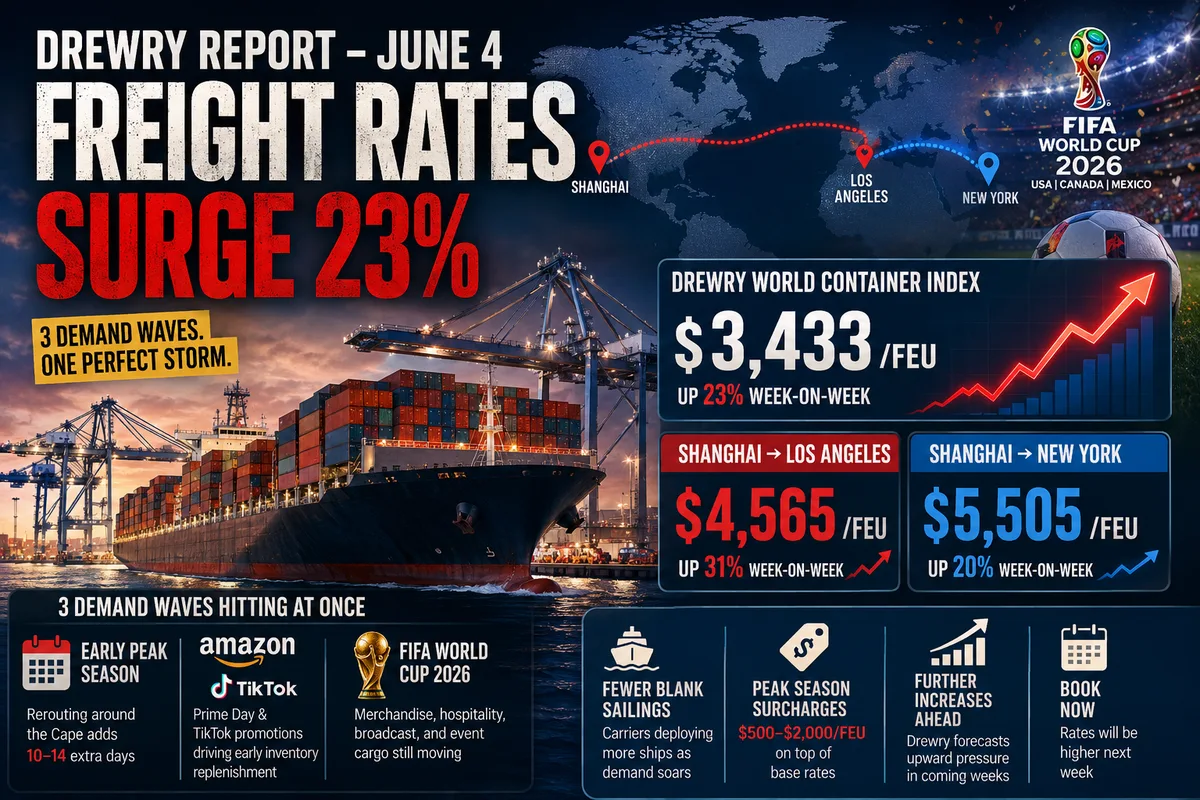
The Numbers — What Drewry Reported on June 4
Every week, Drewry Shipping Consultants publishes its World Container Index (WCI) — one of the most trusted benchmarks for global ocean freight rates. The June 4 report was a shock to many in the industry.
The Drewry World Container Index surged 23% to $3,433 per 40ft container — due to rate increases on the Transpacific and Asia–Europe trade routes as peak season sets in.
Here are the key route-by-route numbers:
- Shanghai → Los Angeles: UP 31% to $4,565 per 40ft container
- Shanghai → New York: UP 20% to $5,505 per 40ft container
- Global composite index: $3,433/FEU — up 23% in one week
To put this in perspective: just 3 months ago, the same Shanghai-LA route was trading around $2,200/FEU. It has more than doubled in just 12 weeks.
Why Are Rates Jumping So Fast?
Three separate waves of demand are all hitting the market at exactly the same time — and carriers are making the most of it.
Wave 1: Peak Season Is Here Early
The traditional shipping peak season runs from July to September — when retailers stock up for back-to-school and holiday shopping. But in 2026, peak season has arrived weeks ahead of schedule. With peak season now underway and seasonal demand strengthening through June, Drewry expects further upward pressure on rates in the coming weeks.
Why early? Because ships rerouting around the Cape of Good Hope (avoiding the Red Sea and Hormuz) take 10-14 extra days to reach Europe. European importers have been forced to order earlier to make sure goods arrive on time. That early demand is now showing up in the numbers.
Wave 2: Amazon Prime Day and TikTok Promotions
Retailers are replenishing inventories earlier than normal in preparation for major sales events, including Amazon Prime Day and TikTok's mid-year promotions in June and July.
Amazon Prime Day is expected in mid-July 2026. TikTok Shop's major mid-year sale event runs in June. For any retailer selling on these platforms, the cargo that will be sitting in US warehouses by then needs to have LEFT Asia already. Booking that cargo is happening right now — in June — adding a massive wave of additional demand on top of normal peak season volumes.
This combination of early peak season demand AND major retail event preparation — simultaneously — is unprecedented. It has essentially collapsed two separate demand cycles into one.
Wave 3: The FIFA World Cup 2026
This is the one that surprises people — but it makes complete sense when you think about it.
Additional cargo demand is linked to the 2026 FIFA World Cup. The FIFA World Cup begins on June 11, 2026 — just 5 days from today — and is being hosted across the United States, Canada, and Mexico.
What does a football tournament have to do with shipping? Quite a lot, actually:
- Merchandise and branded goods — official World Cup merchandise, replica shirts, flags, scarves, and branded products are manufactured primarily in Asia and need to be in North American stores and online warehouses before the tournament begins. All of that cargo needed to ship weeks ago — and late orders are still moving now.
- Fan travel equipment — stadium seating, temporary infrastructure, giant screens, catering equipment, and promotional materials all require freight movement across North America.
- Hospitality and food service — restaurants, hotels, and hospitality venues in host cities (New York, Los Angeles, Dallas, Miami, Vancouver, Mexico City) are stocking up on supplies to handle massive visitor numbers.
- Electronics and broadcast equipment — the largest sporting event in the world requires enormous quantities of broadcast technology, cameras, screens, and communications equipment.
The World Cup runs until July 19, 2026 — meaning cargo demand linked to this event is sustaining elevated freight activity for the entire peak shipping period.
What Are Carriers Doing With All This Demand?
Carriers are doing what any business does when demand exceeds supply: raising prices. And they are also making a strategic capacity decision.
According to Drewry's Container Capacity Insight, only three blank sailings have been announced on the Transpacific trade route for the next week — significantly fewer than in recent weeks — as carriers anticipate stronger cargo volumes.
This is interesting. Normally, carriers use blank sailings (cancelled departures) to reduce supply and keep rates high. But right now, they are actually deploying MORE ships — because demand is strong enough that they can fill them at high rates without needing to artificially restrict supply.
In addition, carriers successfully implemented Peak Season Surcharges (PSS) on the Transpacific eastbound trade route starting this month. This means on top of base rates, shippers are paying an additional surcharge of $500-$2,000 per container just for the "privilege" of shipping during peak season.
What Does $5,505 to New York Actually Mean?
To help put the current rate environment in context:
- Pre-pandemic normal (2019): ~$1,500/FEU Shanghai-NY
- Peak pandemic rate (2021-22): ~$15,000-$20,000/FEU
- Post-pandemic low (late 2023): ~$1,200/FEU
- Start of 2026 (pre-Iran war): ~$2,800/FEU
- Today — June 6, 2026: $5,505/FEU
Rates today are nearly double what they were at the start of this year — but still well below the insane pandemic peaks. The direction, however, is clearly upward — and Drewry is warning that further increases are coming in the weeks ahead.
What Should Shippers and Freight Forwarders Do?
- If you have July or August cargo — book this week. Every indicator suggests rates will be higher next week than they are today. The time to lock in space is now, not after the OPEC+ meeting, not after the Iran deal — now.
- Expect to pay Peak Season Surcharges. PSS is now a confirmed cost on Transpacific lanes. Budget for $500-$2,000/FEU on top of your base rate when calculating landed costs.
- Check your retail event timelines. If you sell on Amazon or TikTok Shop, your Prime Day and mid-year sale inventory needs to be in US warehouses by late June. If cargo has not shipped yet — you are cutting it very close.
- Consider Los Angeles over East Coast if flexible. LA rates at $4,565 are currently lower than NY rates at $5,505. If your distribution allows it, West Coast ports offer a $940/FEU saving right now.
- Build in extra buffer time. With fewer blank sailings, ships are running — but port congestion at LA, Long Beach, and East Coast ports is building as volumes increase. Plan for 2-3 days of extra transit and delivery time.
Key Takeaways — June 6, 2026
- Drewry WCI surged 23% week-on-week to $3,433/FEU — published June 4, 2026.
- Shanghai → LA: up 31% to $4,565/FEU. Shanghai → NY: up 20% to $5,505/FEU.
- Three demand waves hitting simultaneously: early peak season, Amazon Prime Day + TikTok, FIFA World Cup.
- FIFA World Cup starts June 11 — merchandise, hospitality, and broadcast cargo still moving.
- Carriers deploying more ships (fewer blank sailings) — demand is strong enough to fill them at high rates.
- Peak Season Surcharges now confirmed on Transpacific — budget extra $500-$2,000/FEU.
- Drewry forecasts further rate increases in the coming weeks.
Nobody planned their 2026 shipping budget around the FIFA World Cup. But right now, the world's biggest sporting event — combined with Amazon Prime Day, TikTok promotions, and an early peak season — is one of the forces driving the most expensive container shipping market since the pandemic. If you have cargo to move this summer, the most expensive mistake you can make is waiting.

Comments
No comments yet. Be the first to share your thoughts!
Join the conversation
You need an account to comment on articles.