What OPEC Just Announced — Published Today, June 5
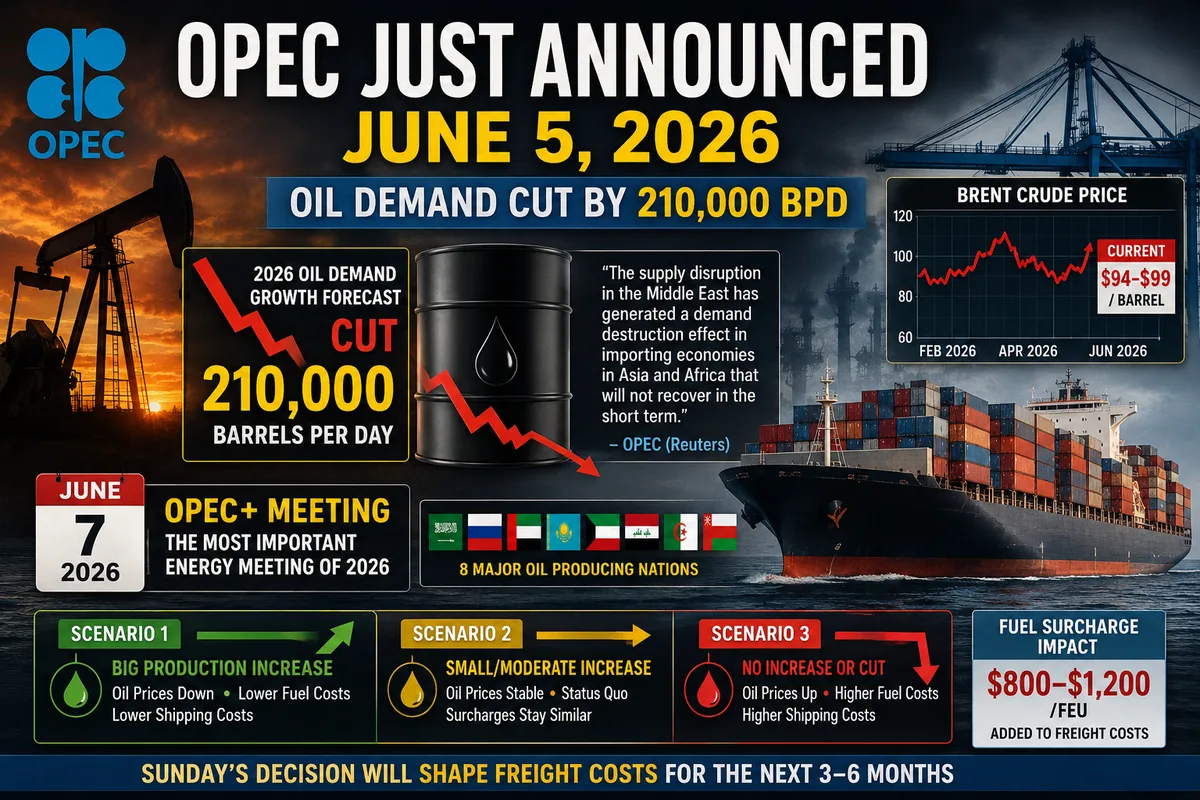
OPEC cut its oil demand growth forecast for 2026, reducing the growth estimate from 1.38 million barrels per day to 1.17 million bpd — a 210,000 bpd adjustment reflecting the cumulative impact of the geopolitical crisis in the Middle East and the volatility of global energy markets.
In simple terms: OPEC is now saying that because of the Iran war and high energy prices, the world will use 210,000 fewer barrels of oil per day than it previously expected in 2026.
Why? Because high oil prices — driven by the Strait of Hormuz closure — are hurting economies in Asia and Africa so badly that those countries are physically consuming less energy. OPEC reported that the OPEC+ bloc experienced a production decline of 1.74 million barrels per day during the Strait of Hormuz crisis — an impact that combined with the projected demand reduction reconfigures the balance between supply and consumption for the second half of the year.
Reuters quoted OPEC as saying: "The supply disruption in the Middle East has generated a demand destruction effect in importing economies in Asia and Africa that will not recover in the short term."
This is a major admission. OPEC is officially saying the Iran war is not just a temporary disruption — it is causing lasting economic damage that is reducing global energy demand.
Why Does This Matter for Shipping and Logistics?
Here is the direct connection that every freight professional needs to understand:
Oil price → Bunker fuel cost → Carrier surcharges → Your freight rates.
When oil is expensive, ships cost more to run. Carriers pass those extra costs to shippers as Emergency Fuel Surcharges (EFS) and Bunker Adjustment Factors (BAF). Right now, oil is near $94-$99 per barrel — roughly 35-40% above pre-war levels. That gap is sitting inside every freight invoice being paid today.
If OPEC's new forecast is correct — that demand is falling — then oil prices should face downward pressure in the second half of 2026. Lower oil = lower bunker costs = lower fuel surcharges = lower total freight costs for shippers.
But there is a catch: this only works if OPEC+ also increases supply. And that decision happens in just 2 days.
The June 7 OPEC+ Meeting — The Most Important Energy Meeting of 2026
The next OPEC+ meeting will take place on June 7, 2026. That is this Sunday — 48 hours from now.
At this meeting, 8 major oil-producing nations — Saudi Arabia, Russia, UAE, Kazakhstan, Kuwait, Iraq, Algeria, and Oman — will decide what to do about oil production levels. The options on the table are:
- Option 1: Increase production. Pump more oil to bring prices down. This would ease the energy crisis, help shipping costs fall, and give economic relief to the countries suffering from high prices. US President Trump has been pushing hard for this option — he has repeatedly called on Saudi Arabia to open the taps.
- Option 2: Hold production flat. Keep current output levels unchanged and let market forces play out. Oil prices stay elevated. Shipping costs stay high.
- Option 3: Cut production. Unlikely given current high prices, but possible if OPEC members want to maximize revenue while the market is tight.
The group has been increasing production in small increments since April 2025. But the Iran war has complicated everything — with Iranian oil exports severely disrupted by the US naval blockade, OPEC members face pressure to fill the gap in global supply.
What Has Been Happening With OPEC+ and Production?
Here is the background you need to understand where OPEC+ stands going into Sunday's meeting:
- Before the Iran war: OPEC+ was gradually unwinding production cuts that had been in place since 2022, slowly bringing more oil back to market.
- February 2026: The Iran war began. Iran's oil exports collapsed under the US naval blockade. Roughly 1.5-2 million barrels per day of Iranian oil effectively disappeared from global markets overnight.
- March-April 2026: Saudi Arabia, UAE, and other Gulf OPEC members came under intense pressure from the US and consuming nations to increase production and fill the Iranian gap. Some increases were agreed — but not enough to fully offset the loss of Iranian supply.
- May 2026: Oil peaked near $109/barrel before falling back toward $94-$99 as ceasefire hopes grew. But it is still far above pre-war levels.
- June 7: The next formal decision point. The market is watching closely.
Three Scenarios for Sunday and What Each Means for Shipping
Scenario 1: OPEC+ Announces a Significant Production Increase
This is the scenario the shipping industry is hoping for. If Saudi Arabia and its partners agree to pump significantly more oil — say, 500,000 to 1 million additional barrels per day — oil prices could fall sharply. Combined with progress on the US-Iran deal, Brent crude could potentially drop back toward $80-$85/barrel within weeks. Bunker fuel costs would fall. Emergency fuel surcharges would begin to ease. This is the scenario that starts normalizing freight costs.
Scenario 2: OPEC+ Makes a Small or Moderate Increase
The most likely outcome based on current signals. A modest increase of 100,000-300,000 bpd would show goodwill toward consuming nations without flooding the market. Oil prices would stay relatively stable — maybe edging down toward $90-$95/barrel. Fuel surcharges would not increase, but would not fall dramatically either. The status quo continues for shipping costs through most of summer.
Scenario 3: OPEC+ Holds Flat or Cuts
The worst scenario for shippers. If members decide current production levels are sufficient — or if compliance disputes prevent agreement — oil prices could spike back above $100/barrel, especially if the US-Iran peace deal also collapses. Fuel surcharges would increase further. This is the scenario that makes the current June peak season rate environment even more painful.
What the Numbers Look Like Right Now
- Brent crude today: ~$94-$99/barrel
- Pre-war level (February 2026): ~$70/barrel
- War peak (April 2026): ~$109/barrel
- Current fuel surcharge impact: Adding approximately $800-$1,200/FEU to ocean freight costs on top of base rates
- If oil returns to $80/barrel: Fuel surcharges could fall by $400-$600/FEU within 4-6 weeks of carriers repricing
What Should Logistics Professionals Do Right Now?
- Watch Sunday's OPEC+ announcement carefully. The decision will be announced on June 7. Set a news alert for "OPEC+ meeting June 7." The market's immediate reaction — particularly the oil price move — will tell you everything about what June and July freight costs look like.
- Do not assume fuel surcharges will fall soon. Even if OPEC+ increases production on Sunday, it takes 4-8 weeks for additional oil to reach refining, become bunker fuel, and for carriers to reprice their surcharges. Do not plan a budget reduction in fuel costs before August at the earliest.
- Factor current surcharges into Q3 pricing now. If you are pricing contracts or quotes for July-September shipments, use current fuel surcharge levels as your baseline. If surcharges fall later, that is a positive surprise. If they stay or rise and you quoted based on lower rates, you are in trouble.
- Watch for carrier announcements next week. If OPEC+ makes a meaningful production increase on Sunday, expect major carriers — MSC, Maersk, CMA CGM, Hapag-Lloyd — to come under commercial pressure to reduce or pause fuel surcharge increases within 2-3 weeks.
Key Takeaways — June 5, 2026
- OPEC cut its 2026 oil demand growth forecast by 210,000 bpd today — blaming the Iran war for "demand destruction."
- The Iran war caused a 1.74 million bpd production decline in OPEC+ output.
- OPEC+ holds its next production meeting on June 7, 2026 — 48 hours from now.
- Brent crude currently at ~$94-$99/barrel — still 35-40% above pre-war levels.
- A meaningful OPEC+ production increase could start pushing oil and fuel costs lower.
- No production increase — or a collapse in US-Iran talks — could push oil back above $100.
- Current fuel surcharges adding $800-$1,200/FEU to shipping costs — and this does not change quickly even if oil falls.
Sunday's OPEC+ meeting is arguably the most important energy decision for global logistics in the second half of 2026. The outcome will shape freight budgets, carrier surcharges, and supply chain costs for the next three to six months. Every logistics professional should be watching on June 7.

Comments
No comments yet. Be the first to share your thoughts!
Join the conversation
You need an account to comment on articles.