
What Happened?
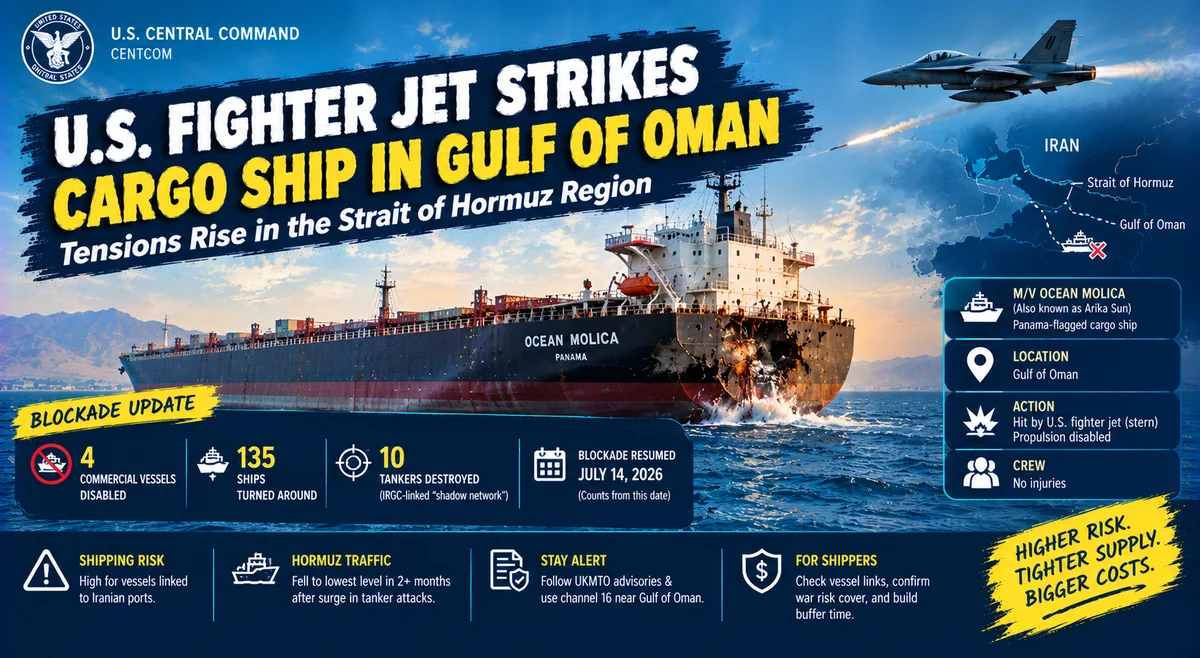
On Saturday, October 10, 2026, a US military fighter jet struck and disabled a commercial cargo ship in the Gulf of Oman, according to US Central Command (CENTCOM).
CENTCOM named the ship as the Panama-flagged M/V Ocean Molica, also known as the Arika Sun. It said the jet hit the stern with a precision munition, "fully disabling the ship's propulsion without harming the crew."
CENTCOM said the ship's crew ignored repeated warnings and tried to run the US naval blockade of Iran. It added that the vessel had left an Iranian port and was trying to travel through regional waters.
What Do the Reports Say About the Ship?
The UK Maritime Trade Operations (UKMTO) agency confirmed on Sunday, October 11, that it had received a report of an incident involving a tanker and military forces in the Gulf of Oman, and that authorities were investigating. CENTCOM described the vessel as a cargo ship, so the two descriptions differ.
The reports we reviewed did not include a response from Iran or from the ship's owner. Details such as the ship's cargo and ownership have not been published. We will update this story if more information is confirmed.
What Are the Blockade Numbers?
CENTCOM says the US resumed its blockade of all ships entering or leaving Iranian ports on July 14. Its latest figures, counted from that date, are:
- 4 commercial vessels disabled
- 135 ships turned around
- 10 tankers destroyed that CENTCOM links to the Iranian Revolutionary Guard Corps (IRGC) "shadow network"
These figures count from the July 14 resumption, so they should not be added to earlier blockade counts from previous months.
How Busy Is the Strait of Hormuz Right Now?
Reuters reported that the number of vessels passing through the Strait of Hormuz fell to its lowest level in more than two months. This followed a week in which attacks on tankers reached their highest level since the US and Israel launched the war on Iran in February. Before the war, the strait carried about 20% of the world's oil consumption.
As we reported on October 4, traffic through the strait had already dropped to a fraction of its normal level. This latest incident adds to the risk for any vessel operating near the Gulf of Oman and the approaches to Hormuz.
What Is CENTCOM Telling Ships?
CENTCOM advised all mariners to follow blockade warnings from its forces. It also asked crews to keep monitoring Notice to Mariners broadcasts and to contact US naval forces on bridge-to-bridge channel 16 when operating in the Gulf of Oman and the approaches to the Strait of Hormuz.
What Does This Mean for You?
- Any ship linked to an Iranian port is at high risk. The blockade covers vessels entering or leaving Iranian ports, and CENTCOM has now shown it will use force on ships that do not comply.
- Gulf of Oman routings need extra care. This incident happened outside the strait itself, so risk is not limited to the narrowest part of Hormuz.
- Insurance and fuel costs may rise again. Each new incident adds to war risk pricing and keeps oil and fuel surcharges under pressure.
- Schedules for Gulf-bound cargo stay unreliable. Low transit numbers mean delays and rerouting remain likely.
What Should Shippers and Forwarders Do Now?
- Step 1: Ask your carrier or forwarder to confirm that the vessel carrying your cargo, and the other parties in the chain, have no connection to Iranian ports on this voyage.
- Step 2: Check your war risk insurance for cargo moving to, from or near the Gulf, and confirm what is covered.
- Step 3: Add extra buffer time to Gulf-bound shipments and agree a backup routing with your forwarder.
- Step 4: If you operate vessels in the area, follow UKMTO advisories and CENTCOM Notice to Mariners broadcasts every day.
- Step 5: Watch oil prices and carrier surcharge notices over the next week, because they can change quickly after incidents like this.
The situation in and around the Strait of Hormuz remains highly unpredictable. For shipping companies and cargo owners, the safest approach is to check every voyage detail carefully, keep insurance up to date, and plan for delays.
Key Takeaways
- A US fighter jet disabled the Panama-flagged cargo ship Ocean Molica (also known as Arika Sun) in the Gulf of Oman on October 10, 2026, according to CENTCOM.
- CENTCOM says the ship left an Iranian port, ignored repeated warnings and tried to run the blockade. The crew was not harmed.
- UKMTO acknowledged an incident involving "a tanker" and military forces and said it was investigating.
- Since the blockade resumed on July 14, CENTCOM says it has disabled 4 commercial vessels, turned around 135 ships and destroyed 10 IRGC-linked tankers.
- Hormuz transits fell to their lowest in more than two months, after the highest level of tanker attacks since the war began in February.
- CENTCOM asked ships to monitor Notice to Mariners broadcasts and use channel 16 near the Gulf of Oman and Hormuz approaches.
- Shippers should check vessel links to Iranian ports, confirm war risk cover, and add buffer time for Gulf-bound cargo.



Comments
No comments yet. Be the first to share your thoughts!