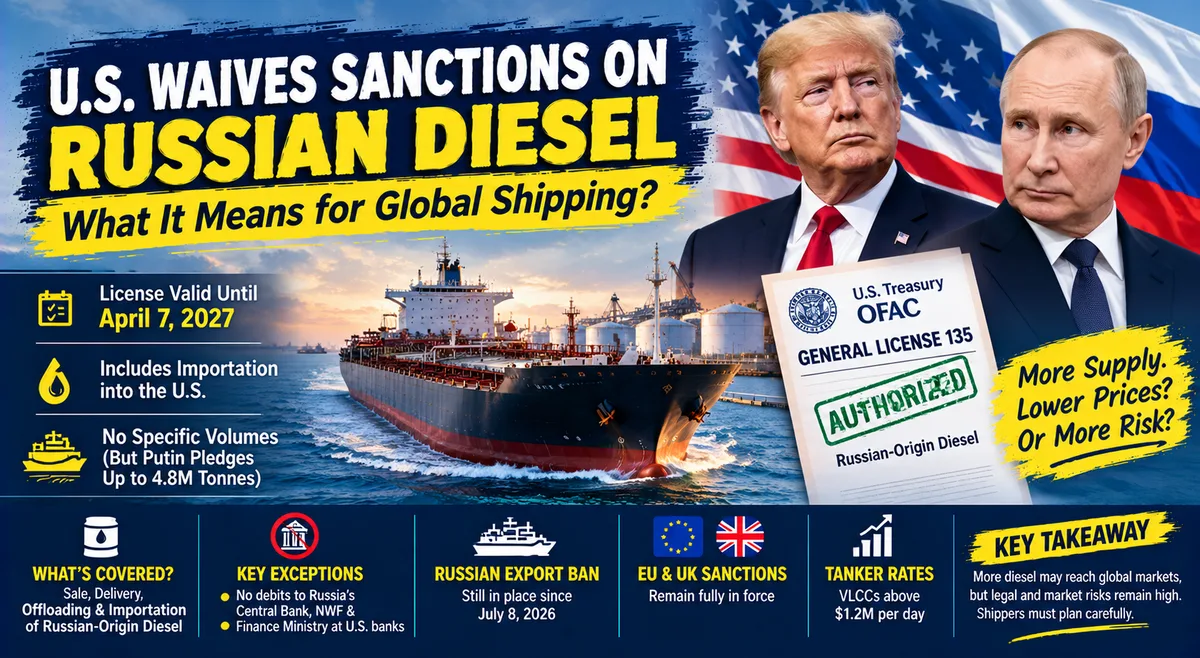
On October 9, 2026, the US Treasury's Office of Foreign Assets Control (OFAC) issued General License 135, authorizing the sale, delivery, offloading and importation of Russian-origin diesel, expressly including importation into the United States, until 12:01 a.m. EDT on April 7, 2027. The license was signed by OFAC Director Bradley T. Smith and issued the same day President Trump said he had reached an agreement with Vladimir Putin to put millions of tonnes of Russian diesel onto world markets.
For shipping and logistics, the announcement raises as many questions as it answers: how much diesel will actually move, who can legally carry it, and what happens when the six-month window closes.
What the License Actually Covers
General License 135 permits transactions that would otherwise be prohibited under the Russian Harmful Foreign Activities Sanctions Regulations and the Ukraine-/Russia-Related Sanctions Regulations. It is limited in one important respect: it does not authorize debits to accounts at US financial institutions owned by the Central Bank of the Russian Federation, the National Wealth Fund or the Russian Ministry of Finance, and it leaves the rest of the US sanctions framework against Russia in place. Treasury described it as a temporary license issued at the president's direction to allow Russian diesel to reach the global market.
What Was Announced, and What Wasn't
Trump said Putin had agreed to release up to 4.8 million tonnes of diesel in stages: more than 300,000 tonnes immediately, a further 500,000 tonnes in November, 1 million tonnes after that, and up to 3 million tonnes more depending on the condition of Russian refineries. He framed the move as a way to lower prices before the November midterm elections and said it would work alongside US control of the Strait of Hormuz. Ukrainian President Volodymyr Zelenskyy condemned the decision, arguing that easing sanctions without concessions from Moscow gives the Kremlin more resources.
Those volumes are statements, not license terms. The license sets no quantities. On the Russian side, the picture is less settled: Moscow has had its own diesel export ban in place since July 8, and Deputy Prime Minister Alexander Novak said recently, according to TASS, that the domestic diesel market is balanced and that exports would be partially reopened only in the event of overproduction.
Two Sanctions Regimes, One Cargo
The most important practical point for operators is that Washington's license does not move the EU or the UK. Industry coverage of the announcement stressed that UK and EU sanctions on Russian diesel remain fully in force. A cargo that is permitted under General License 135 can still be prohibited for a vessel, insurer, bank or charterer with an EU or UK connection, whether through flag, ownership, P&I cover, financing or counterparty.
Legal commentators have also questioned how a general license squares with the 2022 US import ban and recent congressional sanctions legislation, noting that an OFAC general license is legally distinct from a statutory waiver. Those questions are unresolved, and they matter for anyone writing contracts that run beyond the license's expiry.
Why Tanker Capacity Is the Real Constraint
Even if barrels move, ships must carry them, and tanker capacity is already stretched. Reuters reported on October 5 that VLCC rates for Middle East-to-Asia voyages exceeded $1.2 million per day, according to broker Poten & Partners, up from roughly $30,000 a day in January, with freight now about 27% of a delivered barrel's price versus around 3% before. Separately, Standard Chartered estimates Gulf oil exports have recovered to roughly 80% of pre-war levels, but only about 60% of those barrels crossed the Strait of Hormuz, compared with 83% before the war, with ship-to-ship transfer capacity appearing saturated.
Those figures describe crude rather than diesel, but they show how little spare tanker capacity exists. If Russian diesel starts moving in volume, it will add demand to an already tight market.
What This Means for Shippers, Tanker Operators and Insurers
- Don't budget for cheaper diesel yet. The license guarantees no volumes, Russia's export ban is still in place, and any relief in wholesale prices would reach fuel surcharge tables with a lag.
- Treat "legal in the US" and "legal for you" as separate questions. Vessels, charterers and insurers with EU or UK exposure need written legal advice before touching Russian-origin diesel, whatever Washington has authorized.
- Build the April 7, 2027 expiry into every contract. Charters, offtakes and financing that extend past the license window carry reversion risk, so sanctions clauses and exit mechanisms matter more than usual.
- Watch the first loadings. Russian export loadings and vessel-tracking data over the coming weeks will show whether the announced volumes materialize or the export ban holds.
- Expect pressure on tonnage if volumes appear. With tanker rates at multiples of January levels and ship-to-ship capacity saturated, new long-haul diesel cargoes would land in a market with little slack.
Key Takeaways — October 10, 2026
- OFAC issued General License 135 on October 9, 2026, authorizing the sale, delivery, offloading and importation of Russian-origin diesel, including into the United States, until April 7, 2027.
- Trump said Putin agreed to release up to 4.8 million tonnes in stages (300,000+ tonnes immediately, 500,000 in November, 1 million after, up to 3 million more). The license itself sets no volumes.
- The license does not authorize debits to accounts of Russia's Central Bank, National Wealth Fund or Finance Ministry at US institutions, and leaves other US sanctions in place.
- EU and UK sanctions on Russian diesel remain fully in force, and Russia's own diesel export ban has been in place since July 8.
- Zelenskyy condemned the move, and legal commentators question how a general license squares with the 2022 import ban and recent congressional sanctions legislation.
- Tanker markets are already tight, with VLCC rates above $1.2 million per day (Reuters, October 5), so any new diesel flows would land in a constrained market.


Comments
No comments yet. Be the first to share your thoughts!