
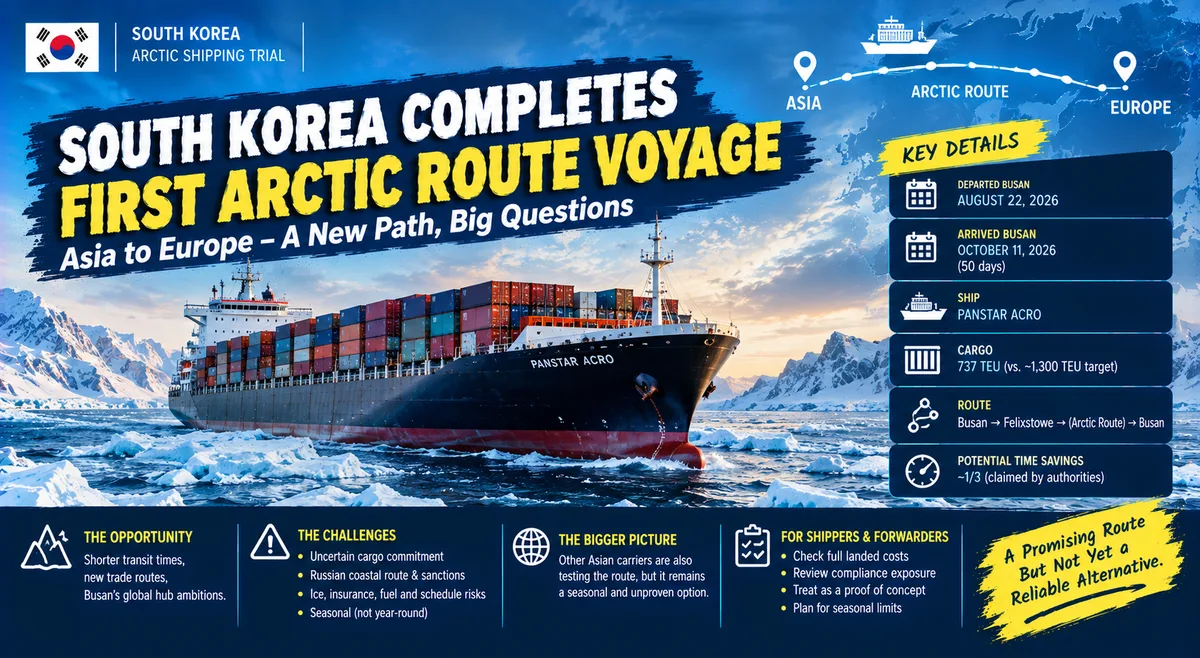
South Korea has completed its first commercial container voyage between Asia and Europe via the Arctic. The PanStar Acro docked at Busan on Sunday, October 11, 50 days after setting sail on August 22. Seoul wants the trial to lead to a regular service and help turn Busan into a global maritime hub, and authorities say the Arctic route could cut typical voyage times by around a third.
The voyage also showed how much still has to be solved before the route becomes a dependable alternative to conventional Asia–Europe routings.
What Was Completed
The PanStar Acro was South Korea's first government-backed container ship trial on the route. It sailed from Busan on August 22, reached the UK port of Felixstowe about halfway through the voyage, and returned to Busan 50 days after departure. Seoul described the round trip as the country's first commercial voyage to Europe via the Arctic.
Cargo Fell Short of the Target
Before departure, PanStar told Reuters it was seeking about 1,300 twenty-foot equivalent units (TEU) of cargo. The ship left with 737 TEU of cargo plus empty containers, roughly 57% of the figure the operator had been aiming for. The reporting does not explain the shortfall, but it is the first commercial data point from the trial, and it suggests shipper commitment has not yet reached the level the operator hoped for.
The Route Runs Along Russia's Coast
The route follows Russia's Arctic coast, and Seoul consulted Moscow about the journey, including whether the ship could get help if it became stuck in ice. That creates a political risk. The project could cause friction with Western allies who want to keep Russia isolated during its war in Ukraine.
For shippers, the route is not only an operational question. Any customer with sanctions-compliance obligations toward Western jurisdictions will need to assess its exposure before booking cargo on a route that depends on Russian coastal waters and Russian cooperation.
What Will Decide Whether It Works
Industry experts quoted in the coverage say the route's value will depend on four things: reliable schedules, the cost of slowing down to avoid ice, special insurance premiums, and extra fuel use. A voyage-time saving of around a third is a headline claim from authorities. It does not by itself show that the full cost per container is lower than on established routes, because each of those four factors can erode the advantage.
How It Fits the Wider Picture
South Korea is not the only Asian trading nation testing the northern route. China's Sea Legend Shipping has been launching a scheduled Arctic container service between Ningbo and Felixstowe this season. The northern route is seasonal, which means any service built on it would operate only in the ice-free window and would still need a conventional alternative for the rest of the year.
What This Means for Shippers and Forwarders
- Treat this as a proof of concept, not a service. One trial voyage with below-target cargo and no published schedule is not a basis for planning 2027 network decisions.
- Compare total landed cost, not days saved. Ask any provider offering Arctic routing to quote insurance, fuel and ice-related delays alongside the transit time.
- Get a compliance review before booking. A route along Russia's coast raises sanctions and reputational questions for customers with Western compliance obligations.
- Remember the seasonality. The northern route cannot be a year-round solution, so Suez and Cape routings remain the base case through the winter months.
- Watch Busan. Announcements on sailing frequency, vessel size and pricing will show whether Seoul's hub ambitions are turning into a commercial product.
Key Takeaways — October 11, 2026
- South Korea's PanStar Acro completed the country's first commercial round trip to Europe via the Arctic, docking at Busan on October 11, 50 days after sailing on August 22.
- Authorities say the Arctic route could cut typical voyage times by around a third and are aiming to turn Busan into a global maritime hub.
- The ship left with 737 TEU of cargo plus empty containers, against the roughly 1,300 TEU its operator had been seeking.
- The route runs along Russia's Arctic coast, and Seoul consulted Moscow, risking friction with Western allies seeking to keep Russia isolated over Ukraine.
- Experts say viability depends on schedule reliability, the cost of slowing to avoid ice, special insurance premiums and extra fuel use.
- Shippers should treat the voyage as a proof of concept and compare full costs and compliance exposure before considering the route.
Comments
No comments yet. Be the first to share your thoughts!