
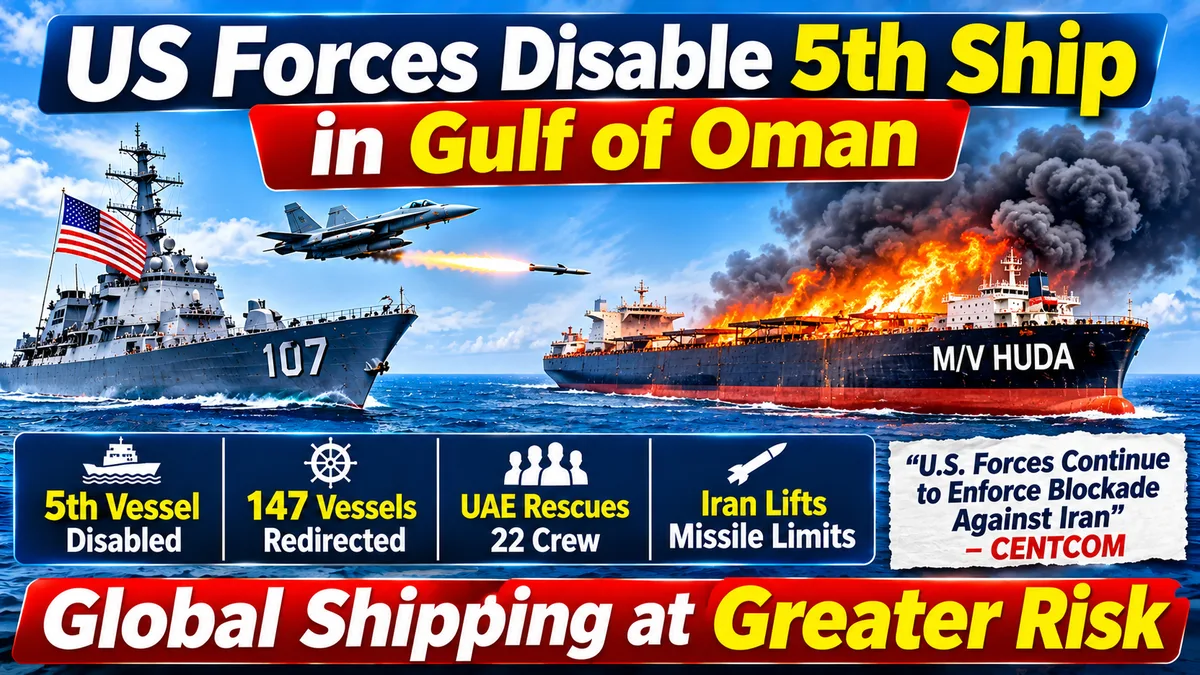

US forces have struck and disabled a commercial cargo vessel in the Gulf of Oman after its crew repeatedly ignored warnings to comply with Washington's naval blockade of Iran — the fifth merchant ship disabled since the blockade began in July 2026. The incident, confirmed by US Central Command (CENTCOM) on Saturday, November 8, marks a sharp escalation in blockade enforcement and comes on the same day that the UAE National Guard rescued 22 crew members from a separate cargo ship fire in the same waters.
MV Huda: What Happened
The targeted vessel, identified as the M/V Huda — a dry bulk carrier of 24,993 DWT sailing under the flag of Saint Kitts and Nevis — had made a port call in Iran and was attempting to depart regional waters when it was intercepted by US forces.
According to CENTCOM, the vessel's crew ignored multiple warnings to comply with the blockade and change course. Before launching the strike, US forces specifically instructed the crew to evacuate sections of the vessel that were to be targeted. Precision munitions fired from a US military aircraft then struck the ship's stern, leaving the vessel disabled in the Gulf of Oman approximately 18 nautical miles east of Khor Fakkan on the UAE's east coast.
CENTCOM released video footage of the strike and issued a statement confirming the action:
"U.S. forces continue to strictly enforce America's naval blockade against Iran."
The United Kingdom Maritime Trade Operations (UKMTO) separately confirmed it had received a report of an incident involving a bulk carrier and military forces in the Gulf of Oman on Saturday evening.
Blockade by the Numbers
The MV Huda is the fifth commercial vessel disabled by US forces since the naval blockade enforcement operations began in July 2026. CENTCOM stated that since July, US forces have redirected 147 commercial vessels that complied with orders to change course — a figure that underscores the scale of maritime traffic being intercepted and rerouted on a daily basis in the Gulf of Oman and surrounding waters.
The five disabled vessels represent the fraction that refused to comply — a number that, while small relative to the total redirected, carries significant consequences for global maritime risk assessments and insurance markets.
Separate Incident: UAE Rescues 22 Crew from Gulf of Oman Ship Fire
In a separate incident on November 8, the UAE National Guard rescued 22 crew members of Arab nationality after a cargo ship caught fire in the Gulf of Oman. All rescued crew were reported to be in stable condition after receiving first aid before being handed over to the relevant authorities.
The UAE National Guard stated the operation highlighted its personnel's readiness to respond to maritime emergencies and their commitment to protecting lives and strengthening maritime security in the region. The cause of the fire was not disclosed in available statements, and the vessel's name was not released by UAE authorities.
Iran Lifts Missile Range Limits — Escalation Deepens
The twin maritime incidents on November 8 come as Iran announced it was lifting its self-imposed missile range limits — a significant escalation signal that has immediate implications for military assets, commercial shipping, and energy infrastructure across the broader Gulf region.
The move follows a series of developments in the past week: US President Donald Trump warned Iran of a "heavy hit" in response to recent military activity, while US forces conducted strikes on Iran's Qeshm Island. Iran and Oman had separately called for an end to the conflict and fresh diplomatic dialogue — signals that have so far failed to slow the pace of military incidents at sea.
A senior Iranian lawmaker told Euronews this week that the Hormuz standoff was "not sustainable" — a rare public acknowledgment from Tehran of the pressure the blockade is placing on Iran's economy and trade routes.
What This Means for Global Freight
For the global logistics industry, the events of November 8 carry several direct consequences:
- War risk insurance premiums will face renewed upward pressure following the first US vessel disabling in a month — underwriters had hoped the pause indicated a de-escalation; today's action reverses that assumption.
- The Gulf of Oman is now as dangerous as the Strait of Hormuz itself — ships no longer need to enter the strait to face military risk; the 18 nautical miles east of Khor Fakkan where MV Huda was struck is a primary transit zone for vessels rerouting via Fujairah.
- Freight forwarders and shippers must review vessel compliance protocols — the CENTCOM blockade is actively enforced, and vessels with any Iranian port call history face interception risk regardless of their flag state.
- Iran lifting missile range limits introduces a new threat vector — the potential for strikes on vessels or infrastructure at greater distances from Iranian territory adds a layer of uncertainty that war risk underwriters will now need to price.
The Gulf of Oman, the Strait of Hormuz, and surrounding waters remain among the most dangerous maritime zones on earth for commercial shipping in November 2026. The events of today — a US military strike, a vessel fire, and an Iranian missile escalation — confirm that the crisis is intensifying, not stabilising.
🔑 Key Takeaways — November 8, 2026
- MV Huda disabled by US forces today — St. Kitts-flagged dry bulk carrier struck by precision munitions in Gulf of Oman after ignoring blockade warnings. 5th vessel disabled since July.
- 147 commercial vessels redirected since July — CENTCOM blockade enforcement is operating at scale, intercepting ships daily across the Gulf of Oman.
- UAE rescues 22 crew from separate ship fire — cargo ship catches fire in Gulf of Oman on same day; all crew safe, cause undisclosed.
- Iran lifts missile range limits — major escalation signal with direct implications for vessel safety, infrastructure risk, and insurance pricing across the Gulf.
- Hormuz standoff "not sustainable" — Iranian lawmaker — rare public acknowledgment of pressure from Tehran, but no ceasefire in sight.
- War risk premiums will rise again — today's events reverse any de-escalation assumptions underwriters had formed during the recent quiet period.
- Gulf of Oman is now a primary risk zone — 18nm east of Khor Fakkan, a key Fujairah rerouting waypoint, is where today's strike occurred. No safe rerouting option exists near the strait.
Incident date: November 7–8, 2026 | Published: November 8, 2026



Comments
No comments yet. Be the first to share your thoughts!