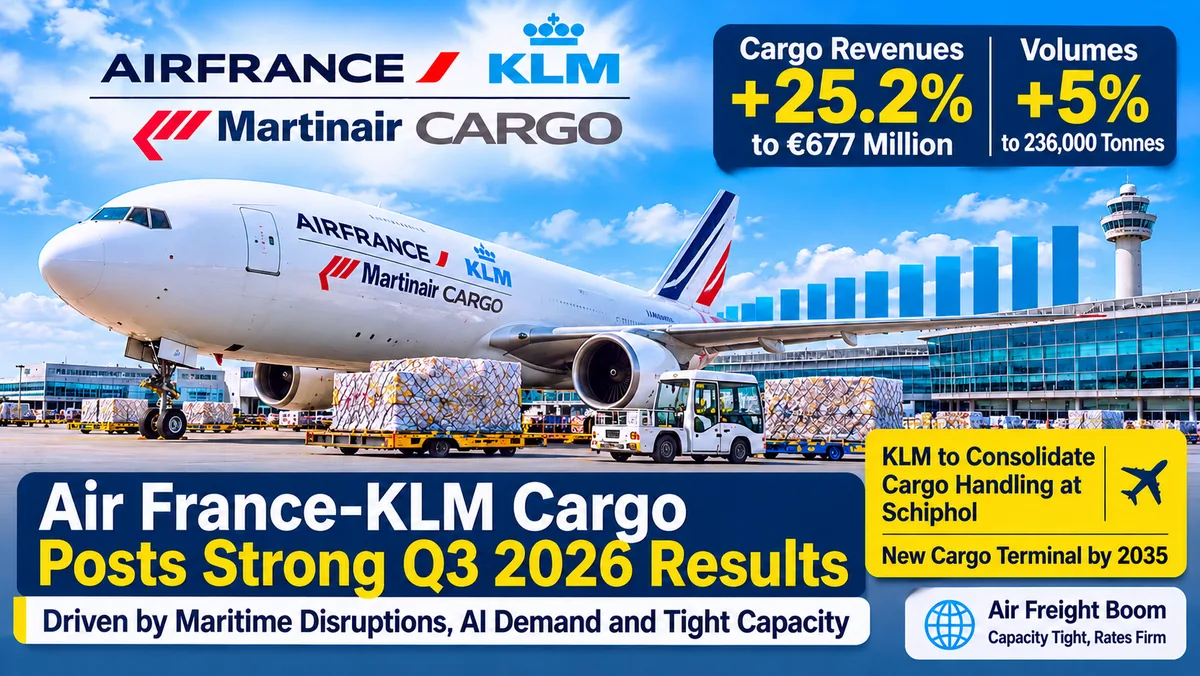

Air France-KLM Martinair Cargo (AFKLMP Cargo) has posted a strong third-quarter performance for 2026, with cargo revenues climbing 25.2% year-on-year to €677 million and cargo volumes increasing 5% to approximately 236,000 tonnes. The results confirm a deepening shift in global freight patterns, as shippers move urgent and high-value cargo away from disrupted maritime routes and toward air transportation.
The Numbers at a Glance
Cargo traffic, measured in revenue tonne-kilometres (RTK), increased by 8% to 1.817 billion RTK in the third quarter, outpacing the 2.3% expansion in available capacity, which reached 3.948 billion available tonne-kilometres (ATK). The stronger traffic performance pushed the cargo load factor up by 2.4 percentage points to 46% — a clear sign that demand is growing faster than supply.
At the group level, Air France-KLM reported third-quarter revenues of approximately €9.9 billion, up 7.6% year-on-year, with net income rising 22.1% to €938 million. The cargo division played a meaningful role in this performance, contributing higher revenues and improved load factors across the group's international network.
What Is Driving the Growth
Air France-KLM attributed the strong cargo performance to three primary factors:
1. Maritime disruptions pushing shippers to air. Ongoing disruptions to ocean shipping routes — particularly around the Suez Canal and Strait of Hormuz — have continued to encourage shippers to move urgent and time-sensitive goods by air. With the Strait of Hormuz recording as few as 4 ship transits per day against a pre-crisis baseline of 85, many importers and exporters with Gulf exposure have no reliable ocean alternative for time-critical cargo.
2. AI supply chain demand. The accelerating global build-out of artificial intelligence infrastructure has created a new and structurally significant source of air freight demand. Movement of high-value technology equipment — including servers, semiconductors, and networking hardware — requires fast and reliable transportation that sea freight cannot provide at the required speed. This AI-related demand contributed to tighter air freight market conditions and supported cargo yields across the group's international routes.
3. Limited freighter availability. Scheduled and unscheduled maintenance limited the availability of freighter aircraft during the quarter, restricting capacity expansion. While this prevented a more substantial increase in cargo volumes, it also reinforced the capacity constraints that supported yield improvement.
E-Commerce Weakness on Asia-Europe Routes
Not all segments performed equally. Air France-KLM reported a sharp decline in e-commerce shipments originating from Asia following the introduction of taxation on small parcels in July 2026. The regulatory change affected a segment that had previously generated significant volumes for international air cargo operators, particularly on Asia-Europe routes.
However, the decline in e-commerce shipments was more than offset by stronger demand from other cargo categories — including AI-related supply chains, urgent maritime-to-air diversions, and full freighter charter business. The results highlight the changing composition of international air freight demand in 2026, with technology and supply chain resilience shipments increasingly driving airline cargo performance.
KLM to Consolidate Cargo Handling at Schiphol
Alongside the financial results, KLM Cargo announced plans to consolidate all cargo handling activities at its own warehouse at Amsterdam Airport Schiphol. Under the restructuring initiative, KLM intends to handle all freight — including cargo carried on both passenger aircraft and dedicated freighter services — within its own facility, rather than relying on third-party ground handling providers.
The move is part of a broader programme aimed at improving productivity, simplifying operations, and strengthening financial performance. KLM stated that the consolidation will help prepare the business for a new cargo terminal at Schiphol scheduled for completion in 2035 and will strengthen the airport's position as a cargo transfer hub by enabling KLM to attract additional connecting freight.
The airline plans to accommodate higher cargo volumes through more efficient processes, increased automation and more flexible deployment of employees — rather than relying on additional recruitment. The announcement signals a significant change in KLM's cargo handling strategy, particularly given its existing five-year agreement with Menzies Aviation, signed in July 2024, to provide cargo warehouse and ramp handling services at Schiphol.
What This Means for the Air Freight Market
The Air France-KLM results are the latest in a series of strong air cargo financial reports from major carriers in Q3 2026. Emirates SkyCargo recorded a 52% revenue surge in its first half of 2026-27 (April–September), and DHL Express posted a 49.5% jump in adjusted operating profit in Q3. The pattern is consistent: maritime disruption is structurally elevating air freight demand and yields, and carriers with strong networks and freighter capacity are the primary beneficiaries.
For shippers and freight forwarders, the Air France-KLM results reinforce a key message for the remainder of 2026 and into 2027: air freight capacity remains tight, demand is outpacing supply, and rates will continue to reflect that imbalance. As the holiday peak season approaches and Chinese New Year falls early in January 2027, shippers who have not already locked in air freight capacity should act without delay.
🔑 Key Takeaways — November 7, 2026
- Revenue up 25.2% to €677 million — Air France-KLM Cargo posts its strongest Q3 result in years, driven by rate improvement and modal shift from ocean to air.
- Volumes up 5% to 236,000 tonnes — cargo traffic (RTK) grew 8%, outpacing the 2.3% expansion in available capacity.
- Load factor hit 46% — up 2.4 percentage points, confirming demand is growing faster than supply.
- Three growth drivers confirmed: Hormuz/Suez maritime disruption, AI infrastructure supply chains, and constrained freighter availability.
- Asia e-commerce volumes declined sharply — July 2026 small parcel taxation hit Asia-Europe cargo flows, but was more than offset by other demand categories.
- KLM consolidating cargo handling at Schiphol — a major structural move ahead of its new cargo terminal in 2035, aiming for higher automation and reduced third-party dependency.
- Air freight boom is broad-based: Emirates SkyCargo +52%, DHL Express +49.5%, Air France-KLM +25.2% — the data confirms air freight is in a structurally strong cycle.
- Action for shippers: With capacity tight and peak season approaching, early booking of Q4 air freight capacity is essential.
Source date: November 7, 2026 | Published: November 7, 2026

Comments
No comments yet. Be the first to share your thoughts!