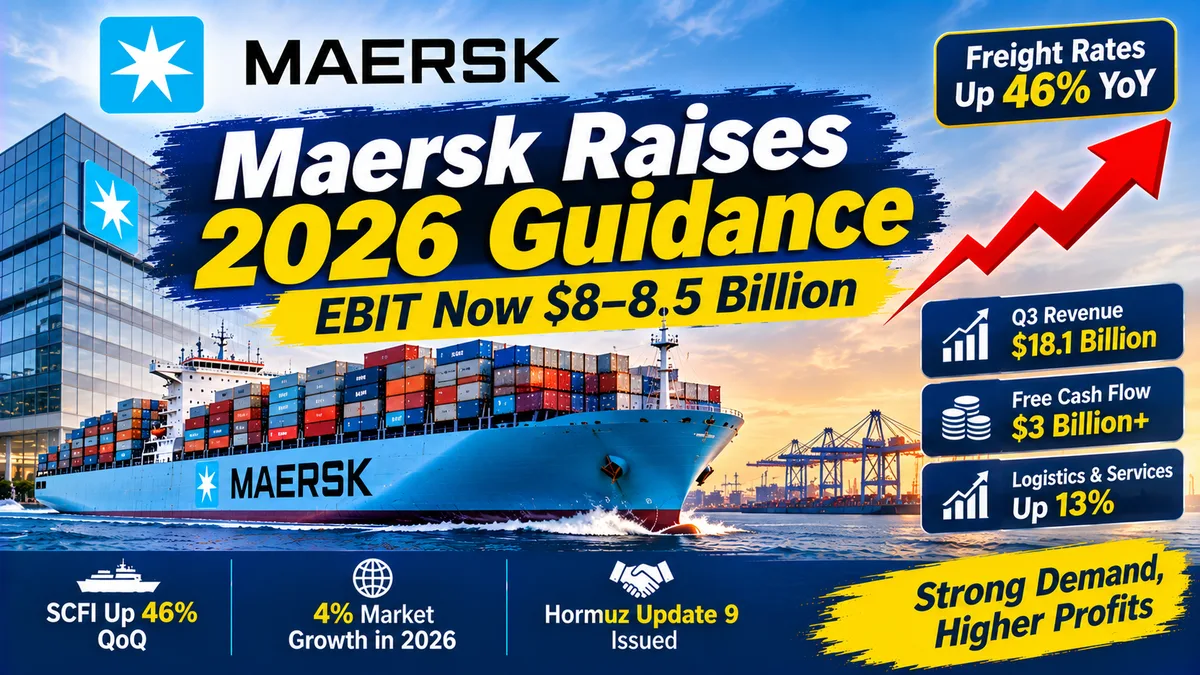

Danish shipping giant A.P. Moller-Maersk has raised its full-year 2026 earnings guidance for the third time this year, following a third quarter in which soaring ocean freight rates and tightening capacity drove revenue to $18.1 billion. The company now expects underlying earnings before interest and taxes (EBIT) of $8–8.5 billion for the full year — a dramatic upgrade from its previous forecast of $4.5–6.5 billion and a clear signal that the wartime freight market is delivering historic returns for the world's major carriers.
What the Numbers Show
The headline figure from Maersk's Q3 2026 results is the freight rate. The average loaded freight rate across Maersk's ocean network rose by approximately 46% year on year to $3,287 per forty-foot equivalent unit (FFE) — a level that reflects both the structural capacity squeeze caused by the Hormuz crisis and the surge in frontloading demand from shippers seeking to build inventory ahead of further disruptions.
The Shanghai Containerised Freight Index (SCFI) rose 46% during Q3 compared with the previous quarter, confirming that the rate environment is a market-wide phenomenon rather than a Maersk-specific one. Total Q3 revenue of $18.1 billion was supported across all three of Maersk's main business divisions.
Maersk's Logistics & Services division posted revenue of $4.5 billion, up 13% year on year, with particularly strong growth in landside logistics and landbridge operations across the Gulf region — a direct consequence of cargo being rerouted away from the Hormuz strait via overland corridors. Air freight, project logistics, and contract logistics also contributed positively to the division's performance.
Alongside the EBIT upgrade, Maersk raised its expected free cash flow to more than $3 billion for the full year — a significant improvement driven by higher operating margins and disciplined capital allocation.
The Hormuz Factor
Maersk's results cannot be understood without the context of the ongoing US-Iran conflict that began on February 28, 2026. The closure of the Strait of Hormuz to commercial shipping — which today records as few as 4 transit attempts per day against a pre-crisis baseline of 85 — has had two compounding effects on the container market.
First, it has physically removed capacity from the global system. Thousands of vessels remain stranded or rerouting, reducing the effective supply of ship-days available to move cargo. Second, it has triggered a wave of frontloading by shippers across Asia, Europe, and the Americas — all seeking to build inventory buffers before further disruptions cut supply lines. More demand, less capacity, and higher fuel costs from war risk and rerouting have combined to push freight rates to multi-year highs.
Maersk has responded operationally by accelerating its landbridge programme, activating overland freight corridors through Saudi Arabia, Jordan, and Turkey to serve Gulf importers, and implementing emergency port rotation changes at several Middle East terminals. Its Hormuz Disruption Update 9, also published today, introduces temporary line detention relief solutions for cargo owners affected by the crisis in impacted countries — a sign that the operational complexity of the situation continues to evolve.
Peak Season Outlook
With Q4 2026 now underway, Maersk's upgraded guidance reflects confidence that the strong rate environment will persist through the peak season period. Global container market volume growth is expected at approximately 4% for full-year 2026, consistent with Maersk's earlier revised forecast. The company will release its full interim Q3 results on November 5, 2026 — today — alongside an investor presentation and webcast.
Bank of America and several other major brokerages maintain a buy rating on Maersk stock, though analysts have noted that the market is watching closely for any signs of rate softening in Q4 as the peak season cycle matures and geopolitical conditions evolve.
What This Means for the Freight Market
For logistics professionals, Maersk's results serve as one of the clearest real-time indicators of where the global freight market stands. The 46% rate increase is not an outlier — it reflects the same pressures that every shipper, forwarder, and importer is navigating today. War risk surcharges, emergency fuel premiums, port congestion fees, and rerouting costs have fundamentally changed the cost structure of moving goods through or around the Middle East.
Shippers and freight forwarders with contracts up for renewal in Q4 should factor in the likelihood that rate levels will remain structurally elevated as long as the Hormuz corridor remains disrupted. The window for securing capacity at current rates — before Q1 2027 contract cycles open — is narrowing.
🔑 Key Takeaways — November 5, 2026
- Maersk raises EBIT guidance to $8–8.5 billion — up from $4.5–6.5 billion, the third guidance upgrade of 2026 and a near-doubling of profit expectations.
- Q3 revenue hit $18.1 billion — driven by ocean freight rates up 46% YoY to $3,287/FFE and volume growth across all trade lanes.
- SCFI up 46% quarter-on-quarter — confirming that rate strength is a market-wide reality, not a carrier-specific result.
- Logistics & Services up 13% to $4.5 billion — landside logistics and Gulf landbridge operations are growing fast as ocean rerouting creates new demand for overland freight.
- Free cash flow raised to $3 billion+ — Maersk's financial position continues to strengthen despite higher operating costs from the wartime environment.
- Maersk issues Hormuz Update 9 today — temporary detention relief introduced for cargo in impacted countries. Shippers should check their forwarder for eligibility.
- Peak season rates expected to hold — container market volume growth forecast at 4% for full-year 2026. Secure Q4 capacity now before rates move further.
Source date: November 5, 2026 | Published: November 5, 2026


Comments
No comments yet. Be the first to share your thoughts!