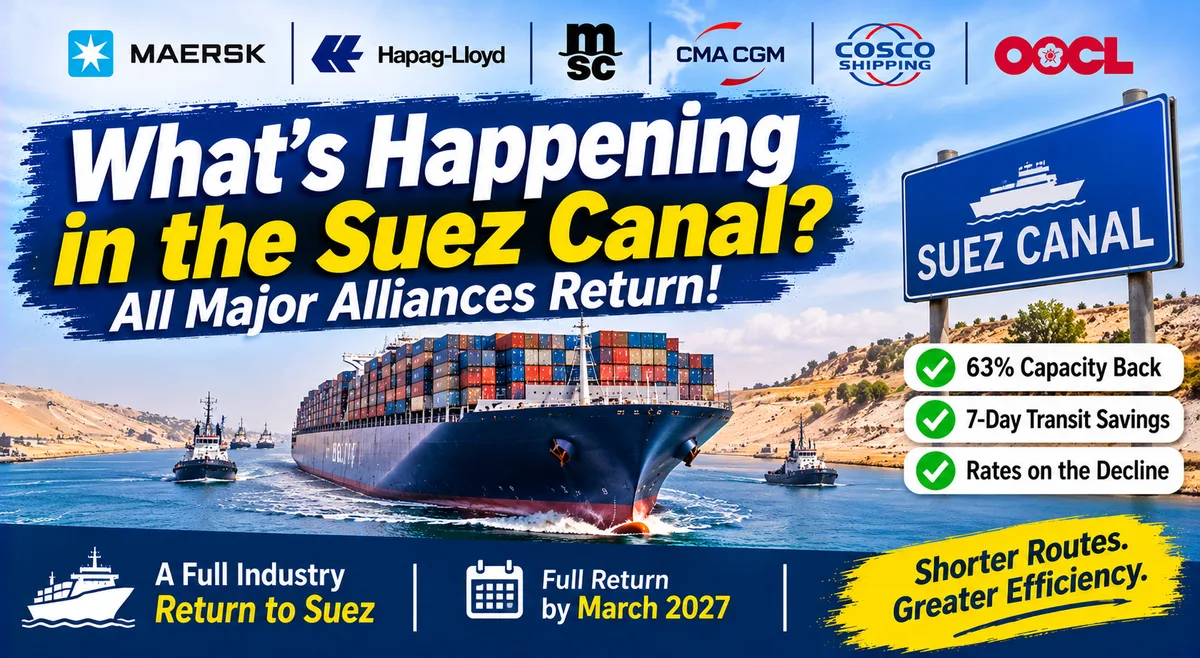

The global container shipping industry is completing its return to the Suez Canal, with all four major carrier alliances now operating or committing to Asia-Europe and Asia-Mediterranean services through the waterway. The development marks the most consequential routing shift in global freight since the Red Sea crisis began in late 2023 — and carries direct implications for freight rates, transit times, and supply chain planning heading into 2027.
Who Is Back and When
As of November 4, 2026, the Suez Canal return encompasses every major carrier group:
- Maersk and Hapag-Lloyd (Gemini Cooperation) — ME1 India-Europe service officially resumed Suez transits today, November 4, with the westbound Atlanta Express departing Salalah. The Gemini partners have signalled a full Suez Canal return across all services by Q1 2027, with Hapag-Lloyd CEO Rolf Habben Jansen confirming a phased, managed approach to the restoration.
- MSC — The world's largest container line resumed Suez transits in August 2026 and now operates 11 loops through the waterway, representing approximately 2.2 million TEU of deployed capacity.
- CMA CGM — Has maintained a Suez Canal presence and progressively expanded its operations, with westbound and eastbound services now restored on multiple rotations.
- COSCO and OOCL — Restored six services through the canal, with combined deployed capacity of approximately 1.27 million TEU.
- Evergreen (Ocean Alliance) — Taiwan's carrier will send the 16,556 TEU Ever Eon and 16,556 TEU Ever Edit on eastbound Suez transits on November 7 and 11 respectively, with the 20,124 TEU Ever Gifted following on November 16. Evergreen is also relaunching its China-Red Sea service on November 12.
- HMM and Yang Ming (Premier Alliance) — South Korea's HMM and Taiwan's Yang Ming will join their Premier Alliance partners in restarting Suez crossings in December, completing the full industry return.
The Numbers: How Much Capacity Is Back
According to Linerlytica data, approximately 63% of Far East-Europe container capacity has now returned to Suez Canal routings. Mediterranean trades are leading the recovery, with around 70% of capacity back on Suez routings — compared with 58% on Far East-North Europe services.
Some services continue to use a hybrid approach — Suez Canal westbound toward Europe, Cape of Good Hope eastbound — as carriers balance efficiency with risk management. The full symmetrical return on all rotations is expected to be complete across the industry by early 2027.
Asia-Europe services that have returned to Suez have achieved average transit-time improvements of approximately seven days compared to the Cape of Good Hope routing — a saving that translates directly into lower vessel operating costs, reduced fuel consumption, and shorter inventory cycles for cargo owners.
Why Are They Coming Back Now
The return is driven by a combination of competitive pressure, security reassessment, and operational economics. As leading carriers resumed Suez transits from mid-2026 onward, those still routing around Africa faced a growing competitive disadvantage on transit times — a gap that cargo owners began to price into their carrier selection decisions.
HMM's spokesperson confirmed the carrier had undertaken a thorough risk assessment before committing to resume Suez transits. The US Central Command's August 2026 mine-clearance declaration for major shipping lanes, combined with a gradual reduction in Houthi attack frequency through the summer, gave carriers sufficient confidence to begin phased restorations.
Hapag-Lloyd CEO Rolf Habben Jansen noted the approach had been deliberately cautious: "As we have said all along, if we go back, we will do it step by step and in a managed way. I'm really happy that's what we've done, because we can also manage the load on the hubs and on the ports in Europe and the Mediterranean."
What This Means for Freight Rates and Shippers
The progressive Suez return is already exerting downward pressure on Asia-Europe freight rates. With more capacity returning to shorter routes, effective market capacity on the Far East-Europe trade is increasing — removing some of the artificial tightness created by the longer Cape of Good Hope diversion which added 10–14 days per round trip and effectively removed significant vessel capacity from the market.
Container rates between Asia and Europe have already begun to soften, with analysts noting a 3% decline in global container rates as the Suez return gathered pace in October. The trend is expected to continue into Q1 2027 as the remaining holdouts complete their restoration.
For shippers and freight forwarders, the practical impacts are significant: shorter transit times reduce the need for safety stock, improve cash flow on goods in transit, and open up more reliable booking windows. However, shippers should note that the security situation in the Red Sea remains fluid — both Maersk and Hapag-Lloyd have explicitly conditioned their return on continued stability, and carriers retain the right to reroute around Africa if the threat environment deteriorates.
Context: NavilinkGlobal Has Covered This Journey
NavilinkGlobal first reported on the quiet early-stage return of Maersk, CMA CGM, Hapag-Lloyd, COSCO, and MSC to the Suez Canal in August 2026, when the shift was still selective and largely unannounced. Today's industry-wide commitment represents the completion of that journey — from cautious selective returns to a full structural restoration of the world's most important shipping corridor.
🔑 Key Takeaways — November 4, 2026
- All 4 major shipping alliances now returning to Suez — Gemini, Ocean Alliance, Premier Alliance and MSC have all committed to Suez Canal transits on Asia-Europe services.
- 63% of Far East-Europe capacity already back via Suez — Mediterranean trades leading at 70%, Far East-North Europe at 58%.
- Evergreen ships transit Suez November 7, 11 and 16 — completing the Ocean Alliance's full return to the canal.
- HMM and Yang Ming follow in December — finalising the Premier Alliance's return and completing the industry-wide restoration.
- 7-day transit time saving vs Cape of Good Hope — faster routes mean lower costs, shorter inventory cycles, and more reliable schedules for cargo owners.
- Full Maersk Suez return targeted by March 2027 — Gemini partners taking a phased, managed approach to minimise port congestion in Europe.
- Freight rates already softening — global container rates fell 3% in October as restored Suez capacity increased effective supply on Asia-Europe trades.
- Security conditions remain the key variable — all carriers have conditioned their return on ongoing Red Sea stability and retain the right to reroute if the threat escalates.
Source date: November 3–4, 2026 | Published: November 4, 2026

Comments
No comments yet. Be the first to share your thoughts!