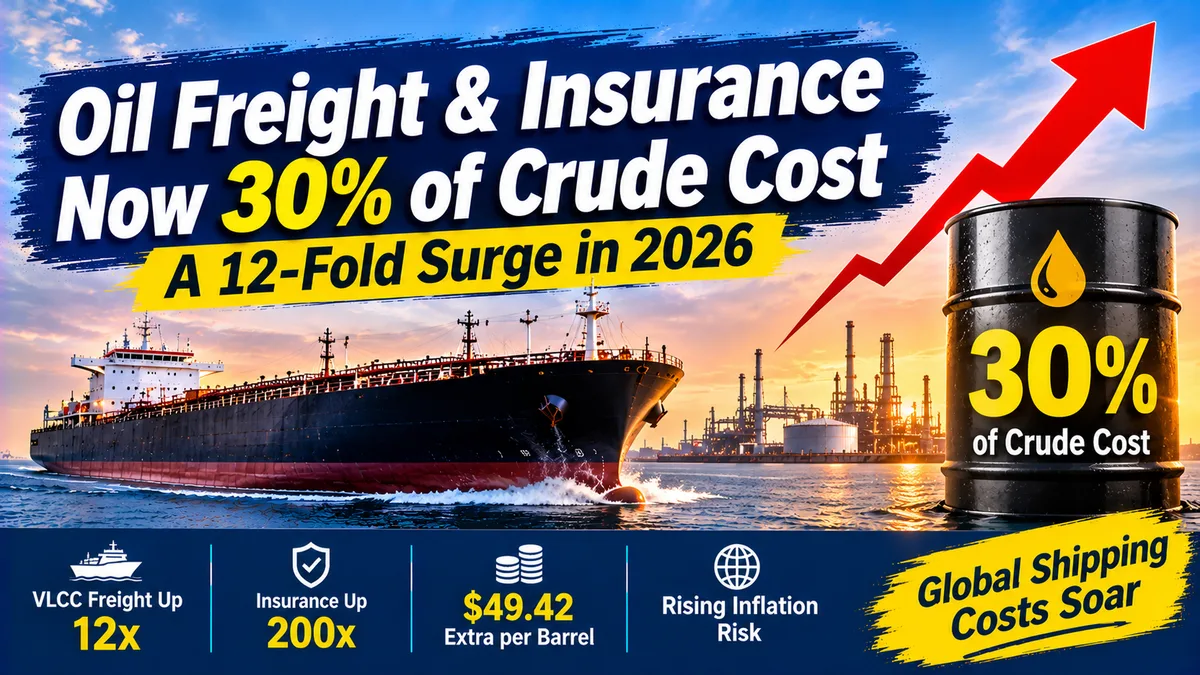

The economics of moving crude oil across international waters have been fundamentally transformed in 2026. What was once a relatively minor logistics expense — accounting for around 3–5% of the total cost of a barrel of crude — has become one of the most significant cost drivers in the global energy supply chain. According to OPEC's November 2026 assessment, the combined cost of freight and insurance for Very Large Crude Carriers (VLCCs) transporting oil from the Middle East to East Asia has climbed to approximately 30% of the total cost of the commodity — up from just 5% at the end of January.
The Numbers Behind the Surge
The scale of the increase is extraordinary. OPEC's data reveals that freight rates for a VLCC on the Middle East–East Asia route have risen nearly 12-fold between the end of January and the end of October 2026:
- The cost of transporting one barrel of crude rose from $3.18 at end-January to $37.13 by end-October
- Insurance costs witnessed an even sharper increase — jumping from $0.06 per barrel to $12.29 — an increase of more than 200 times
- Together, freight and insurance costs have increased by approximately $46 per barrel, reaching nearly $49.42 by the end of October
Under normal market conditions, freight and insurance account for approximately 3% of the total cost of crude oil. The fact that this figure has reached 30% represents a profound departure from historical shipping economics — one that is reshaping the global energy market in real time.
Why This Happened: The Hormuz Factor
The primary driver of this cost explosion is the ongoing Strait of Hormuz crisis, which began when the US-Iran conflict escalated in February 2026. The strait — through which approximately 20% of global oil supply passes — has been effectively closed to normal commercial shipping since late February, forcing tankers to take longer, riskier routes or pay dramatically elevated war risk insurance premiums to attempt transit.
The disruption to the tanker fleet has tightened VLCC availability across all routes. With fewer vessels willing to transit the strait and many rerouted away from the Persian Gulf entirely, the effective supply of tanker capacity serving Middle East oil exports has fallen sharply. When supply contracts and demand holds steady, rates spike — and in 2026, the spike has been without precedent in modern shipping history.
OPEC notes, however, that the disruption to the tanker fleet explains only a small part of the increase in insurance premiums. The broader risk environment surrounding maritime oil transportation — encompassing mine threats, drone attacks, and the possibility of further escalation — has become a major pricing factor in its own right.
The Inflation Transmission Mechanism
The consequences of this cost surge extend far beyond the tanker market. OPEC describes freight as a "critical link" between producing and consuming countries — one that shapes commodity prices, influences how markets function, and directly feeds into global inflation.
When shipping costs rise sharply and persistently, the additional expense moves through the supply chain in predictable ways:
- Refiners pay more to source crude, squeezing refining margins or passing costs downstream
- Fuel distributors face higher delivered costs for petroleum products, pushing up pump prices
- Oil-importing nations see their import bills rise even when the underlying price of crude is unchanged
- Manufacturing and transport sectors absorb higher energy input costs, which feed into the prices of virtually all goods
The problem becomes particularly acute when elevated shipping costs persist across successive shipments — as they have throughout 2026. Unlike a one-off price spike, sustained high freight and insurance costs require businesses and governments to structurally absorb higher logistics expenses, prolonging their inflationary impact.
What This Means for Oil-Producing Countries
The surge in shipping costs is not only a problem for oil-importing nations. For producing countries in the Middle East, elevated transportation costs affect the economics of exporting crude. A barrel of oil that costs $49.42 more to deliver than it did nine months ago is a barrel whose netback value — the revenue the producer actually receives after transport costs — has been materially reduced.
This dynamic creates pressure on the fiscal calculations of oil-exporting governments and may influence production and pricing decisions going forward. OPEC has explicitly warned that exceptionally high freight and insurance costs are transmitted across the entire value chain, increasing and prolonging the cost burden on both producing and consuming countries.
The Outlook for Logistics Professionals
For freight forwarders, logistics managers, and shippers operating in the energy supply chain, the OPEC assessment confirms what market participants have been experiencing firsthand throughout 2026: the cost of moving energy commodities has become a major variable in its own right — one that cannot be managed away through rate negotiations or carrier selection alone.
War risk insurance premiums on tanker routes through or near the Strait of Hormuz have risen to between 3% and 5% of vessel value per voyage for some routes — levels that make certain cargoes economically marginal. For shippers of petroleum products, the combination of elevated base freight rates and war risk surcharges is now a central line item in every landed cost calculation.
Until a durable resolution to the Hormuz crisis is reached, the OPEC data suggests there is no near-term relief in sight. The 30% figure is not a temporary aberration — it is the market's current best estimate of what it costs to move oil safely from where it is produced to where it is consumed.
🔑 Key Takeaways — November 5, 2026
- Oil freight + insurance now = 30% of crude cost — up from just 5% at end-January 2026, per OPEC's November assessment. This is a historic first in modern energy economics.
- VLCC freight rates up nearly 12x — cost per barrel rose from $3.18 to $37.13 between January and October 2026.
- Insurance costs up 200x — from $0.06 per barrel to $12.29, reflecting the extraordinary risk environment in and around the Strait of Hormuz.
- $49.42 extra per barrel — the combined freight and insurance cost added to every barrel of Middle East crude shipped to East Asia by end-October 2026.
- Global inflation risk is real and growing — OPEC warns these costs are transmitted across the entire value chain, hitting refiners, distributors, importers and consumers.
- War risk insurance is now a core cost variable — not a footnote. Logistics professionals must build elevated premiums into every energy cargo calculation until Hormuz normalises.
- No near-term relief in sight — until a durable Hormuz resolution emerges, the structural shift in oil shipping economics is here to stay.
Source date: November 5, 2026 | Published: November 5, 2026

Comments
No comments yet. Be the first to share your thoughts!