
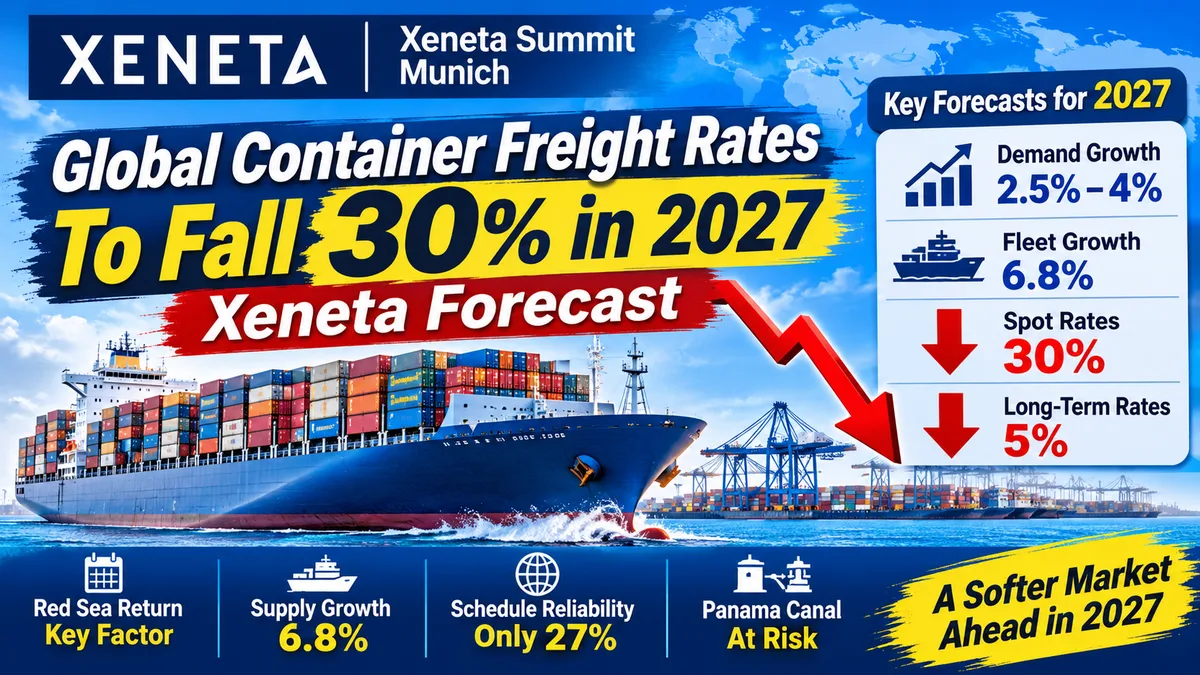

Global ocean container shipping spot rates are forecast to fall 30% in 2027, according to the Xeneta Ocean Outlook Report unveiled on Thursday at the annual Xeneta Summit in Munich. The forecast was presented by Peter Sand, Chief Analyst at Xeneta, to more than 600 industry leaders from the world's largest shippers and logistics service providers.
The Four Key Forecasts for 2027
The Xeneta Ocean Outlook 2027 sets out the following market fundamentals and rate projections — all measured as full-year 2027 averages against a Q3 2026 baseline:
- Global demand growth slowing to between 2.5% and 4% (down from 4.7% in the first eight months of 2026)
- Global fleet growth of 6.8%, within a range of 5.4% to 8.3%
- Global average spot rate to fall 30%
- Global average long-term rate to fall 5%
Sand was clear that the forecast points to a softer market — but equally clear that it is not guaranteed. He told delegates:
"Rates were expected to soften in each of the past three years before seismic shocks sent them spiralling in the opposite direction — the Red Sea Crisis in 2024, the US tariffs in 2025 and the Hormuz Crisis in 2026. Supply growth will outrun demand in 2027, but market fundamentals are easily overpowered by major supply chain shocks and it would be foolish to rule that out in 2027."
To illustrate the scale of disruption in 2026, Sand highlighted that Transpacific rates to the US West Coast spiked 343% between February 28 and October 31, 2026, with triple-digit percentage increases seen across all Far East fronthaul routes — a scale of cost increase that most shippers would not have considered possible entering the year.
Red Sea Return Is Pivotal
The return of container shipping services to the Red Sea and Suez Canal is the single most important variable in the 2027 rate forecast. In October 2026, carriers committed 467,297 TEU of weekly capacity to Red Sea routes — roughly double the offered capacity compared to the end of August 2026, though still only 50% of the pre-crisis level seen in August 2023.
The gradual return has already released 599,000 TEU of capacity previously absorbed by longer Cape of Good Hope diversions. With an additional 2.9 million TEU of new vessels due for delivery in 2027 and only 0.5 million TEU expected to be demolished, total fleet growth of 6.8% would add significant supply pressure — pushing rates lower if demand does not keep pace.
Sand was careful to frame the Red Sea situation as a double-edged risk:
"The Red Sea is pivotal to ocean container shipping in 2027 because it offers both sides of the coin. If there is a full return, freight rates could plummet. We could also be faced with the opposite extreme if a deterioration in the security situation in the wider Middle East forces carriers to revert to Cape of Good Hope diversions. This would bring chaos to ocean networks and upward pressure on rates. The significant ramping up of Red Sea services in recent months should not distract from the fragility of the geo-political situation. It will not take much to ignite the situation again and then the house of cards comes falling down."
Demand Growth to Slow as Frontloading Unwinds
The strong demand growth of 4.7% seen in 2026 was driven in large part by frontloading — shippers pulling forward purchases and building inventory buffers to protect against the ripple effects of Hormuz disruption and rising freight costs. That dynamic is now expected to reverse.
Sand explained: "Supply chain shocks have distorted the rhythm of container shipping. Demand has been strong in 2026, but this growth will be difficult to sustain in 2027 as shippers draw down the inventories built up against headwinds of more modest consumer appetite for containerized goods." As a result, Xeneta projects a weaker start to 2027 and a softer peak season.
Schedule Reliability at Historic Lows
One of the most striking data points from the Xeneta Summit was the state of schedule reliability. Global on-time arrivals stood at just 27% in Q3 2026 — and on the critical Far East to Europe trade lane, the figure collapsed to just 4% in September 2026. Sand acknowledged that some improvement is likely in early 2027, but warned it is coming from an extremely low baseline.
Panama Canal Remains a Wildcard
Beyond the Red Sea, Sand identified the Panama Canal as the most significant known risk on the horizon for 2027. Low water levels could force transit restrictions at any point, compelling shippers to pay a premium for timely passage — or reroute entirely.
"With the Suez Canal — the world's other critical artery for maritime trade — already compromised, there isn't too much slack in the system to manage further supply chain shocks."
What This Means for Shippers and Forwarders
For logistics professionals planning for 2027, the Xeneta forecast carries clear operational and commercial implications. If rates do fall 30% on spot markets and 5% on long-term contracts, shippers currently locked into elevated 2026 contract rates stand to benefit significantly at renewal. Forwarders will face margin pressure as the spread between contract and spot narrows.
However, the consistent message from the Xeneta Summit is that planning purely around the base case is a mistake. The freight market has confounded consensus forecasts in 2024, 2025 and 2026. Building in contingency for continued disruption — whether from the Middle East, Panama, extreme weather or geopolitical escalation — remains as important as ever heading into 2027.
🔑 Key Takeaways — November 7, 2026
- Spot rates forecast to fall 30% in 2027 — Xeneta Ocean Outlook 2027, presented at the Munich Summit today by Chief Analyst Peter Sand to 600+ industry leaders.
- Long-term contract rates to fall 5% — a more modest decline reflecting the stickiness of annual agreements vs volatile spot markets.
- Red Sea return is the single biggest variable — 467,297 TEU/week already committed to Red Sea routes in October 2026, but still only 50% of pre-crisis levels. 599k TEU already released from Cape diversions.
- Fleet growth of 6.8% adds massive supply in 2027 — 2.9 million TEU of new vessels due for delivery. If demand doesn't keep pace, rates fall fast.
- Demand growth slowing to 2.5–4% — down from 4.7% in 2026, as frontloading unwinds and consumer appetite softens.
- Schedule reliability at historic lows — only 27% of vessels arriving on time globally in Q3 2026; Far East–Europe collapsed to just 4% in September.
- Panama Canal is the next risk to watch — low water levels could add new restrictions at any point, with little slack left in global routing alternatives.
- Warning: forecasts have been wrong 3 years in a row — 2024 (Red Sea), 2025 (US tariffs), 2026 (Hormuz) all produced shock outcomes. Build resilience and budget contingency for 2027.
Source date: November 6–7, 2026 | Published: November 7, 2026


Comments
No comments yet. Be the first to share your thoughts!