
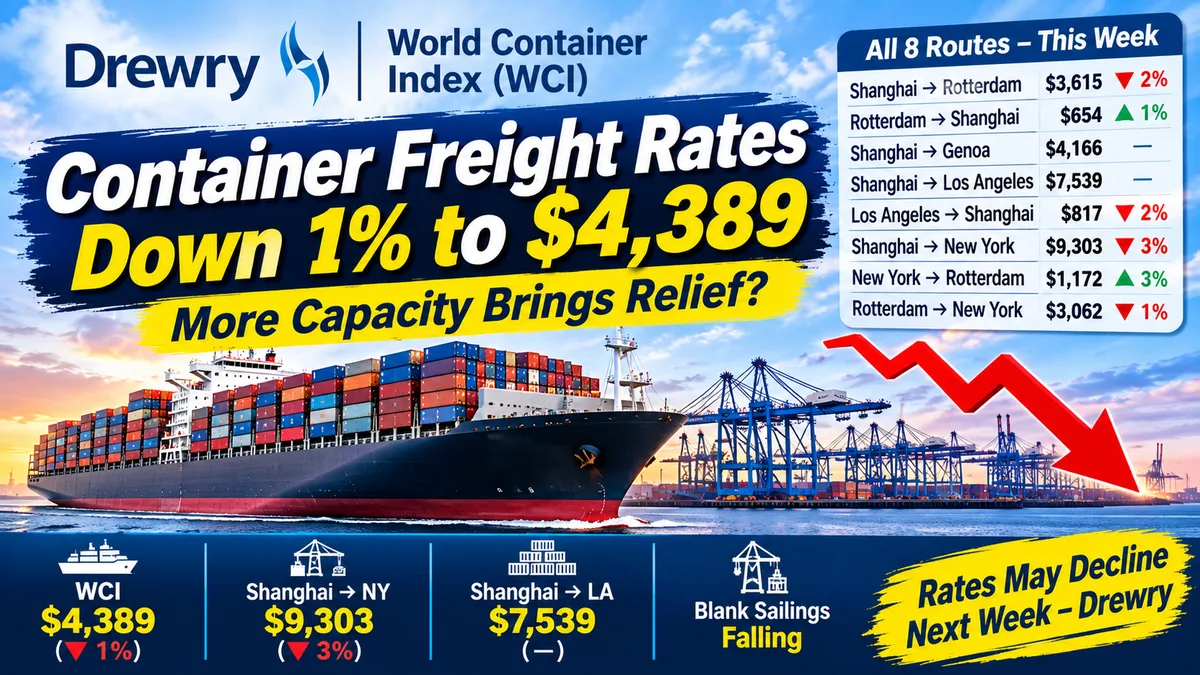

Global container freight rates edged lower this week, with the Drewry World Container Index (WCI) declining 1% to $4,389 per 40ft container for the week of November 5, 2026. The modest pullback was driven primarily by softening rates on Transpacific and Asia-Europe routes, as congestion at major Chinese ports began to ease and blank sailing activity reduced. Despite the decline, rates remain significantly above pre-crisis levels and carriers are already manoeuvring to defend their position heading into peak contract season.
All Eight Routes — This Week's Verified Rates
- Shanghai → Rotterdam: $3,615 per 40ft container (▼ 2% / -$71 week-on-week)
- Rotterdam → Shanghai: $654 per 40ft container (▲ 1% / +$8 week-on-week)
- Shanghai → Genoa: $4,166 per 40ft container (unchanged)
- Shanghai → Los Angeles: $7,539 per 40ft container (unchanged)
- Los Angeles → Shanghai: $817 per 40ft container (▼ 2% / -$20 week-on-week)
- Shanghai → New York: $9,303 per 40ft container (▼ 3% / -$328 week-on-week)
- New York → Rotterdam: $1,172 per 40ft container (▲ 3% / +$37 week-on-week)
- Rotterdam → New York: $3,062 per 40ft container (▼ 1% / -$44 week-on-week)
Source: Drewry World Container Index, Week 45 — 2026
What Is Driving the Decline
The primary driver of this week's rate dip is an improvement in Chinese port congestion, which had been running at six to twelve day vessel waiting times over the previous month following a string of typhoon disruptions. Average vessel waiting times at Shanghai improved to 35 hours last week as weather conditions stabilised and cargo throughput increased. This released additional effective capacity into the Transpacific and Asia-Europe trades, applying modest downward pressure on spot rates.
Blank sailing activity also eased. According to Drewry's Container Capacity Insight, three blank sailings have been announced for next week on Transpacific services — down from five this week — indicating carriers are adding capacity back into the market. On Asia-Europe routes, five blank sailings are planned for next week, down from eight, suggesting a similar trend.
As a result of these capacity additions, Drewry projects further rate declines next week on Transpacific lanes, while Asia-Europe rates are expected to remain broadly stable as carriers contest the market ahead of contract season.
Carriers Push Mid-November FAK Increases
Despite the week-on-week softening, carriers are not retreating from rate ambitions. On Asia-Europe routes, major lines are actively pushing through Freight All Kinds (FAK) rate increases targeted at mid-November implementation. The motivation is clear: year-end contract negotiations are approaching, and carriers want to establish the highest possible spot rate floor before annual agreements are locked in for 2027.
However, the success of these increases is uncertain. With blank sailing counts falling and effective capacity rising, Drewry notes that "ample capacity creates uncertainty around the implementation of the increases" — meaning shippers and forwarders may have negotiating room to resist the mid-month hike if market conditions continue to soften.
Context: Where Rates Stand vs. 2026 Lows
To understand today's market, context matters. The WCI stood at approximately $1,899 per 40ft container in late February 2026 — just before the US-Iran conflict began on February 28. It has since risen more than 130%, peaking above $4,900 during the height of the Chinese port congestion crisis in September and October 2026 before beginning a modest correction in recent weeks.
The Transpacific route remains the most elevated. Shanghai to New York at $9,303 and Shanghai to Los Angeles at $7,539 represent extraordinary costs for US importers — particularly those managing Q4 peak season inventory for retail and e-commerce. By comparison, the same routes were trading at approximately $3,957 and $3,132 respectively in January 2026.
What This Means for Shippers and Forwarders
The 1% weekly decline is a small but meaningful signal that the peak of the 2026 rate surge may be behind us — at least for now. With Chinese port congestion easing, blank sailing volumes falling, and spot demand softening slightly ahead of the holiday retail peak, there is a window of opportunity for shippers to negotiate or lock in rates before carriers implement mid-November increases.
However, structural risks remain. The Strait of Hormuz continues to operate at a fraction of its pre-crisis transit capacity, the LA/Long Beach port complex faces an active strike threat from ILWU Local 26 security workers with a deadline tonight, and Chinese New Year 2027 falls on February 6 — earlier than last year — compressing the Q1 2027 shipping window for Asia-Pacific importers.
For logistics professionals managing Q4 and early Q1 supply chains, this week's rate data confirms one thing: rates are off their peak, but they remain at levels that demand active freight cost management, not passive acceptance.
🔑 Key Takeaways — November 6, 2026
- WCI down 1% to $4,389 — modest weekly decline driven by easing Chinese port congestion and increased capacity availability.
- Shanghai → New York: $9,303 — still the highest major route, down 3% week-on-week but 135% above February 2026 levels.
- Shanghai → LA: $7,539 — unchanged this week despite broader market softening.
- Shanghai → Rotterdam: $3,615 — down 2%; Asia-Europe rates under pressure as capacity returns.
- Blank sailings falling — 3 announced next week on Transpacific (vs 5 this week), 5 on Asia-Europe (vs 8). More capacity = more downward rate pressure ahead.
- Carriers pushing mid-November FAK increases — but Drewry flags uncertainty over implementation given rising capacity.
- Drewry outlook: rates to decline next week on Transpacific; stable on Asia-Europe pending FAK outcome.
- Action now: shippers with Q4 and Q1 2027 volume should use this softening window to negotiate — before mid-November FAK increases and CNY 2027 demand surge tighten the market again.
Data source: Drewry World Container Index, Week 45 — November 5, 2026 | Published: November 6, 2026


Comments
No comments yet. Be the first to share your thoughts!