

What's Changing
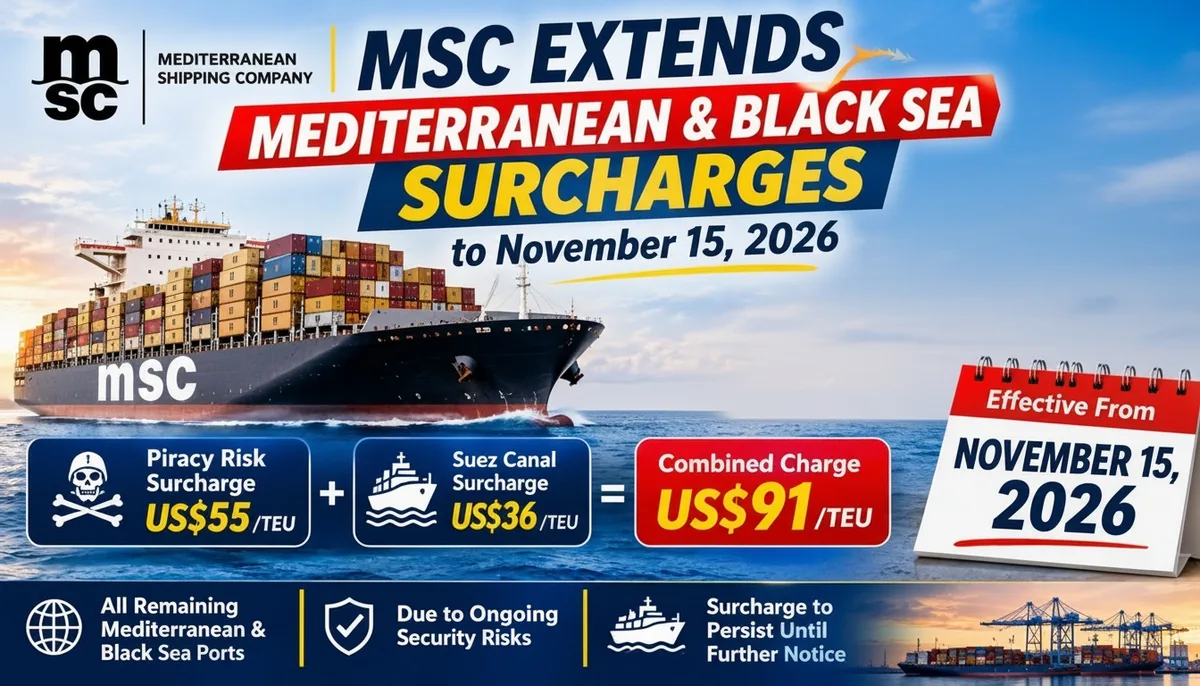
MSC will extend its Piracy Risk Surcharge and Suez Canal Surcharge to all remaining Mediterranean and Black Sea ports, the carrier confirmed this week. The wider scope now covers the West Mediterranean, East Mediterranean, Adriatic, North Africa and Black Sea regions, applying to all cargo moving from Asia.
The extension to all remaining ports takes effect from 15 November 2026, based on the proforma date, and the charges will remain in place until further notice.
MSC's own advisory explained the rationale directly: "The security situation and piracy risk around the Arabian Peninsula is affecting vessel operations and transit routes, causing disruption throughout our network."
What the Charges Actually Cost
MSC will apply the following amounts:
- Piracy Risk Surcharge: US$55 per TEU
- Suez Canal Surcharge: US$36 per TEU
- Combined charge: US$91 per TEU
For a standard 40-foot container, that combined charge effectively doubles to roughly $182, since TEU-based surcharges are typically applied per unit of capacity rather than per container.
How This Rollout Has Progressively Expanded Since September
This November 15 extension is the final stage of a surcharge rollout MSC has steadily widened over the past two months, and tracing that progression helps explain why today's "full Mediterranean" coverage looks the way it does:
- 15 September 2026: MSC first introduced the $91/TEU combined surcharge on cargo from Asia to selected East Mediterranean and Black Sea ports, including Alexandria, Istanbul, Odessa, Constanta and others.
- 30 September 2026: The carrier extended the same surcharges to Casablanca, Agadir and Nador in Morocco, along with additional Spanish, French and Italian ports including Barcelona, Valencia, Marseille-Fos, Genoa and Naples, plus Algeria, Tunisia and Libya.
- 19 October 2026: A further extension added 43 more Mediterranean and North African destinations, including Derince and Port Said West.
- 15 November 2026: This latest announcement closes the remaining gaps, bringing all West Mediterranean, East Mediterranean, Adriatic, North Africa and Black Sea ports under the same surcharge structure.
In other words, rather than a single sweeping announcement, MSC has been incrementally widening geographic coverage roughly every two to four weeks since mid-September — a pattern that suggests the carrier has been responding to an evolving security assessment rather than applying a fixed policy from the outset.
Why the Timing Is Notable: A Return to Suez Alongside Rising Costs
This surcharge extension lands at a somewhat counterintuitive moment. As we've tracked in our own recent coverage, MSC and other major carriers have been gradually and selectively resuming Suez Canal transits after months of Cape of Good Hope diversions — Suez traffic has been climbing back toward, though still well below, pre-disruption levels.
Industry analysis has noted that the cost savings from returning to the shorter Suez route are real but modest — one estimate put the fuel savings at roughly $1 million per round-voyage for a 24,000 TEU ship, or about $43 per slot, against the Cape route. War-risk insurance premiums, set voyage by voyage, work against that saving. The practical result is that shippers are currently paying on both sides of this equation: they benefit from the shorter transit time of the Suez route returning, while still absorbing the piracy and Suez surcharges carriers continue to apply to offset elevated security costs.
Not Just MSC: CMA CGM Introduces Its Own Black Sea Surcharge
MSC's extension is not happening in isolation. This same week, CMA CGM introduced a separate War Risk Surcharge (WRS) of $35 per TEU on all cargo moving to and from Black Sea countries, effective November 9, 2026. CMA CGM's move follows the Joint War Committee's September 16 designation of the Black Sea maritime area as a war risk zone under its Listed Areas, and the surcharge applies to cargo moving through both CMA CGM's own services and third-party feeder services.
Together, these two carrier announcements in the same week point to a broader industry pattern: major container lines are independently converging on similar cost-recovery mechanisms for Black Sea and Mediterranean security risk, rather than any single carrier acting alone.
What This Means for Shippers and Freight Forwarders
- Budget for $91/TEU on any remaining unaffected Mediterranean or Black Sea lane from November 15. If your cargo moves from Asia to any Mediterranean, North African, Adriatic or Black Sea port not already covered by MSC's earlier September or October extensions, this surcharge will now apply to your shipments.
- Check whether your specific port was already covered under the earlier phases. Given the incremental rollout since September, confirm with MSC or your forwarder whether your destination port has been subject to these charges since September 15, September 30, October 19, or only now from November 15 — this affects how far back the cost increase has already been embedded in your freight budget.
- Compare surcharge structures if you also ship via CMA CGM on Black Sea lanes. With CMA CGM's separate $35/TEU War Risk Surcharge taking effect November 9 on Black Sea cargo, shippers using multiple carriers on this route should map out the different surcharge amounts and effective dates across their carrier mix.
- Do not expect these surcharges to disappear as Suez traffic normalizes. Based on the pattern of extensions rather than removals since September, and the fact that war-risk insurance is priced voyage by voyage rather than easing automatically, these charges appear likely to persist "until further notice" even as the broader Suez return continues.
- Factor this into year-end and 2027 contract rate negotiations. With multiple carriers now applying broadly similar security-related surcharges across overlapping Mediterranean and Black Sea geography, shippers negotiating upcoming contracts should treat these as a structural cost addition rather than a temporary line item likely to be dropped soon.
Key Takeaways
- MSC will extend its Piracy Risk Surcharge ($55/TEU) and Suez Canal Surcharge ($36/TEU) — combined $91/TEU — to all remaining Mediterranean and Black Sea ports from November 15, 2026.
- The rollout has expanded in four stages since September 15, progressively covering more ports roughly every two to four weeks.
- MSC attributes the surcharges to ongoing security and piracy risk conditions around the Arabian Peninsula.
- The extension lands alongside carriers' gradual return to Suez Canal routing, where cost savings from the shorter route are real but modest once war-risk insurance is factored in.
- CMA CGM separately introduced its own $35/TEU Black Sea War Risk Surcharge effective November 9, 2026, following the Joint War Committee's September designation of the Black Sea as a war risk zone.
- Shippers should check their specific port's surcharge history, compare charges across carriers, and plan for these costs to persist rather than ease near-term.




Comments
No comments yet. Be the first to share your thoughts!