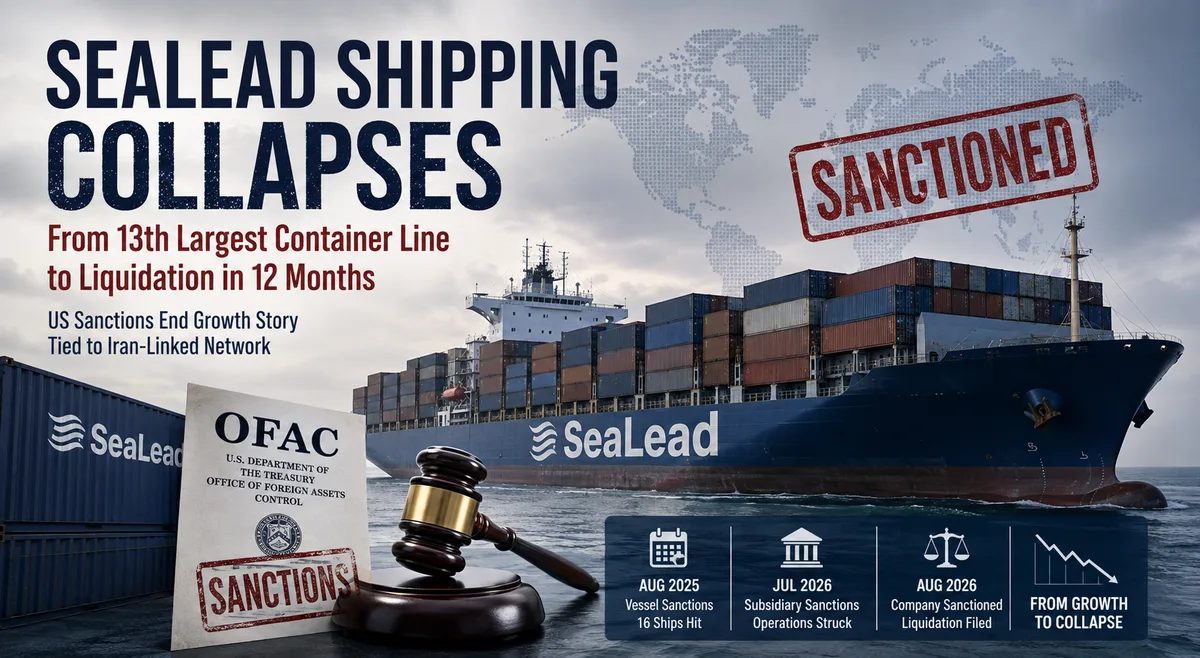
In mid-2025, SeaLead Shipping was one of the container industry's most talked-about growth stories. The Singapore-based carrier had grown from a small Red Sea feeder operator into a midsize global liner with 53 vessels, routes spanning Asia-Europe, Asia-Red Sea, Asia-North America, and the Middle East, and a ranking of 13th largest container line in the world according to Alphaliner. By August 4, 2026, it was in liquidation.
Singapore-based SeaLead Shipping has ceased trading after US sanctions impeded operations. The liner operator filed for voluntary liquidation in late July, and on Monday, Cosimo Borrelli of Admiralty Asia Partners was appointed the liquidator. The collapse is the most significant casualty of the Iran sanctions campaign tied to the Hormuz conflict — and a warning about how quickly US secondary sanctions can dismantle a fast-growing shipping company once they reach its core operating entities.
What SeaLead Was — and Why It Mattered
SeaLead's growth story was genuinely impressive. Founded as a small feeder carrier, the company expanded aggressively through chartered tonnage to build a global network connecting major Asian manufacturing hubs to European, Middle Eastern, and North American markets. At its peak, it operated 53 container ships — 2 owned, 51 chartered — with routes that included the Far East-Mediterranean 5CX service and the China-Red Sea CRS service, among others.
What made SeaLead notable in the industry was the speed of its expansion. It had grown from a regional feeder carrier to the 13th largest liner operator globally within a few years — a trajectory that attracted significant attention from analysts, charterers, and competitors alike. The company's Malaysian subsidiary, SeaLead Shipping Malaysia, was still actively booking cargo as an NVOCC as recently as late July 2026, according to The Loadstar's sources.
That aggressive growth also meant SeaLead was heavily dependent on chartered tonnage and on maintaining clean relationships with major shipping lines that accepted its containers for transhipment and feeder services. Once those relationships became legally risky — because dealing with a sanctioned entity exposes counterparties to their own OFAC liability — SeaLead's business model collapsed rapidly.
How the Sanctions Built Up — A Three-Stage Process
SeaLead's demise was not sudden. It was the cumulative result of three escalating rounds of US sanctions targeting its connections to the Shamkhani network — an Iranian shipping network centred on Mohammad Hossein Shamkhani, son of Ali Shamkhani, a top political adviser to Iran's Supreme Leader and former commander of the Islamic Revolutionary Guard Corps Navy.
Stage 1 — August 2025: OFAC sanctioned 22 container ships with links to the Shamkhani network, including 16 vessels chartered by SeaLead. SeaLead immediately terminated those charter contracts and stated it was in full compliance with sanctions requirements. The company lost roughly one-third of its fleet overnight but continued operating on its remaining tonnage.
Stage 2 — July 2026: The US Treasury escalated directly against SeaLead's corporate structure. OFAC sanctioned SeaLead Shipping companies in Singapore, Dubai, and Marshall Islands, as well as an agency company in India — hitting the main operating companies, not just individual vessels. The sanctions form part of a wider package targeting more than 50 individuals, companies, and vessels associated with the Shamkhani network — accusing the network of involvement in Iranian oil exports, global container shipping, and commodity trading. At this point, SeaLead's ability to operate was fundamentally compromised: even unsanctioned vessels became commercially unviable because shipping lines, port operators, and cargo owners faced OFAC exposure simply by transacting with a sanctioned entity.
Stage 3 — August 2026: The final nail in the coffin appears to have been hammered in last month, when OFAC sanctioned SeaLead itself, as well as its subsidiaries in India, the Marshall Islands, and the UAE. Several other Shamkhani-linked companies were also named, including Aare Lines, Hansa Shipping, Lubeck Shipping, Volta Shipping, and WeFreight Shipping. With no corporate entity able to legally operate, SeaLead filed for voluntary liquidation.
What Happens to SeaLead's Cargo and Customers
For shippers who had cargo booked on SeaLead services, the immediate questions are operational. The Loadstar understands that until the end of last month, SeaLead's Malaysian subsidiary was still trying to book cargo as an NVOCC, but that shipping lines had become wary of taking its business. With voluntary liquidation now in process and a liquidator appointed, any cargo in transit or booked on future SeaLead sailings needs to be rerouted immediately through alternative carriers.
The routes most affected are SeaLead's intra-Asia and Asia-Red Sea services, where it had built significant market share. China United Lines — which previously capitalised on SeaLead's earlier disruption — and other intra-Asia carriers are the most obvious beneficiaries of the capacity withdrawal. On the Asia-Mediterranean corridor, the 5CX service termination removes another slot option in an already capacity-constrained market.
The Broader Implications — Sanctions as a Shipping Tool
SeaLead's collapse illustrates how the US sanctions campaign tied to the Iran-Hormuz conflict is reshaping the global container shipping industry in ways that go well beyond the physical closure of the strait. The three-stage escalation that brought down SeaLead — vessel-level sanctions, then subsidiary-level sanctions, then company-level sanctions — is a template that OFAC has now demonstrated it is willing and able to execute against a mid-sized global carrier.
The companies named alongside SeaLead in the Shamkhani network — Aare Lines, Hansa Shipping, Lubeck Shipping, Volta Shipping, and WeFreight Shipping — are all now under sanctions. Whether any of them face the same liquidation outcome depends on whether their corporate structures can survive OFAC designation in the way SeaLead's ultimately could not. The naming of a shipping agency in India and subsidiaries across the Marshall Islands, UAE, and Singapore in a single sanctions package shows the geographic reach of the enforcement campaign.
For other carriers operating in markets adjacent to Iran — intra-Asia, Asia-Middle East, Asia-Red Sea — the SeaLead case is a compliance warning. The Shamkhani network was not conducting overtly illegal operations in most cases: it was a legitimate commercial shipping business whose ultimate beneficial ownership connected it to Iranian interests. The OFAC action treated that connection as sufficient grounds for full sanctions designation. Any carrier or forwarder with cargo flows touching Iranian-connected entities — even indirectly — faces the same exposure risk.
What Shippers and Freight Forwarders Need to Do
- If you have cargo booked on SeaLead services, rebook immediately. With voluntary liquidation underway and a liquidator appointed, SeaLead's future sailings are not going to happen. Don't wait for official confirmation of individual service cancellations — the company has ceased trading.
- Run OFAC compliance checks on all carriers in your network. SeaLead's collapse shows that mid-sized carriers with apparent commercial legitimacy can carry sanctions exposure through their ownership structures. Your freight forwarder's carrier vetting process needs to include OFAC status checks, not just commercial and safety assessments.
- Assess capacity impact on intra-Asia and Asia-Red Sea lanes. SeaLead had meaningful market presence on these corridors. Its withdrawal reduces available capacity at a time when the Hormuz closure is already constraining Middle East-linked freight options. Expect some rate pressure on these specific lanes.
- Watch the other named companies. Aare Lines, Hansa Shipping, Lubeck Shipping, Volta Shipping, and WeFreight Shipping are all now under sanctions alongside SeaLead. If you have any commercial relationship with any of these entities, review it immediately against OFAC requirements.
Key Takeaways — August 6, 2026
- SeaLead Shipping, until recently the world's 13th largest container line, has ceased trading and entered voluntary liquidation. A liquidator was appointed August 4, 2026.
- The collapse resulted from three escalating rounds of US OFAC sanctions targeting SeaLead's connections to the Shamkhani network — an Iran-linked shipping operation — culminating in direct sanctions against SeaLead's core operating companies in Singapore, Dubai, Marshall Islands, and India.
- Several other Shamkhani-linked companies were also sanctioned simultaneously, including Aare Lines, Hansa Shipping, Lubeck Shipping, Volta Shipping, and WeFreight Shipping.
- SeaLead operated 53 container ships across Asia-Europe, Asia-Red Sea, Asia-North America, and Middle East routes — its collapse removes significant capacity from intra-Asia and Asia-Middle East corridors.
- The case establishes a three-stage OFAC enforcement template — vessel sanctions, subsidiary sanctions, company sanctions — that can bring down a mid-sized global carrier within 12 months of initial action.
- For shippers and forwarders: rebook any SeaLead cargo immediately, run OFAC compliance checks on all carriers in your network, and monitor the other named Shamkhani-network companies for further enforcement action.
Comments
No comments yet. Be the first to share your thoughts!