What Just Happened?
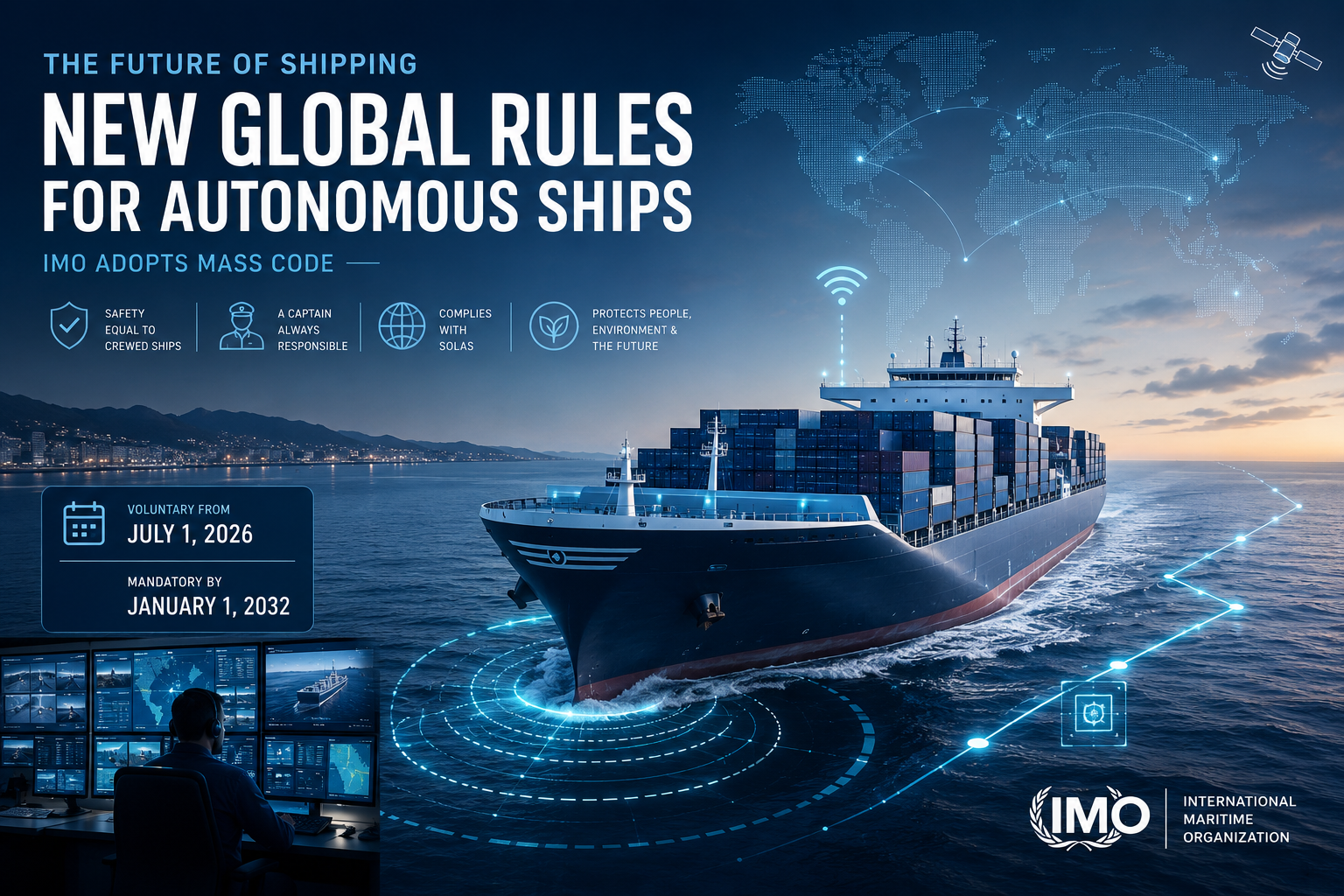
The International Maritime Organization has adopted a new International Code of Safety for Maritime Autonomous Surface Ships — known as the MASS Code — to support the safe integration of AI-enabled and remotely operated commercial ships into global shipping.
In simple terms: ships that are controlled by computers, AI systems, or remote operators on land now have their own set of international rules for the first time ever. The MASS Code takes effect from July 1, 2026.
What Is an Autonomous Ship?
An autonomous ship is not necessarily a ship with zero humans. The MASS Code covers a range of automation levels:
- Level 1: Automated systems on board, but a full crew is still present.
- Level 2: Ship is remotely controlled from shore, but crew is still on board.
- Level 3: Ship is remotely controlled from shore with no crew on board.
- Level 4: Fully autonomous — the ship makes its own decisions with no human in the loop.
Under the code, an operational vessel is classified as autonomous if its shipboard software is verified to safely execute navigational commands without onboard human intervention.
What Do the New Rules Say?
The MASS Code sets clear standards that autonomous ships must meet to operate legally in international waters. The key rules include:
- Same safety standards as crewed ships. The MASS Code establishes a goal-based framework to ensure that autonomous ships meet safety, security, and environmental protection standards equivalent to those required for conventional manned vessels.
- A captain is always responsible. The MASS Code mandates that a designated captain or master retains absolute legal responsibility for the vessel at all times, regardless of whether that captain is physically on the bridge or monitoring the ship from a land-based Remote Operations Centre.
- Must comply with SOLAS. Autonomous ships will also be required to comply with the International Convention for the Safety of Life at Sea (SOLAS) and other applicable mandatory IMO instruments.
- Applies to large cargo ships in international trade. The new framework will apply to large cargo ships engaged in international trade.
Is This Mandatory Right Now?
Not yet — but it will be. It will initially be implemented on a voluntary basis for at least two years. This gives shipping companies and governments time to test the rules in real-world conditions before they become binding law.
The roadmap going forward is clear:
- July 1, 2026: MASS Code takes effect — voluntary phase begins.
- 2026–2028: Experience-building phase — real ships tested against the rules.
- 2028: Development of the mandatory version of the code begins.
- January 1, 2032: Expected entry into force of the IMO's first mandatory MASS Code.
Why Does This Matter for the Logistics Industry?
This is a bigger deal than it might seem. Here's why logistics professionals should care:
- Lower shipping costs in the future. Crew costs are one of the biggest expenses in running a ship — food, wages, accommodation, training, rotation. Remove the crew and costs drop significantly. Those savings can eventually flow through to shippers as lower freight rates.
- Ships can run 24/7 without fatigue. Human crews need rest. Autonomous ships don't. This means faster voyages, more precise scheduling, and better reliability for cargo delivery timelines.
- Safer at sea. Around 75–96% of maritime accidents involve human error. AI-controlled ships don't get tired, distracted, or make snap judgments in bad weather.
- The rules are now clear — investment will follow. One of the biggest reasons autonomous shipping hasn't taken off faster is regulatory uncertainty. Now that the IMO has published a global framework, shipping companies and investors have the confidence to commit serious money to this technology.
What's Already Out There?
Autonomous ships are not just a future concept. Several vessels are already operating:
- Yara Birkeland — the world's first fully electric, autonomous cargo ship, operating in Norway.
- Mayflower Autonomous Ship — crossed the Atlantic Ocean completely without a crew in 2022.
- Multiple Japanese and Korean shipping companies are running autonomous vessel trials on short-sea routes.
What was missing until now was the global legal framework to scale these operations to international trade. The MASS Code fills that gap.
Key Takeaways
- IMO adopted the world's first global autonomous ship safety code — May 22, 2026.
- Known as the MASS Code — covers AI-controlled and remotely operated cargo ships.
- Takes effect July 1, 2026 on a voluntary basis.
- Mandatory version expected by January 1, 2032.
- A designated captain must always remain legally responsible — even from shore.
- Lower costs, better safety, and 24/7 operations are the big benefits for the industry.
The era of self-sailing ships is no longer a question of if — it's a question of when. And with the IMO's MASS Code now in place, the countdown to crewless cargo ships in international trade has officially begun.
Comments
No comments yet. Be the first to share your thoughts!
Join the conversation
You need an account to comment on articles.