What Is Happening?
Three months ago, a U.S. shipping broker watched nearly a dozen loads of copper and electronics bound for AI data centres vanish in transit. The theft cost the company almost US$5 million.
"The bad guys are good at marketing," said Keith Lewis, head of operations at risk-assessment firm Verisk CargoNet. "It's so much more strategic now, so much more targeted. They know what's hot and they know what's selling."
This incident is not an isolated case. It is part of a fast-growing, highly organized criminal trend that is hitting the logistics industry hard — and costing consumers money every time they buy anything that touches AI infrastructure.
The Numbers Are Alarming
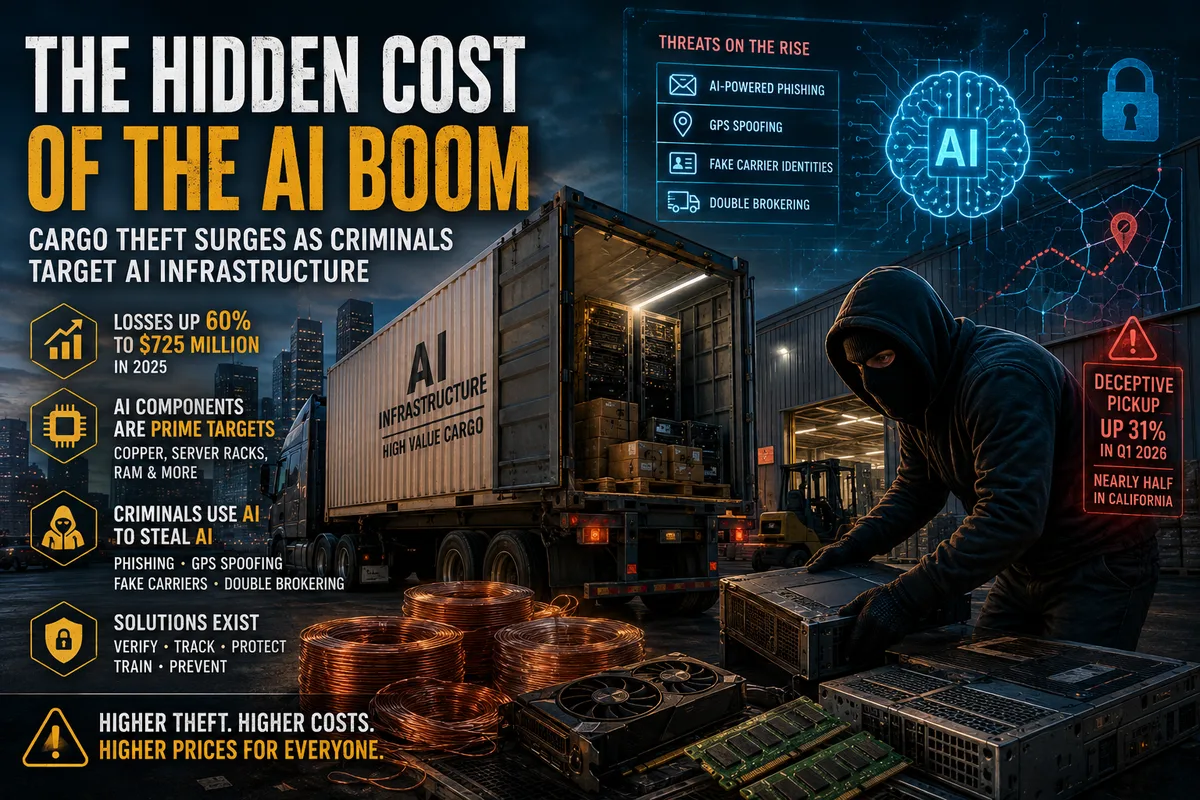
Last year, losses from supply chain crime in Canada and the U.S. rose 60% to nearly US$725 million — more than $1 billion Canadian — as big-rig bandits zeroed in on valuable shipments, according to a report from CargoNet.
Here is what the data shows:
- Total supply chain crime losses: $725 million — up 60% year over year
- Average theft value rose 36%, "driven by more selective, high-value targeting by organized groups"
- Metal theft climbed 77%, fuelled largely by demand for copper products
- Many more thefts went unreported — companies fear reputational damage or higher insurance premiums
And the problem is getting worse in 2026, not better.
Why Is AI Driving Cargo Theft?
The connection between the AI boom and cargo theft is direct. Building AI data centers requires enormous quantities of very specific, very valuable physical materials:
- Copper — used in cables, wiring, and cooling systems throughout every data center
- Server racks and GPU units — worth hundreds of thousands of dollars each
- RAM chips — small, lightweight, extremely valuable, and easy to move and resell
- Networking hardware — switches, routers, and cables used to connect AI infrastructure
"With the emergence of AI data centres, you have a lot of components for those AI data centres being stolen: server racks, RAM, copper," Lewis said. These are not random opportunistic thefts — they are targeted operations run by organized criminal networks that follow AI infrastructure supply chains as closely as any logistics analyst would.
Criminals Are Using AI to Steal AI Components
Here is where the story takes an extraordinary turn. The same AI technology powering data centers is now being used by criminals to steal the components that build them.
According to Geotab's 2026 cargo security report, criminal networks are now deploying:
- AI-powered phishing: Automated, highly convincing fake emails sent to freight brokers, carriers, and warehouse staff — designed to steal login credentials and access shipment tracking systems
- GPS spoofing: Technology that tricks a truck's GPS into reporting a false location — so the vehicle can be diverted while the tracking system shows everything is normal
- Stolen carrier identities: Criminals create fake trucking companies with real-looking credentials, win loads through freight brokers, and simply drive away with them — a scheme called "fictitious pickup"
- Double brokering: Loads are booked with one carrier but secretly passed to another — giving criminals an opportunity to intercept shipments mid-chain
Deceptive pickup — where criminals use fake identities, forged credentials, and carrier impersonation to walk away with legitimate loads — rose 31% compared to Q1 2025. Nearly half of those incidents occurred in California.
Who Is Most at Risk?
Any shipper, freight forwarder, or carrier moving high-value technology components is in the crosshairs right now. But the risk is not limited to AI hardware:
- Electronics and semiconductors — always high-value targets, now more so
- Pharmaceuticals — especially cold-chain medication shipments
- Food and beverages — high volume, easier to liquidate quickly
- Metals — copper, aluminium, and steel demand surging with AI construction boom
Geotab's 2026 research found that 52% of fleet professionals still identify unattended trucks in unsecured lots as their primary concern, while only 23% flag fraud-based schemes as their greatest threat. That gap is dangerous — because fraud-based theft is now far more common and far harder to detect than a simple trailer break-in.
What Can Logistics Companies Do Right Now?
The good news is that technology is also part of the solution. Here is what leading companies are doing to fight back:
- AI-powered carrier verification. Platforms like Overhaul's FraudWatch use AI to proactively flag suspicious carrier profiles, detect double brokering attempts, and verify driver identities before a load is even released.
- Real-time GPS tracking with anomaly alerts. Modern telematics systems flag unexpected route deviations, unauthorized stops, and GPS inconsistencies within seconds — giving dispatchers the chance to intervene before cargo disappears.
- Digital chain of custody. Smart cargo door systems like those from Wabash pair physical locking mechanisms with digital access logs — creating a verified record of who touched the freight at every point in the journey.
- Two-factor carrier identity checks. Before releasing a load, shippers should independently verify carrier identity through a second channel — phone call, registered DOT number check, or direct contact with the motor carrier — not just an email confirmation.
- Employee training on phishing. Many cargo thefts start with a fake email. Regular training on how to spot credential phishing attacks is one of the most cost-effective prevention tools available.
The Cost Gets Passed to Consumers
Cargo theft is not just a logistics industry problem — it is ultimately a consumer problem. When AI components, electronics, or food shipments are stolen, those losses flow through supply chains and end up in higher prices for the products consumers buy.
With AI infrastructure investment running at hundreds of billions of dollars annually in 2026, the value of goods moving through supply chains is higher than ever before — which makes those supply chains an increasingly attractive target for organized crime.
Key Takeaways
- Supply chain crime losses rose 60% in 2025 to $725 million in North America — CargoNet report, May 31, 2026.
- AI data center components — copper, server racks, RAM — are now primary theft targets.
- Average theft value up 36%; metal theft up 77%.
- Criminals are using AI-powered phishing, GPS spoofing, and fake carrier identities.
- Fictitious pickup schemes up 31% in Q1 2026 — nearly half in California.
- Solutions exist: AI verification platforms, real-time GPS tracking, digital chain of custody.
- Losses ultimately get passed to consumers through higher product prices.
The AI boom has created extraordinary new opportunities for logistics. But it has also created an extraordinary new threat. The companies that take cargo security seriously in 2026 will protect their margins, their customers, and their reputations. The ones that don't are increasingly vulnerable to criminal networks that are just as sophisticated as any technology company.



Comments
No comments yet. Be the first to share your thoughts!
Join the conversation
You need an account to comment on articles.