What Just Launched?
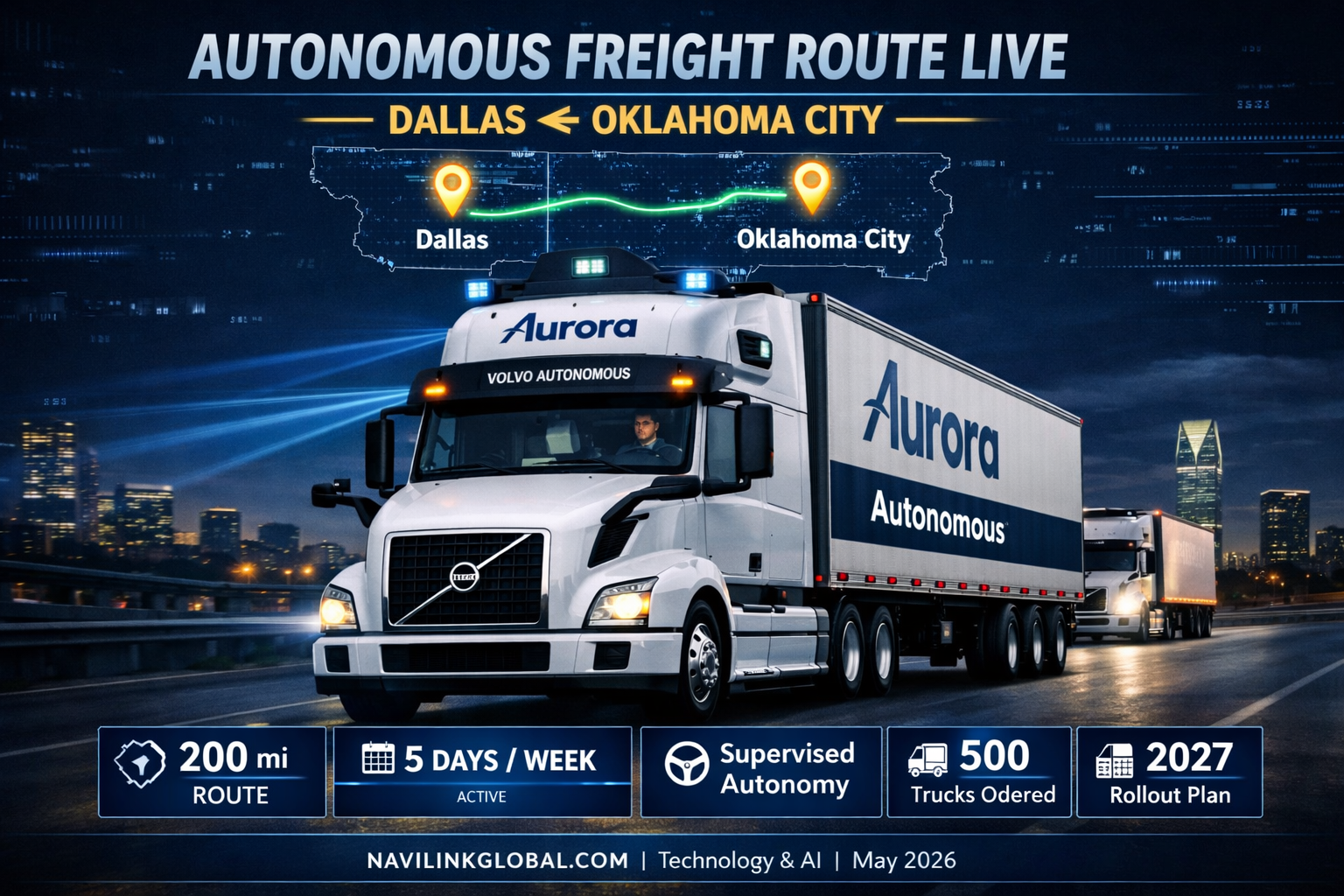
Volvo Autonomous Solutions (V.A.S.) and Aurora Innovation (NASDAQ: AUR) have officially begun hauling freight on a 200-mile autonomous truck route between Dallas and Oklahoma City. The trucks are running five days a week, delivering cargo directly to customer facilities — not just depot-to-depot transfers.
The vehicle doing the work is the Volvo VNL Autonomous, a purpose-built self-driving truck integrated with Aurora's proprietary "Aurora Driver" technology. This isn't a proof-of-concept anymore. Goods are moving. Customers are receiving them.
How Did It Come Together So Fast?
One of the most impressive parts of this story is the speed of deployment. Within weeks of the decision to expand, Aurora mapped the Dallas-to-Oklahoma City interstate route and began autonomous hauls. That kind of rapid deployment shows how mature the technology has become — this is no longer a years-long R&D process for every new route.
The route currently operates in supervised autonomy mode, meaning a safety driver is present but the Aurora Driver is doing the driving. The companies are now in the final validation phase for fully driverless operations — meaning no human in the cab at all.
Why Does Delivering to Customer Facilities Matter?
Previously, autonomous trucks mostly ran terminal-to-terminal — hub to hub — where a human driver would then take over for the final miles to the customer. By operating directly to customer facilities, V.A.S. can reduce the need for drayage moves and additional handoffs, helping remove complexity from the logistics flow.
That's a big deal. Every handoff in a supply chain is a potential delay, a cost, and a point of failure. Cutting those out means faster deliveries and lower costs for shippers.
What's Coming Next?
This is just the beginning of a much larger rollout. Aurora and Hirschbach have announced a Memorandum of Understanding for the carrier to acquire 500 Aurora Driver-powered trucks, with delivery starting in 2027. Meanwhile, Volvo plans to build hundreds of the VNL Autonomous trucks in 2027 at its New River facility — the largest Volvo production facility in the world.
The scale being planned here is significant. We're not talking about a handful of experimental vehicles — we're talking about hundreds of autonomous trucks entering commercial freight operations within the next 12–18 months.
What Does This Mean for the Logistics Industry?
Autonomous trucking has been "coming soon" for a decade. What's different now is that it's actually here — running scheduled freight, on public highways, to customer addresses. Here's what logistics professionals should be thinking about:
- Driver shortages may ease over time. The US trucking industry faces a well-documented shortage of qualified drivers. Autonomous trucks on long-haul interstate routes free up human drivers for local and complex deliveries where they're harder to replace.
- Freight costs could fall on key lanes. Autonomous trucks don't need rest breaks, can run at night, and don't require the same cost structures as driver-operated rigs. On high-volume corridors, this could put downward pressure on rates.
- New competitive dynamics for carriers. Carriers that adopt autonomous technology early — like Hirschbach — will have a cost and capacity advantage over those that don't.
- Infrastructure and regulation will be key. Texas has been one of the most autonomous-truck-friendly states in the US. Expansion to other states will depend on regulatory progress.
Key Takeaways
- Volvo and Aurora launched a live 200-mile autonomous freight route: Dallas to Oklahoma City.
- Trucks run five days a week, delivering directly to customer facilities.
- Currently in supervised autonomy — fully driverless operations in final validation phase.
- 500 Aurora-powered trucks ordered by carrier Hirschbach, delivery from 2027.
- Volvo to build hundreds of VNL Autonomous trucks in 2027.
- This is the clearest signal yet that autonomous trucking is entering mainstream logistics.
The question for the freight industry is no longer if autonomous trucks will reshape logistics. It's how fast — and whether your business will be ready.

Comments
No comments yet. Be the first to share your thoughts!
Join the conversation
You need an account to comment on articles.