Three Companies, One Clear Signal
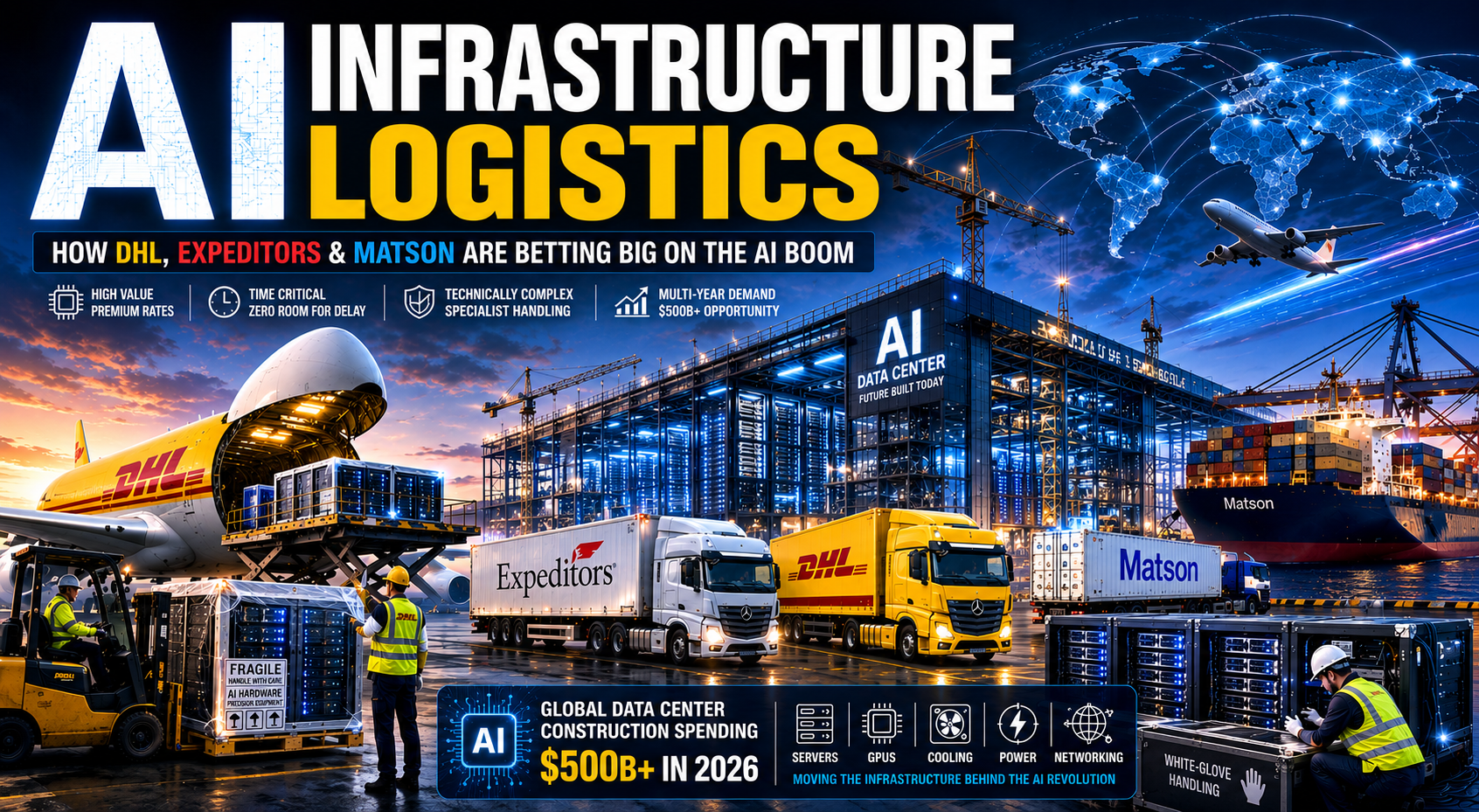
When DHL, Expeditors, and Matson — three very different logistics businesses operating across very different markets — all start talking about the same opportunity at the same time, the industry should pay attention.
In their latest earnings calls, investor updates, and public statements published around May 26, 2026, all three pointed to AI infrastructure logistics as a key growth driver for the rest of 2026 and beyond. The common thread: hyperscalers — companies like Microsoft, Google, Amazon, and Meta — are building data centers at extraordinary speed, and moving the equipment to build and run those facilities is a serious, complex, high-value logistics challenge.
DHL: 10 New Warehouses, 7 Million Square Feet — Just for AI Data Centers
DHL has made the most aggressive public commitment to this space. DHL announced a significant expansion of its North America data center logistics infrastructure with 10 dedicated warehouse sites totalling more than seven million square feet of capacity set to go live in 2026.
These are not ordinary warehouses. Designed for hyperscale and colocation data center operators racing to deploy new capacity, the facilities offer white-glove handling, rack configuration services, and specialized warehouse-to-site transportation.
What does "white-glove handling" actually mean in this context? It ensures servers, power modules, and networking systems are moved under tightly controlled conditions to prevent damage that could trigger costly delays. A single damaged server rack can cost hundreds of thousands of dollars and delay an entire data center deployment by weeks.
Rack configuration services move critical integration and testing out of the live construction zone and into secure warehouse environments, reducing on-site complexity and lowering the risk of installation delays.
DHL Group CEO Hendrik Venter put it directly: "Hyperscalers are creating the digital backbone of the AI era, and they are doing so at extraordinary speed. Our expanded North America footprint is purpose-built to match that pace."
With hyperscalers, DHL has seen significant revenue growth in 2025 and is doubling down on 2026 expectations, scaling capabilities to capture what's coming. Recent wins include hyperscaler warehousing projects in the US and Asia, with a very strong pipeline across all business units.
Expeditors: AI Hardware Is Reshaping Air Freight Demand
Expeditors International — one of the world's largest freight forwarders — has been highlighting a specific phenomenon in air freight: AI-related hardware shipments are becoming a significant driver of premium air cargo demand.
The reason is straightforward. AI chips, GPUs, and server components are extremely high-value, time-sensitive, and cannot afford supply chain delays. When a hyperscaler needs to hit a data center deployment deadline, they will pay whatever it takes to fly the equipment in rather than risk a 30-day ocean shipment. This creates a sustained premium demand for air freight capacity on key lanes — particularly Asia to North America and Asia to Europe, where most AI hardware manufacturing is concentrated.
Expeditors has been positioning its air freight forwarding capabilities to capture this demand, noting it as one of the most resilient pockets of freight demand in an otherwise mixed market.
Matson: AI Infrastructure Is Driving Volume on Pacific Lanes
Matson — the Hawaii and Pacific specialist that also runs premium expedited China-to-US services — has seen AI-related cargo become a growing portion of its China–Long Beach express service volumes. As hyperscalers race to source and import AI hardware components from Asian manufacturers, Matson's fast, reliable transpacific service has become an attractive option for time-sensitive technology shipments.
This is a notable shift for Matson, which built its reputation on serving island economies and retail importers. The AI infrastructure boom is bringing a new, high-value customer profile to its network.
Why Is AI Infrastructure Such a Big Logistics Opportunity?
The scale of what's being built is hard to overstate. Industry analysts estimate that global data center construction spending will exceed $500 billion in 2026 alone — driven by the AI race between tech giants. Every dollar of that construction spending involves moving physical equipment: servers, GPUs, cooling systems, power infrastructure, networking hardware, and more.
Here's what makes it uniquely attractive for logistics providers:
- High value per shipment. A single server rack can be worth $500,000 or more. Clients pay premium rates for specialist handling.
- Time-critical. Data center deployment timelines are tied to massive business commitments. Delays are extremely costly — creating strong demand for reliable, premium logistics.
- Technically complex. Standard freight handling won't work. Temperature control, shock protection, secure chain of custody, and specialist installation support are all required — creating high barriers to entry and protecting margins.
- Sustained, multi-year demand. The AI infrastructure buildout is not a one-time event. Hyperscalers are in a multi-year race to deploy capacity — meaning this freight opportunity will run for years, not months.
What This Means for the Wider Logistics Industry
For freight forwarders, 3PLs, and carriers watching DHL, Expeditors, and Matson move into this space, the message is clear: AI infrastructure logistics is becoming a genuine specialization — and the window to establish capability and customer relationships is open right now.
Smaller specialist logistics providers with technical handling expertise, secure facilities, and relationships in the technology sector are already winning business from hyperscalers who need agile, specialist partners beyond the global giants. This is not a market exclusively for the largest players.
Key Takeaways
- DHL, Expeditors, and Matson all highlighted AI infrastructure as a major logistics growth driver — May 26, 2026.
- DHL opened 10 new North America data center logistics warehouses with 7M+ sq ft of capacity in 2026.
- AI hardware shipments are driving premium air freight demand on Asia–US and Asia–Europe lanes.
- Global data center construction spending forecast to exceed $500B in 2026.
- High-value, time-critical, technically complex cargo = premium rates and strong margins.
- Multi-year demand runway — the AI buildout is far from over.
The AI revolution is not just a software story. It is a physical infrastructure story — and logistics is right at the heart of it.

Comments
No comments yet. Be the first to share your thoughts!
Join the conversation
You need an account to comment on articles.