The June 12 Warning Every Shipper Needs to Read
On June 12, 2026, ITS Logistics — an Echo Global Logistics company — released its monthly US Port/Rail Ramp Freight Index. The findings are serious:
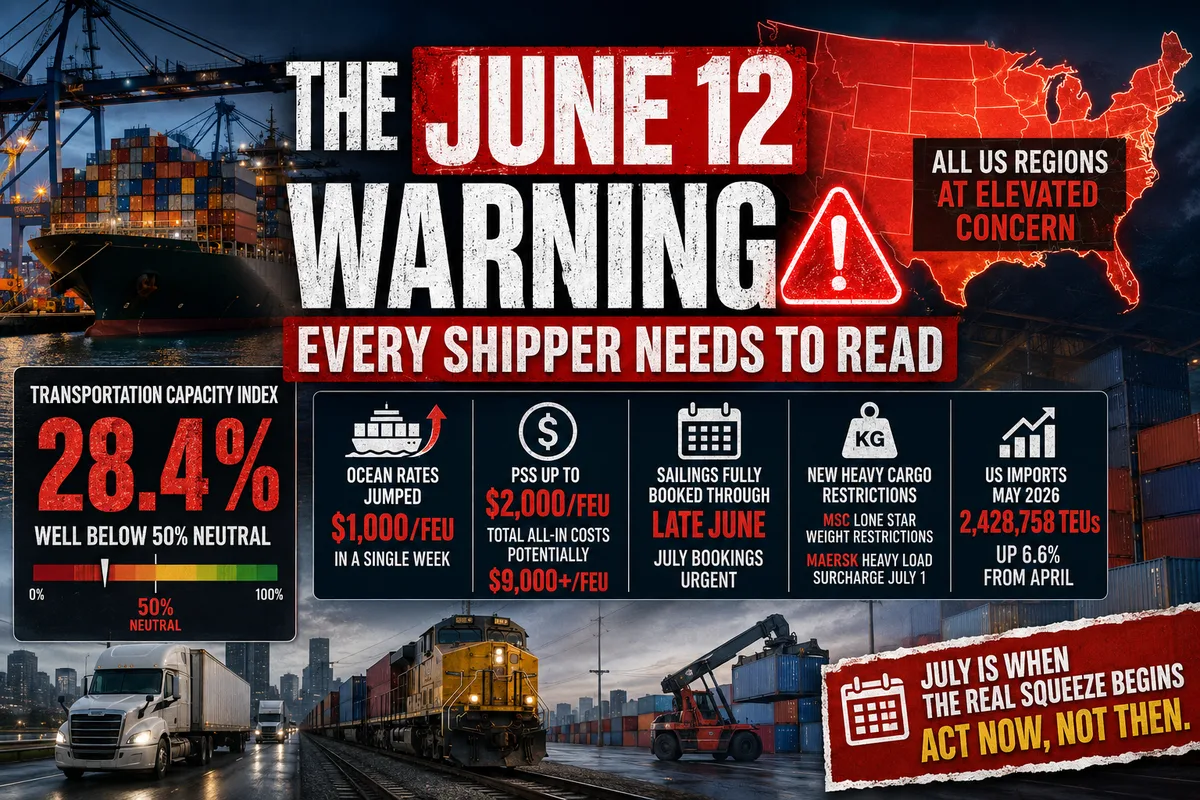
All US regions are now at elevated concern. Not some regions. Not most regions. Every single region across the United States is flashing warning signs at the same time.
"Ocean and rail container drayage markets may not be feeling the market squeeze yet — but shippers should be prepared for tightening as soon as July, when peak season begins," said Paul Brashier, Vice President of Global Supply Chain for ITS Logistics.
Then came the most alarming line in the entire report: "It is not a question of IF inland trucking container haulage rates increase — but WHEN."
The Most Important Number: 28.4%
The Logistics Managers' Index (LMI) placed Transportation Capacity at just 28.4% — well below the 50% neutral threshold.
Here is what this means in plain English. The LMI Transportation Capacity score works like this:
- Above 50% = capacity is expanding — plenty of trucks, rail, and drayage available
- At 50% = neutral — supply and demand are balanced
- Below 50% = capacity is contracting — fewer trucks available than cargo that needs moving
At 28.4%, the US freight market is not just below neutral. It is deeply into contraction territory. This is the kind of reading that precedes serious rate spikes — exactly what happened in 2021 and what is now repeating in 2026.
ITS Logistics confirmed: "The US over-the-road transportation ecosystem is currently operating at tension levels not seen since the COVID era."
What Is Actually Happening on the Ground Right Now
The June 2026 Freight Market Update from J.M. Rodgers — also published this week — adds critical detail to what shippers are experiencing right now across every major trade lane:
Ocean Rates Jumped $1,000/FEU in a Single Week
West Coast rates alone increased by more than $1,000 per FEU in a single week following the successful implementation of June 1 General Rate Increases. This is not a gradual increase — it is a sudden, sharp jump that caught many shippers off guard.
Peak Season Surcharges on Top of GRIs
Peak Season Surcharges (PSS) of up to $2,000 per FEU are now in effect across several trade lanes — stacked on top of the base rate and the GRI. For a shipper moving cargo from China to the US East Coast, the total surcharge burden is now:
- Base rate: ~$5,500/FEU
- Emergency Fuel Surcharge: ~$800-$1,200/FEU
- Peak Season Surcharge: up to $2,000/FEU
- Total all-in: potentially $9,000+/FEU
Sailings Fully Booked Through Late June
Many sailings from China and Vietnam are fully booked through late June. If you have not already confirmed July bookings — you are behind. Carriers are filling ships faster than shippers are booking them right now.
Heavy Cargo Getting Hit With New Restrictions
Two of the world's largest carriers introduced new restrictions on heavy cargo this week:
- MSC implemented strict weight restrictions on its Lone Star service serving Gulf Coast ports
- Maersk announced a new Heavy Load Surcharge effective July 1 for overweight cargo moving from Far East Asia to the US
For industrial shippers moving heavy machinery, automotive parts, or construction materials — these restrictions add real cost and complexity to your July shipments.
US Imports Hit 2.4 Million TEUs in May — Up 6.6%
Here is why the capacity crunch is happening: cargo volumes are surging at exactly the moment capacity is tightening.
US containerized imports for May 2026 totaled 2,428,758 TEUs — a 6.6% increase from April. This is one of the highest monthly import volumes in US history.
Why are imports surging? Three reasons hitting simultaneously:
- Early peak season: Retailers are front-loading orders due to longer transit times from Asia via the Cape of Good Hope route
- Amazon Prime Day and TikTok mid-year sales: Sellers are rushing inventory into US warehouses for major promotional events in July
- Tariff front-loading: Some shippers are accelerating imports ahead of potential new tariff actions — getting goods in before any new duties apply
More cargo + less capacity = higher rates. It is that simple. And it is going to get worse in July.
Which Regions and Ports Are Under Most Pressure?
The ITS Logistics index highlights specific areas of concern across all US regions:
- Pacific (West Coast): Port of Los Angeles and Port of Long Beach handling record volumes — drayage appointments increasingly difficult to secure, container dwell times rising
- Atlantic (East Coast): Capacity most constrained on East Coast services — many sailings from China and Vietnam fully booked through late June. Port of New York/NJ and Savannah under particular pressure
- Gulf Coast: MSC weight restrictions on Lone Star service adding complexity — capacity tightest for heavy industrial cargo
- West Inland (rail ramps): Chicago, Dallas, Denver rail ramps seeing rising dwell times as intermodal volumes surge from mode-shifting shippers fleeing high trucking costs
- East Inland: Memphis, Atlanta, Columbus rail ramps filling up as East Coast port volumes translate into inland congestion
Why Is Trucking Capacity Disappearing?
The trucking market is being squeezed from multiple directions simultaneously:
- High fuel costs: Diesel remains elevated due to the Iran war energy shock — at over $5/gallon in most US regions, operating costs for carriers are significantly above normal
- World Cup disruptions: The FIFA World Cup — which kicked off June 11 — is creating delivery restrictions around stadium perimeters in six major US freight cities: New York, LA, Dallas, Miami, Atlanta, and Seattle
- Driver shortages: The structural US truck driver shortage continues — there are simply not enough qualified drivers to handle surging cargo volumes
- Intermodal overflow onto trucks: As rail ramps fill up, cargo that cannot get rail appointments is being moved by truck instead — adding to highway trucking demand
What Should Shippers and Freight Forwarders Do Right Now?
- Book July and August ocean freight THIS WEEK. Sailings from China and Vietnam are already filling through late June. July sailings will be next. Every day you wait, fewer options remain at reasonable rates.
- Secure drayage appointments in advance. At major ports — especially LA/Long Beach and New York/NJ — drayage appointment windows are filling fast. Book your container pickup appointments as soon as the vessel ETA is confirmed — do not wait until the ship arrives.
- Check your cargo weight against new carrier restrictions. If you ship heavy industrial goods, machinery, or automotive parts — verify your cargo weight against MSC's new Lone Star restrictions and Maersk's July 1 Heavy Load Surcharge to avoid unexpected extra charges or bookings being rejected.
- Have a backup plan for rolling. With sailings fully booked, the risk of your cargo being "rolled" to the next vessel is real. Build 1-2 week buffer time into your delivery promises to customers and buyers.
- Consider premium "guaranteed loading" options. Several carriers are now offering guaranteed space — at a premium. For time-critical cargo, this premium is worth evaluating against the cost of a 1-2 week delay.
- Review your trucking contracts now. With Transportation Capacity at 28.4%, rates are going to rise. If your trucking contracts have rate adjustment clauses, understand when they trigger. If you are on spot market trucking — budget for meaningful rate increases in July and August.
Key Takeaways — June 14, 2026
- ITS Logistics June Port/Rail Ramp Index (June 12): ALL US regions at elevated concern — first time since COVID era.
- Transportation Capacity index: 28.4% — deeply in contraction territory, well below 50% neutral level.
- US containerized imports in May: 2,428,758 TEUs — up 6.6% from April.
- West Coast rates jumped over $1,000/FEU in a single week following June 1 GRIs.
- PSS up to $2,000/FEU now in effect — total all-in costs potentially above $9,000/FEU on some lanes.
- Many sailings from China/Vietnam fully booked through late June — July bookings urgent.
- MSC weight restrictions on Gulf Coast Lone Star service — Maersk Heavy Load Surcharge from July 1.
- July is when the real squeeze begins — act now, not then.
The US freight market has not been this tight since COVID. In 2021, the companies that waited too long to book space, secure drayage, and lock in trucking capacity paid the price — in blown budgets, missed delivery deadlines, and furious customers. The same warning signs are flashing now. The companies that act this week will be in a very different position than those that wait until July.

Comments
No comments yet. Be the first to share your thoughts!
Join the conversation
You need an account to comment on articles.