
The Record That No One Expected This Fast
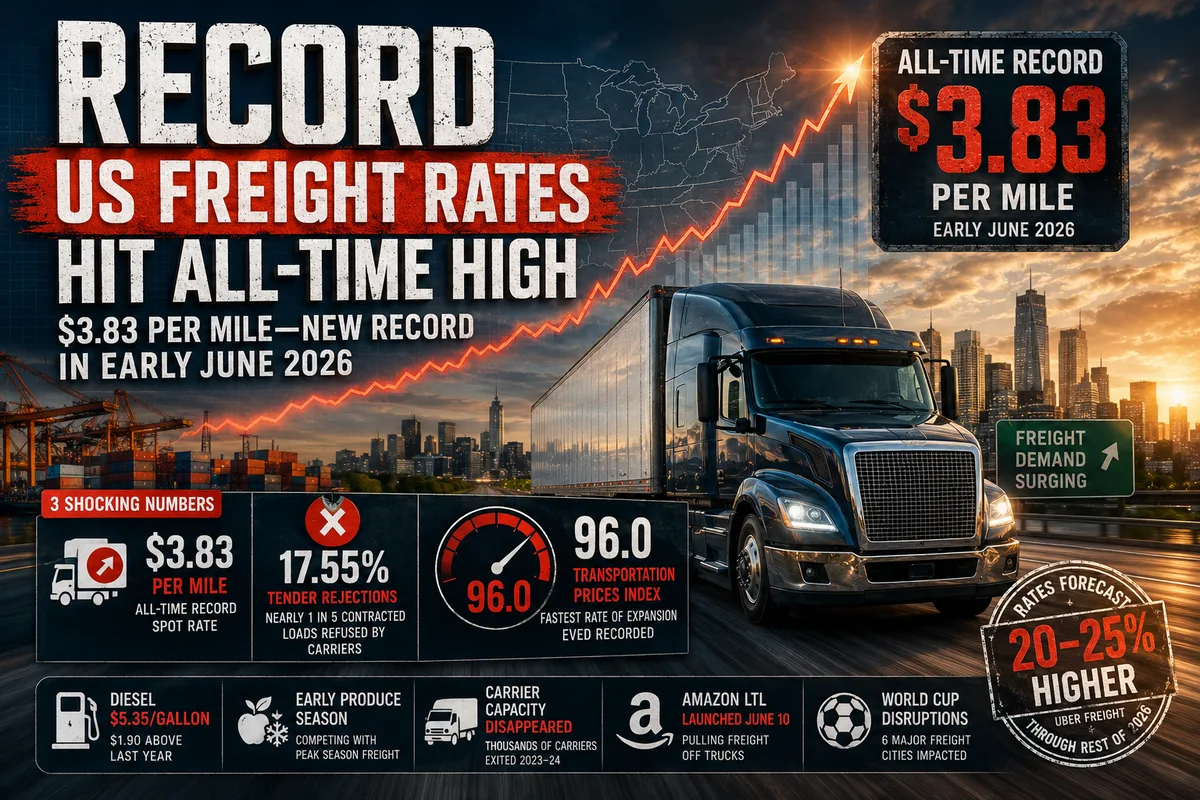
In early June 2026, something happened in the US freight market that had never happened before in recorded history. Truckload spot rates hit an all-time record high, jumping $0.09 per mile overnight to $3.83 per mile — the highest level ever recorded according to FreightWaves.
To understand why this is extraordinary, here is some context:
- During the COVID freight boom (2021-22): Spot rates peaked at around $3.50-$3.60/mile — thought at the time to be a once-in-a-generation extreme
- Post-COVID crash (2023-24): Rates fell all the way back to $1.50-$1.70/mile as excess capacity flooded the market
- Early 2026: Rates began recovering as capacity tightened
- June 2026: $3.83/mile — a new all-time record, surpassing even the COVID peak
This is not a temporary blip. Multiple data sources confirm the same picture: the US trucking market is now tighter than it has ever been — at any point in its history.
The Three Shocking Numbers
Three data points from this week tell the full story of just how extreme the current market has become:
Number 1: $3.83 Per Mile — All-Time Record Spot Rate
Truckload spot rates hit an all-time record high in early June 2026, jumping $0.09 per mile overnight to $3.83 per mile, the highest level ever recorded. For a 1,000-mile shipment, that means your spot rate cost just jumped from roughly $3,740 to $3,830 overnight — and that is before fuel surcharges are added.
Number 2: 17.55% Tender Rejections
Tender rejections climbed to 17.55% — meaning nearly 1 in 5 contracted loads is being refused by carriers in favor of higher-paying spot market freight.
This number is critical. When carriers start rejecting contracted loads at this rate, it signals that the spot market is paying so much more than contract rates that carriers would rather lose a long-term relationship than haul a load at the agreed contract price. HedgeEye has confirmed that US trucking rates have surged to the highest levels since 2022.
Number 3: 96.0 Transportation Prices — Fastest Expansion EVER
According to the Logistics Managers Index, transportation prices are expanding at "the fastest rate of expansion ever recorded for any metric in the nearly ten-year history of the index." Transportation Prices are up to 96.0 — and Transportation Capacity continues to contract quickly at 31.7.
The LMI Transportation Prices index works like this: 50 is neutral, above 50 means prices are rising, and 100 would mean prices are rising as fast as they possibly could. At 96.0, the index is saying prices are rising at almost the maximum possible rate — and this is the highest reading the index has EVER produced in 10 years of data.
What Is Causing This Historic Rate Spike?
Multiple forces are converging simultaneously:
1. Diesel at $5.35 Per Gallon — $1.90 Above Last Year
The national average diesel price is $5.350 per gallon according to the US Energy Information Administration — up $1.899 year-over-year. California is seeing $7.051 per gallon and the New England region is at $5.731 per gallon.
Even though oil has come down from its $109/barrel peak — Brent fell to $87.29/barrel as of June 13 — diesel prices at the pump remain far above pre-war levels. The Strait of Hormuz crisis has permanently reset the fuel cost structure for US trucking, and those costs are being passed directly to shippers.
2. Produce Season Arriving Early — Competing With Peak Season Freight
Uber Freight's Q2 Market Update identified a specific problem: "We're seeing rising fuel costs, an unusually early produce season and a truckload market that's already tightening before the traditional summer peak," said Nathan Adams, Vice President of Transportation Procurement at Uber Freight. "Spot rates are already above contract rates in many lanes, fuel costs are rising and carriers are shifting equipment toward higher-paying produce freight."
Produce freight — refrigerated trucks moving fresh fruit and vegetables across the US — typically peaks in summer and competes directly with dry van and flatbed freight for available capacity. When produce season arrives early AND overlaps with peak season cargo imports from Asia, the result is a severe capacity crunch.
3. Carrier Capacity Has Disappeared
Truckload spot rates are rising sharply due to early seasonal demand, higher fuel costs and tightening capacity. Reduced excess capacity and increased routing guide failures are pushing more freight into the spot market.
During the 2023-2024 freight recession, thousands of small carriers — owner-operators and small fleets — went out of business because rates were too low to cover their costs. That capacity has not come back. The trucks and drivers that exited the market during the downturn are not easily or quickly replaced. Now that demand has surged back, there are simply not enough trucks to handle the volume.
4. Amazon LTL Pulling Freight Off Trucks
Amazon's new LTL service — launched June 10 — is adding another layer of complexity. As Amazon positions itself as an alternative to traditional trucking for palletized freight, some cargo that would normally move by truckload is being evaluated for Amazon's network instead. This creates uncertainty and volatility in carrier planning.
5. World Cup Disruptions in Six Major Freight Cities
The FIFA World Cup — which kicked off June 11 — is creating delivery windows and routing restrictions around stadiums in New York, Los Angeles, Dallas, Miami, Atlanta, and Seattle. These are six of the most important freight hubs in North America. Every match day in these cities adds complexity and delays for trucks trying to serve those markets.
Uber Freight's Forecast: 20-25% Higher Rates Through the Rest of 2026
Here is the number that should make every logistics budget manager stop and re-read their Q3 and Q4 plans.
Uber Freight now expects spot rates to run 20% to 25% above prior-year levels throughout the remainder of 2026. Truckload spot volumes increased 44% within the Uber Freight network in Q2.
Twenty to twenty-five percent above last year's levels. For a company that spent $10 million on trucking in 2025, that means budgeting $12-$12.5 million for the same freight in the second half of 2026. For a company that spent $100 million — add $20-$25 million to your budget.
C.H. Robinson's June 2026 Freight Market Update — published June 13 — confirmed the same picture: US truckload markets remain tight as elevated spot rates and worsening route guide depth strain capacity across dry van, refrigerated, and flatbed segments. Carrier discipline and equipment constraints keep pricing elevated year over year, with volatility varying by region and equipment type.
What About LTL — Less-Than-Truckload?
LTL is also tightening — but more slowly than truckload. LTL markets remain stable but are gradually tightening as freight shifts back from truckload and pricing discipline persists among carriers. Fuel volatility and evolving shipment mix are increasing network density in select regions, signaling a slow transition toward a firmer capacity environment.
The dynamic here is worth understanding: as truckload rates hit record highs, some shippers try to shift cargo to LTL to save money. But as more freight moves into the LTL network, LTL capacity also tightens — and rates follow. The pressure is spreading from one mode to another.
This is also the context for Amazon's LTL entry: Amazon is entering a market that is actively tightening, at a time when every shipper is looking for alternatives to record-high truckload rates.
What Should Shippers Do Right Now?
- Accept that spot market rates are the new reality for Q3 2026. With tender rejections at 17.55%, contract rates are being refused by carriers on a massive scale. If you are relying on contracted capacity, you need a backup plan — because nearly 1 in 5 of those contracted loads will be rejected and pushed to spot.
- Lock in any available contract capacity immediately. Even though contract rates are below spot right now, carriers may start repricing contracts upward. Locking in rates before carrier RFPs close gives you cost certainty in an uncertain market.
- Prioritize trusted carrier relationships over rate shopping. When capacity is this tight, carriers are choosing which shippers to work with — not the other way around. Shippers with a reputation for paying quickly, providing good freight, and treating drivers well will secure capacity that rate-focused shippers cannot.
- Budget 20-25% more for trucking in H2 2026 — now. Uber Freight's forecast is clear. If your Q3-Q4 logistics budget was built on 2025 trucking rates, revise it upward by 20-25% immediately before you present it to your CFO.
- Explore intermodal for longer lanes. For shipments over 750 miles, intermodal rail continues to offer meaningful cost savings versus truckload even at current rail ramp congestion levels. Work with your freight forwarder to identify which lanes could be converted from truck to intermodal.
- Consolidate shipments where possible. LTL rates are tightening but still below truckload spot. If you have multiple smaller shipments going to the same region, consolidation into LTL or volume LTL can reduce your total freight spend.
Key Takeaways — June 16, 2026
- US truckload spot rates hit an ALL-TIME RECORD HIGH of $3.83/mile in early June 2026 — surpassing even the COVID peak.
- Tender rejections: 17.55% — nearly 1 in 5 contracted loads being refused by carriers.
- LMI Transportation Prices: 96.0 — fastest rate of expansion ever recorded in nearly 10 years of data.
- Diesel: $5.35/gallon nationally — $1.90 above last year. California: $7.05/gallon.
- Uber Freight forecasts spot rates to stay 20-25% above prior-year levels through the rest of 2026.
- Spot volumes up 44% in Uber Freight's network in Q2 2026.
- C.H. Robinson confirms route guide depth worsening and carriers becoming more selective.
- LTL gradually tightening as freight shifts away from truckload — pressure spreading across modes.
The US freight market has never been more expensive than it is right now. The record set in early June 2026 is not just a number — it reflects a market where too much cargo is chasing too few trucks, diesel costs are still far above normal, and the structural capacity that was lost during the 2023-24 downturn has not returned. Uber Freight's 20-25% above prior-year forecast is not a worst-case scenario. It is their base case. Plan accordingly.



Comments
No comments yet. Be the first to share your thoughts!